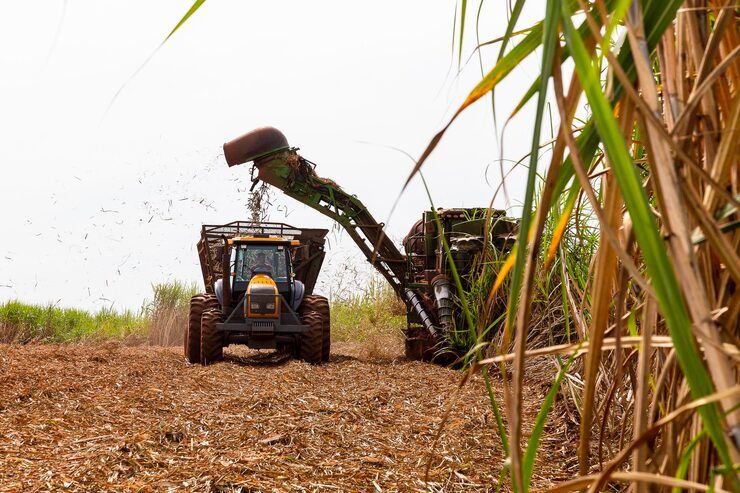
Sugarcane harvesters are agricultural machines designed to cut mature sugarcane, remove unwanted leafy material, and prepare harvested cane for transportation and processing. They help farmers and agricultural contractors manage harvesting operations across plantations of different sizes.
Sugarcane is an important crop used in sugar production, ethanol manufacturing, and several agricultural and industrial applications. Harvesting it can involve substantial manual labor because the crop grows densely, develops tough stalks, and often produces large quantities of leaves and other plant material.
Mechanical harvesting combines cutting mechanisms, crop-feeding systems, cleaning equipment, and material discharge arrangements to process sugarcane more efficiently. The suitability of a machine depends on field conditions, crop characteristics, farm layout, and the requirements of nearby processing facilities.
Understanding Sugarcane Harvesting Machines
A modern sugarcane harvester generally moves through standing cane rows, cuts the stalks near ground level, removes the leafy tops, and chops the stalks into shorter billets. These billets are collected and discharged into a transport vehicle or trailer.
Some machines are designed for whole-stalk harvesting, while others use a chopper-harvester system that produces shorter cane sections.
Common types of sugarcane harvesting equipment include:
Self-propelled sugarcane harvesters: Integrated machines that travel through fields and perform multiple harvesting operations.
Chopper harvesters: Cut stalks into billets that can be transported in bulk.
Whole-stalk harvesters: Cut cane while retaining longer stalk sections.
Tractor-mounted harvesting equipment: Implements that use a tractor as the primary power source.
Mechanical cane cutters: Equipment designed for particular cutting or field-preparation tasks.
The appropriate configuration depends on farm size, row spacing, terrain, crop density, soil conditions, and the harvesting method used in the region.
How a Sugarcane Harvester Works
Most chopper-style harvesters follow a series of coordinated operations.
Crop guidance: Crop dividers guide standing cane toward the cutting and feeding mechanisms.
Base cutting: Cutting discs or blades sever the stalks near the ground. Cutting height is important because excessive cutting can leave usable cane in the field, while cutting too low may introduce soil and stones.
Feeding and chopping: Feed rollers move the stalks through the machine, where a chopping mechanism divides them into billets of a suitable length.
Leaf separation: Fans and cleaning systems remove loose leaves and other lightweight plant material from the chopped cane.
Discharge: The cleaned billets are transferred through a discharge elevator into a transport vehicle.
The performance of each stage affects the amount of recoverable cane, the quantity of unwanted material in the harvested crop, and the overall field efficiency.
Why Sugarcane Harvesters Matter
Mechanical harvesting can help address labor availability, harvesting speed, and the logistical demands of large-scale sugarcane production.
Agricultural Productivity
A properly selected harvester can process substantial areas of standing cane during a working shift. This helps coordinate harvesting with transportation and the operating schedules of sugar mills.
However, actual productivity varies according to machine capacity, field shape, crop yield, operator skill, maintenance, weather, and the distance between fields and collection points.
Labor and Operational Planning
Manual sugarcane harvesting can require considerable physical effort and coordinated cutting, gathering, and loading activities. Mechanical systems combine several of these operations, changing the number and type of workers required.
Farm managers must also account for operator training, machine maintenance, transport vehicles, fuel or energy consumption, and the timing of harvesting activities.
Reducing Harvesting Losses
Machine adjustment plays an important role in cane recovery. Incorrect cutting height, unsuitable forward speed, poor feeding, or excessive cleaning can increase losses.
Regular inspection and adjustment can help reduce broken stalks, missed cane, excessive leaf contamination, and unnecessary damage to the soil.
Environmental Considerations
Harvesting practices influence soil compaction, crop residue management, and fuel consumption. Heavy machinery operating on wet soil can damage field structure, while excessive removal of crop residues may reduce the protective ground cover available after harvesting.
Farmers therefore need to balance harvesting efficiency with soil conservation and long-term field productivity.
Recent Developments in Sugarcane Harvesting Technology
Developments during 2025 and 2026 reflect broader agricultural trends toward precision farming, improved machine monitoring, and more efficient crop handling.
Precision Agriculture and Machine Monitoring
Modern agricultural equipment increasingly incorporates sensors, satellite positioning, digital displays, and operating-data systems. These technologies can help operators monitor machine movement, harvesting progress, fuel consumption, and field coverage.
When supported by compatible equipment, precision guidance can help maintain row alignment and reduce unnecessary overlapping passes. The practical benefits depend on field geometry, signal quality, operator training, and the accuracy of the installed systems.
Improved Crop Cleaning and Cane Recovery
Equipment development continues to focus on improving crop feeding, billet handling, and separation of leaves from harvested cane. Better adjustment of cleaning fans and feeding mechanisms can help balance material cleanliness against the risk of losing usable cane.
Manufacturers and agricultural research institutions also investigate blade design, machine stability, and operating settings for different sugarcane varieties and field conditions.
Mechanization and Agricultural Modernization
In countries with large sugarcane industries, agricultural modernization programs increasingly emphasize suitable machinery, technical training, productivity, and improved farm operations.
India's agricultural mechanization initiatives, for example, include support frameworks intended to improve access to appropriate agricultural equipment and promote efficient farming practices. The availability and eligibility of particular programs depend on current government guidelines and state-level implementation.
These developments highlight the importance of matching machinery to actual field conditions rather than assuming that one machine configuration is appropriate for every sugarcane-growing region.
Laws, Policies, and Agricultural Regulations
Sugarcane harvesting operations may be affected by agricultural machinery standards, worker-safety requirements, environmental regulations, road-transport rules, and crop-residue management policies.
Requirements vary by country and region.
Agricultural Mechanization in India
India's agricultural mechanization programs include the Sub-Mission on Agricultural Mechanization (SMAM), which aims to improve access to agricultural machinery and encourage mechanization, including through eligible equipment arrangements and agricultural machinery centers.
Farmers and agricultural enterprises should consult the current guidelines issued by the Ministry of Agriculture and Farmers Welfare and their respective state agriculture departments to determine which equipment and activities qualify under applicable programs.
Eligibility, documentation, implementation arrangements, and assistance levels can change over time.
Machinery Safety
Sugarcane harvesters contain moving blades, feed rollers, conveyors, and other mechanisms that can cause serious injuries if operated incorrectly.
Appropriate safety practices include:
Training operators before machine use
Keeping guards and protective systems in place
Stopping and isolating machinery before maintenance
Following manufacturer operating instructions
Maintaining safe distances from moving equipment
Inspecting hydraulic systems and cutting components
Using suitable personal protective equipment
Workplace requirements depend on the applicable national and regional regulations.
Crop Residue and Environmental Rules
Some harvesting systems leave substantial quantities of leaves and other residues in the field. Their management can influence soil health, fire risk, and subsequent agricultural operations.
In India, restrictions on agricultural burning and environmental requirements may affect how crop residues are handled. Farmers should check applicable state and local rules before burning or disposing of plant material.
Tools and Resources for Sugarcane Harvesting
Several technical resources can help farmers and agricultural managers assess harvesting equipment and improve field operations.
Government Agricultural Resources
Agriculture department websites and agricultural research institutions provide information about mechanization programs, equipment demonstrations, crop management, and technical recommendations.
In India, relevant resources include the Ministry of Agriculture and Farmers Welfare, state agriculture departments, and agricultural universities specializing in sugarcane production.
Equipment Selection Checklist
Before choosing a harvesting system, consider the following factors.
| Evaluation Factor | What to Assess |
|---|---|
| Field size | Total area and daily harvesting requirement |
| Row spacing | Compatibility with the machine's dimensions |
| Crop yield | Expected tonnes of cane per hectare |
| Soil conditions | Bearing capacity, drainage, and compaction risk |
| Machine capacity | Expected hourly field performance |
| Cane quality | Cutting accuracy and cleaning effectiveness |
| Maintenance | Blade wear, hydraulic systems, and spare components |
| Transportation | Availability of trailers and delivery arrangements |
Harvesting Performance Calculations
Farm managers can estimate field productivity by comparing the area harvested with the hours worked.
For example, if a machine harvests 12 hectares in 10 productive hours, its average field capacity is:
12 hectares ÷ 10 hours = 1.2 hectares per hour.
This is a hypothetical calculation, not a performance guarantee. Actual field capacity may be lower when turning, refueling, maintenance, crop blockages, or transport delays are included.
Digital farm-management spreadsheets can help track harvested area, machine hours, fuel consumption, cane losses, and maintenance intervals over an entire harvesting season.
Frequently Asked Questions
What is a sugarcane harvester used for?
A sugarcane harvester cuts mature cane and, depending on its design, removes leaves, chops stalks into billets, and transfers the harvested material into transport vehicles.
What is the difference between a whole-stalk harvester and a chopper harvester?
A whole-stalk harvester retains longer sections of cane, while a chopper harvester cuts the stalks into shorter billets. The suitable method depends on local harvesting practices, transportation systems, and processing requirements.
Which factors affect sugarcane harvester performance?
Field size, row spacing, crop density, terrain, soil moisture, machine condition, operator skill, transport availability, and harvesting settings all influence performance.
Can sugarcane harvesters operate on small farms?
Some compact or tractor-mounted harvesting systems may be suitable for smaller fields, depending on their design and local conditions. Field access, turning space, row spacing, and the availability of compatible transport equipment are important considerations.
How can harvesting losses be reduced?
Regular blade maintenance, correct cutting height, suitable forward speed, proper feeding, appropriate cleaning settings, and trained operation can help reduce cane losses and contamination.
Conclusion
Sugarcane harvesters are important agricultural machines that combine cutting, feeding, cleaning, and crop-handling operations. They can improve harvesting coordination and reduce dependence on manual cutting, particularly where fields and supporting infrastructure are suitable for mechanization.
Developments in precision agriculture, machine monitoring, and crop-cleaning systems continue to influence sugarcane harvesting technology. At the same time, effective operation requires attention to machine maintenance, soil conditions, crop losses, worker safety, and environmental responsibilities.
Choosing an appropriate harvesting system involves evaluating field characteristics, crop yield, row spacing, transport capacity, and local agricultural regulations. With suitable equipment and careful operating practices, mechanical harvesting can support more organized and efficient sugarcane production.