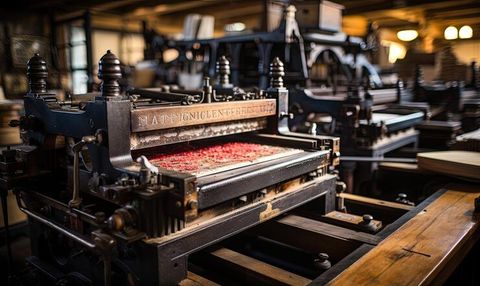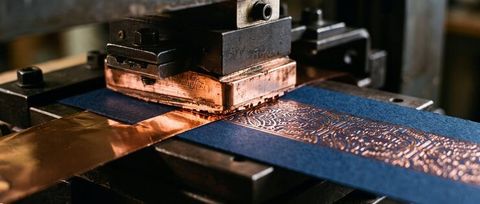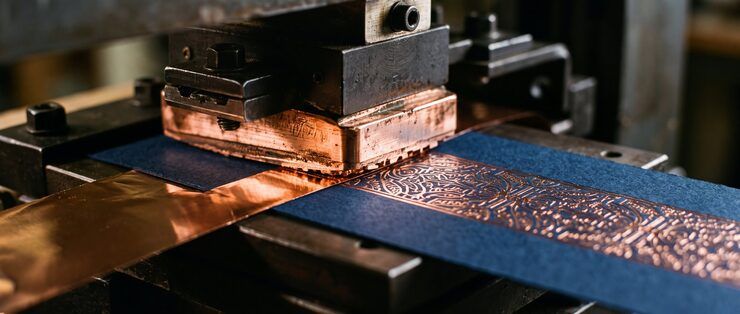
Hot foil stamping machines are industrial printing and finishing systems that transfer a thin layer of decorative or functional foil onto a surface using controlled heat, pressure, and a stamping die. The process is widely used in packaging, publishing, stationery, labels, cosmetics packaging, and product identification.
Unlike conventional ink printing, hot foil stamping transfers a material layer from a carrier film onto a substrate. The result may be metallic lettering, decorative patterns, logos, borders, or specialized markings. Gold and silver effects are common, but foils are also available in colored, holographic, matte, and other finishes.
The technology exists because manufacturers often need printed materials that combine visual detail with a distinctive surface appearance. Depending on the foil formulation and substrate, the process can also provide durable markings and decorative effects that are difficult to reproduce using ordinary printing methods.
Understanding Hot Foil Stamping Technology
A typical hot foil stamping system contains a heated stamping head or platen, a die, a foil feeding mechanism, a pressure system, and controls for temperature and timing.
The die carries the design to be transferred. When the heated die presses the foil against the material, the foil's release layer separates from its carrier film in the intended areas.
The finished result depends on several interacting variables:
Stamping temperature
Applied pressure
Contact duration
Die design and condition
Foil formulation
Substrate composition
Surface smoothness
Material feeding accuracy
Incorrect settings can lead to incomplete transfer, blurred details, uneven coverage, foil cracking, or excessive material waste. Reliable production therefore requires testing and process control.
Types of Hot Foil Stamping Machines
Different machine configurations support different production requirements.
Manual hot foil stamping machines are commonly used for small production runs, specialized craft applications, and simple marking tasks. Operators typically control material placement and pressing.
Pneumatic stamping machines use compressed air to generate pressing force. They can provide repeatable operation when pressure, temperature, and cycle settings are properly controlled.
Hydraulic stamping machines use hydraulic systems to generate force for applications that require specific pressure characteristics. Their suitability depends on the substrate, die size, and machine design.
Automatic hot foil stamping presses integrate feeding, positioning, stamping, and discharge mechanisms. These systems are designed for repeatable production and higher throughput.
Roll-to-roll foil stamping systems process continuous materials such as films, labels, and selected flexible substrates.
Combined embossing and foil stamping machines can create both a foil effect and a raised or recessed surface feature in one coordinated operation, depending on the equipment configuration.
Common Industrial Applications
Hot foil stamping is used across several industries.
Packaging: Decorative lettering, borders, and branding on cartons and specialty packaging.
Publishing: Book covers, journals, presentation folders, and selected printed materials.
Labels: Decorative elements and product identification features.
Stationery: Invitations, certificates, greeting cards, and formal documents.
Cosmetics packaging: Metallic details on cartons and compatible packaging components.
Product identification: Selected markings on leather, paperboard, plastics, and other compatible substrates.
The process is not suitable for every material. Surface coatings, heat sensitivity, texture, and substrate composition affect whether a clean transfer can be achieved.
Importance of Hot Foil Stamping Machines
Hot foil stamping machines support visual differentiation, detailed finishing, and repeatable decoration in manufacturing environments.
Print Quality and Consistency
Controlled stamping parameters help maintain consistent foil coverage across a production run. Automated feeding and registration can improve alignment between the die and the printed material.
This is especially important for packaging and labels where small differences in position or appearance may be noticeable.
Material Compatibility
Different substrates respond differently to heat and pressure. Paperboard, coated paper, leather, and selected plastics may require different foil formulations and processing settings.
Testing helps identify appropriate combinations before a full production run begins.
Production Efficiency
Automatic feeding and repeatable stamping cycles can reduce manual handling and improve production consistency. However, actual output depends on machine speed, setup time, die complexity, substrate size, inspection requirements, and stoppages.
A suitable machine should be evaluated according to the complete production process rather than its maximum advertised cycle rate alone.
Quality Control
Operators commonly inspect finished materials for:
Incomplete foil transfer
Misalignment
Uneven pressure
Surface damage
Wrinkling or tearing
Unwanted foil residue
Inconsistent color or finish
Regular inspection can help identify problems before they affect larger quantities of material.
Recent Developments and Industry Trends
During 2025 and 2026, printing and packaging technology continued to emphasize automation, material efficiency, digital workflow integration, and environmental performance.
Automation and Digital Production
Modern finishing equipment increasingly uses programmable controls, automated material handling, and digital job settings. These features can help operators repeat established production parameters and reduce setup variation.
Integration with broader printing workflows can also help coordinate stamping with cutting, folding, embossing, and other finishing processes.
Digital Foil Decoration
Digital foil decoration has continued to develop as an alternative for selected applications. Depending on the technology, digital systems can create foil effects without a conventional metal stamping die.
The suitability of digital and traditional hot foil stamping depends on production volume, substrate, design complexity, desired finish, and equipment capabilities. Digital decoration does not necessarily use the same transfer mechanism as conventional heat-and-pressure stamping.
Material Efficiency
Manufacturers are increasingly examining foil consumption, carrier-film waste, setup losses, and the compatibility of finishing materials with packaging recovery systems.
Material reduction can involve improved registration, optimized foil layouts, appropriate temperature and pressure settings, and better separation of production waste.
Smart Manufacturing
Sensors, programmable logic controllers, and automated monitoring can help maintain operating conditions and identify production irregularities. These systems may improve process consistency, although their effectiveness depends on installation, calibration, operator training, and maintenance.
Because developments vary by manufacturer and machine category, technical specifications should be checked against the requirements of the intended application.
Laws, Regulations, and Workplace Safety
Hot foil stamping operations are affected by industrial safety requirements, electrical standards, machine guarding rules, and environmental regulations. Applicable laws depend on the country and the facility's activities.
Machine Safety
Heated dies and moving press mechanisms create risks involving burns, crushing, and pinch points. Appropriate controls may include:
Fixed or interlocked machine guards
Emergency stop controls
Clearly identified operating controls
Safe procedures for die changes
Temperature monitoring
Training for operators
Lockout procedures during maintenance
Workers should not reach into a stamping area while the machine is operating. Maintenance and adjustments must follow the manufacturer's safety instructions and applicable workplace rules.
Electrical and Thermal Safety
Machines with heated components require suitable electrical protection and temperature controls. Cables, heating elements, and control systems should be inspected according to maintenance requirements.
Adequate ventilation may also be necessary depending on the foil formulation, substrate, and other materials used during production.
Environmental Considerations
Foil carrier films, rejected printed materials, packaging waste, and production offcuts require appropriate waste management.
Recyclability depends on the substrate, foil composition, adhesives, coatings, and the recycling system available in the relevant region. A stamped paper product should not automatically be assumed to be recyclable in every local collection program.
Regulations in India
In India, relevant requirements may include the Occupational Safety, Health and Working Conditions Code, 2020, applicable state-level factory rules, electrical safety requirements, and environmental regulations governing industrial waste.
The precise obligations depend on the provisions in force, the facility's classification, and the nature of its operations. Manufacturers should verify current requirements with the relevant authorities before commissioning equipment.
Tools and Resources for Machine Selection
A structured evaluation helps determine whether a particular stamping machine fits the intended production environment.
Technical Specification Checklist
Before selecting equipment, document:
Maximum stamping area
Required operating temperature
Available pressure range
Cycle speed and expected throughput
Compatible foil types
Supported substrate thickness
Registration and alignment accuracy
Power requirements
Die compatibility
Maintenance and safety features
Production Planning Tools
A spreadsheet can help estimate production requirements by recording the number of impressions, average cycle time, setup duration, rejection rate, and planned operating hours.
For example, theoretical hourly output can be estimated by dividing 3,600 seconds by the average cycle time in seconds. Actual production will generally be lower after accounting for loading, setup, inspections, and interruptions.
Quality Testing Resources
Sample stamping trials can help establish the appropriate temperature, pressure, and contact time for a specific combination of foil and substrate.
A quality checklist may record transfer completeness, alignment, adhesion, appearance, surface damage, and consistency across multiple samples.
Manufacturer Documentation
Technical manuals and equipment specifications can provide information about operating limits, installation requirements, die setup, maintenance intervals, and approved materials. These documents should guide machine operation and safety procedures.
Frequently Asked Questions
What is a hot foil stamping machine used for?
It transfers foil onto compatible surfaces using heat, pressure, and a stamping die. Common applications include packaging, book covers, labels, stationery, decorative printing, and selected product markings.
What materials can be used with hot foil stamping?
Compatible materials can include paper, paperboard, leather, and certain plastics. Results depend on the substrate's surface, heat tolerance, coating, and the foil formulation.
What is the difference between hot foil stamping and ordinary printing?
Ordinary printing generally deposits ink or another image-forming material onto a surface. Hot foil stamping transfers a foil layer using controlled heat and pressure, creating a distinctive decorative or functional finish.
How can stamping quality be improved?
Consistent quality depends on suitable foil and substrate selection, correct temperature and pressure, accurate registration, a properly maintained die, and regular inspection of finished materials.
What safety precautions are necessary?
Operators should use appropriate machine guards, follow safe die-changing procedures, avoid moving press components, monitor heated surfaces, and follow maintenance and emergency procedures established for the equipment.
Conclusion
Hot foil stamping machines are important tools in industrial printing and finishing. They create decorative and functional foil effects across packaging, publishing, labels, stationery, and other compatible products.
Machine performance depends on the relationship between temperature, pressure, contact time, die design, foil formulation, and substrate characteristics. Automation and digital workflow integration can improve consistency, while careful testing and maintenance help control defects and material waste.
Choosing suitable equipment requires an assessment of production requirements, material compatibility, operating costs, safety provisions, and applicable regulations. A well-managed stamping process combines appropriate machinery with trained operators, quality checks, and responsible material handling.