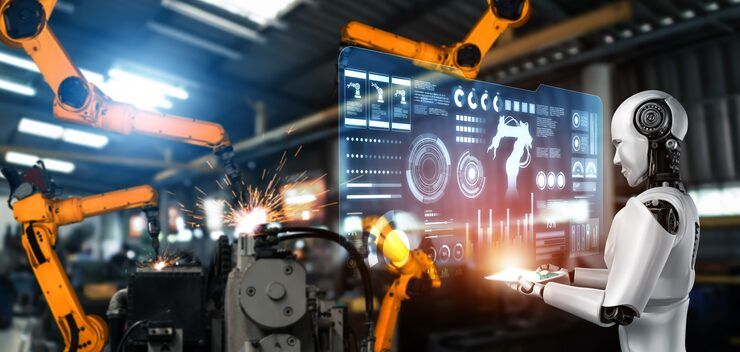
Industrial automation refers to the use of advanced technologies, machines, software, robotics, and control systems to perform manufacturing and production activities with limited manual intervention. It helps factories manage repetitive operations, monitor equipment, control production lines, and maintain consistent output.
Traditional manufacturing often depends on workers operating machines and completing individual production tasks. Modern industrial automation combines programmable logic controllers (PLCs), industrial robots, artificial intelligence (AI), sensors, and connected systems to coordinate these activities.
The development of automation is closely connected to Industry 4.0, which focuses on digital technologies and connected industrial operations. More recent developments, sometimes described as Industry 5.0, emphasize collaboration between people and intelligent machines.
Main Technologies Used in Industrial Automation
Several technologies work together to support automated production:
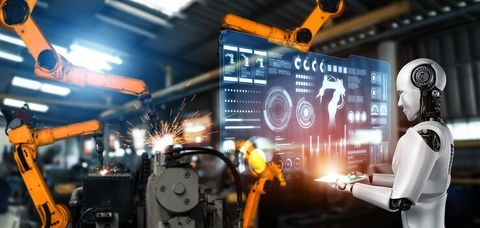
Industrial Robotics: Robotic arms and automated machines perform welding, assembly, packaging, painting, and material handling.
Artificial Intelligence: AI systems analyze production information, identify patterns, and support operational decisions.
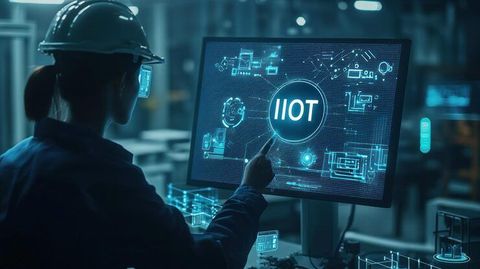
Internet of Things (IIoT): Connected sensors and devices exchange information between machines and production systems.
Programmable Logic Controllers: PLCs control machinery, production sequences, and industrial processes.
Machine Vision: Cameras and image-processing systems inspect products and identify manufacturing defects.
Digital Twins: Virtual representations of physical machines or production facilities help engineers simulate and monitor operations.
These technologies allow manufacturers to connect physical equipment with digital systems and improve visibility across production environments.
Why Industrial Automation Matters in Modern Manufacturing
Improving Production Efficiency
Industrial automation helps manufacturers organize production activities and reduce unnecessary interruptions. Automated systems can repeat programmed tasks with consistent timing, which is particularly useful in industries that require large production volumes.
Automation can support:
Faster production cycles and improved workflow coordination.
Consistent product dimensions and manufacturing quality.
Reduced errors during repetitive operations.
Better monitoring of machine performance.
More efficient use of raw materials and energy.
For example, an automotive manufacturing facility can use robotic arms for welding, painting, and component assembly. Automated inspection systems can then examine finished components before they move to the next production stage.
Workplace Safety and Human-Robot Collaboration
Industrial robots can perform repetitive, physically demanding, or hazardous activities. This can reduce workers' exposure to high temperatures, heavy materials, chemicals, and moving machinery.
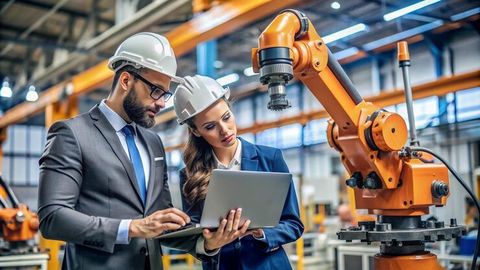
Collaborative robots, commonly called cobots, are designed to work near human operators under appropriate safety conditions. They can support assembly, inspection, and material handling while people perform tasks requiring judgment, supervision, and problem-solving.
However, collaborative robots still require risk assessments, suitable protective measures, and clearly defined operating procedures.
Industries Using Industrial Automation
Industrial automation is becoming increasingly relevant across different manufacturing environments.
Industry | Common automation applications |
|---|---|
Automotive | Robotic welding, painting, assembly |
Electronics | Circuit board inspection and component placement |
Food processing | Sorting, filling, packaging |
Pharmaceuticals | Precision manufacturing and quality monitoring |
Textiles | Automated cutting, weaving, dyeing |
Aerospace | Component assembly and precision inspection |
Logistics | Automated warehouses and robotic transportation |
Understanding the Economic and Operational Impact
Manufacturers evaluate automation through several performance indicators. These measurements help identify whether automated equipment is improving production activities.
Performance indicator | What it measures |
|---|---|
Overall Equipment Effectiveness (OEE) | Equipment availability, performance, and quality |
Production cycle time | Time required to complete a production cycle |
Defect rate | Percentage of products that fail quality requirements |
Machine downtime | Time when equipment is unavailable |
Energy consumption | Energy used during manufacturing |
First-pass yield | Products meeting quality requirements without rework |
These indicators are particularly important when evaluating industrial automation systems, manufacturing execution software, predictive maintenance platforms, and robotic production equipment.
Recent Industrial Automation Developments and Trends
Industrial automation is moving beyond traditional programmable machinery. Artificial intelligence, connected robotics, intelligent inspection, and autonomous production technologies are changing how factories operate.
Artificial Intelligence and Autonomous Robotics
AI-powered industrial robotics is an important development in modern manufacturing. Traditional robots generally follow predefined instructions, while AI-enabled systems can analyze information and adjust certain operations according to changing conditions.
For example, machine learning algorithms can examine production data to identify unusual equipment behavior. Computer vision can recognize product defects, while AI-assisted robotic systems can help organize materials and adjust movement patterns.
On January 8, 2026, the International Federation of Robotics identified AI and autonomy, humanoid robots, and the continued development of industrial robotics as important industry trends.
Growth in Global Industrial Robot Installations
The International Federation of Robotics published its World Robotics 2026 findings on September 24, 2026. The report recorded 603,307 industrial robot installations worldwide during 2025, representing an 11% increase compared with 2024.
The global operational stock exceeded five million industrial robots, reflecting the growing role of robotics in manufacturing.
Digital Twins and Smart Factories
Digital twin technology creates virtual representations of physical machinery, production lines, or entire industrial facilities. These models can use information from connected sensors to reflect real operating conditions.
Manufacturers can use digital twins to:
Simulate production changes before implementation.
Examine equipment performance.
Identify potential production bottlenecks.
Support predictive maintenance planning.
Evaluate different manufacturing configurations.
Smart factories combine digital twins with IIoT sensors, cloud computing, industrial software, and automated machinery. This creates a more connected production environment.
Collaborative and Mobile Robotics
Collaborative robots are increasingly used for tasks that require interaction between machines and people. Their applications include component placement, packaging, inspection, and repetitive assembly.
Autonomous mobile robots (AMRs) are another developing technology. They can transport materials within warehouses and manufacturing facilities using sensors, mapping technologies, and navigation software.
Unlike traditional automated guided vehicles that commonly follow predefined routes, AMRs can navigate changing environments using onboard systems.
Energy-Efficient and Sustainable Manufacturing
Energy management is becoming an important consideration in industrial automation. Smart sensors and automated monitoring systems help manufacturers understand electricity consumption across different production activities.
Automated energy management can support:
Monitoring electricity usage.
Identifying inefficient machinery.
Managing equipment operating schedules.
Reducing unnecessary production downtime.
Improving resource utilization.
These developments connect industrial automation with broader sustainability and environmental management objectives.
Laws, Regulations, and Industrial Automation Policies
Industrial automation is influenced by workplace safety laws, machinery regulations, cybersecurity requirements, and manufacturing standards. Requirements differ between countries, so manufacturers must follow the rules applicable to their operating locations and export markets.
International Machinery Safety Standards
The International Organization for Standardization (ISO) develops standards that support industrial safety and consistent manufacturing practices.
Important standards include:
ISO 10218-1:2025: Establishes safety requirements for industrial robots.
ISO 10218-2:2025: Addresses safety requirements for industrial robot applications and integration.
ISO 13849: Covers safety-related parts of machinery control systems.
IEC 61508: Provides a framework for functional safety in electrical, electronic, and programmable electronic systems.
In February 2025, ISO published the updated ISO 10218-1:2025 standard, reflecting developments in industrial robotics and robot safety.
European Union Machinery Regulation
Regulation (EU) 2023/1230 establishes health and safety requirements for machinery placed on the European market. It addresses machinery design, conformity assessment, technical documentation, and safety-related technologies.
The regulation is scheduled to apply from January 20, 2027, replacing the previous Machinery Directive 2006/42/EC. Manufacturers preparing automated machinery for the European market should consider these requirements during equipment development and integration.
Workplace Safety and Government Manufacturing Initiatives
In countries such as the United States, workplace safety requirements administered by the Occupational Safety and Health Administration (OSHA) influence industrial machinery operation, worker protection, and equipment maintenance.
In India, industrial establishments must consider applicable occupational safety legislation, factory regulations, electrical safety requirements, and relevant Bureau of Indian Standards (BIS) standards.
Government manufacturing initiatives, including India's Production Linked Incentive (PLI) programmes, also encourage investment in selected manufacturing sectors and advanced production capabilities.
Manufacturers should evaluate applicable regulations before installing robotics, automated production lines, or AI-controlled machinery.
Tools and Resources for Industrial Automation
Several software platforms, technical resources, and engineering tools help manufacturers plan, monitor, and manage automated production environments.
Industrial Automation Software
1. Siemens TIA Portal
An engineering platform used for PLC programming, industrial automation configuration, and human-machine interface development.
2. Rockwell Automation Studio 5000
Used for industrial control system configuration, controller programming, and production equipment management.
3. ABB RobotStudio
A robotics simulation and programming environment that allows engineers to plan robot movements and examine production layouts.
4. FANUC ROBOGUIDE
A simulation platform used to develop and test robotic applications before implementing them in physical production environments.
5. MATLAB and Simulink
Engineering platforms used for control-system modelling, simulation, industrial automation research, and system analysis.
Useful Technical Resources
International Federation of Robotics: Global industrial robotics statistics, industry research, and technology developments.
International Organization for Standardization: Machinery safety and industrial robotics standards.
NIST: Manufacturing technology research, smart manufacturing guidance, and cybersecurity resources.
IEC: International standards for electrical systems, industrial control, and functional safety.
ISA: Industrial automation, instrumentation, and control-system knowledge.
These resources help engineers, production managers, and manufacturers understand emerging technologies and technical requirements.
Frequently Asked Questions
What Is the Future of Industrial Automation?
The future of industrial automation will involve greater use of artificial intelligence, collaborative robots, autonomous mobile robots, digital twins, and connected manufacturing systems. These technologies are expected to support more flexible and data-driven production environments.
How Does AI Improve Industrial Robotics?
AI helps industrial robots interpret information, identify patterns, recognize objects, and adapt certain operations. It can also support predictive maintenance and automated quality inspection.
What Is the Difference Between Traditional Robots and Collaborative Robots?
Traditional industrial robots generally operate within designated work areas separated from people by safety measures. Collaborative robots are designed for applications involving human interaction, subject to suitable risk assessments and protective systems.
What Is a Smart Factory?
A smart factory is a manufacturing facility that connects machinery, sensors, software, robotics, and data systems. These technologies help monitor production conditions and coordinate industrial activities.
Does Industrial Automation Replace Human Workers?
Industrial automation changes the nature of manufacturing work rather than eliminating the need for people. Human involvement remains important in programming, engineering, equipment maintenance, quality management, supervision, and complex decision-making.
Conclusion
Industrial automation is reshaping manufacturing through robotics, artificial intelligence, connected machinery, and intelligent production systems. These technologies help manufacturers improve production consistency, monitor equipment, manage resources, and strengthen workplace safety.
Future developments will likely focus on autonomous robotics, AI-powered manufacturing, digital twins, collaborative machines, and sustainable production. However, successful implementation will depend on appropriate technology selection, workforce training, cybersecurity, and regulatory compliance.
As industrial technology continues to evolve, manufacturers that combine human expertise with intelligent automation will play an important role in the development of modern production systems.