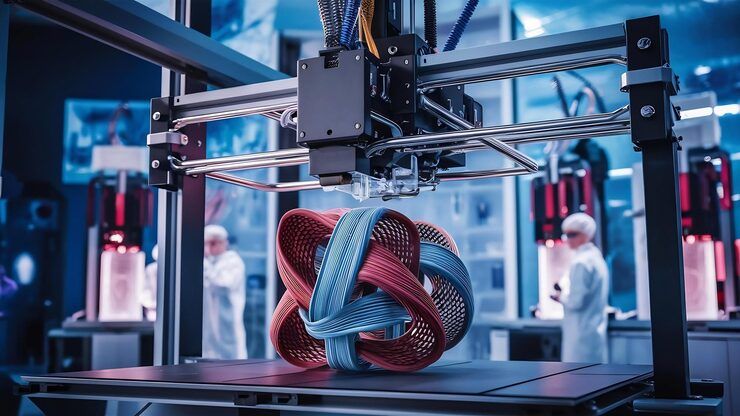
3D printing, commonly known as additive manufacturing, is a modern production technology that creates physical objects from digital designs. Unlike traditional manufacturing, which often involves cutting, drilling, or removing material from a larger piece, additive manufacturing builds objects layer by layer. This approach allows manufacturers to produce complex shapes, lightweight structures, and customized components with greater design flexibility.
The technology combines computer-aided design (CAD), specialized printing equipment, advanced materials, and digital manufacturing software. A digital model is converted into instructions that guide the printer through each stage of production.
Additive manufacturing includes several different technologies, such as:
Fused Deposition Modeling (FDM): Uses heated thermoplastic material to create objects layer by layer.
Selective Laser Sintering (SLS): Uses laser energy to fuse powdered materials into solid structures.
Stereolithography (SLA): Uses ultraviolet light to harden liquid photopolymer resin.
Direct Metal Laser Sintering (DMLS): Uses laser technology to produce metal components from fine powder.
Binder Jetting: Deposits a binding substance onto powdered material to create three-dimensional structures.
Material Jetting: Deposits small droplets of material that are subsequently hardened.
These technologies support different production requirements, depending on material properties, design complexity, accuracy, and intended applications.
Today, 3D printing is used in aerospace engineering, automotive production, healthcare, construction, electronics, education, and industrial equipment manufacturing. Its development reflects a wider transition toward digital manufacturing and more flexible industrial production systems.
Why Additive Manufacturing Matters Today
Additive manufacturing is becoming increasingly important because industries need production methods that support customization, efficient material utilization, and complex engineering designs.
Traditional manufacturing frequently requires specialized molds, tooling, and multiple production stages. Additive manufacturing can reduce some of these requirements by producing components directly from digital models.
Several industries are experiencing significant changes through this technology.
Aerospace and Aviation
Aircraft manufacturers use metal additive manufacturing to produce lightweight brackets, turbine components, and specialized structural parts. Reducing component weight can contribute to improved aircraft efficiency and lower fuel consumption.
Automotive Manufacturing
Automotive companies use 3D printing for prototype development, interior components, lightweight structures, and specialized production equipment. Engineers can evaluate different designs before moving toward larger manufacturing operations.
Healthcare and Medical Technology
Healthcare applications include customized prosthetics, dental restorations, surgical guides, anatomical models, and certain orthopedic implants. Patient-specific designs can help medical professionals prepare for complex procedures.
Construction and Infrastructure
Large-scale concrete 3D printing is developing as an alternative construction technique. Automated equipment deposits specialized concrete mixtures in programmed layers to create walls and selected structural elements.
Electronics and Industrial Equipment
Additive manufacturing supports the development of specialized housings, electronic enclosures, connectors, and components with complicated internal geometries.
The following table summarizes some important industrial applications.
Industry | Common applications | Potential advantages |
|---|---|---|
Aerospace | Aircraft brackets and turbine components | Lightweight designs |
Automotive | Prototypes and specialized parts | Faster design testing |
Healthcare | Prosthetics and dental models | Customization |
Construction | Printed concrete structures | Design flexibility |
Electronics | Enclosures and connectors | Complex geometries |
Energy | Specialized industrial components | Design optimization |
Recent Developments and Emerging Trends in 3D Printing
During 2025 and 2026, additive manufacturing continued progressing toward larger industrial applications. Research institutions, equipment developers, and manufacturers have increasingly focused on production consistency, advanced materials, automation, and manufacturing standards.
Advancements in Industrial Production
One important development is the growing use of additive manufacturing beyond prototype development. Industries are increasingly evaluating the technology for functional components and production environments where repeatability and material performance are essential.
Metal additive manufacturing is particularly relevant for aerospace, energy, and industrial engineering because it supports complex component geometries.
Artificial Intelligence and Smart Manufacturing
Artificial intelligence is becoming more closely connected with 3D printing workflows. AI-based software can help engineers examine digital designs, identify possible structural weaknesses, and optimize printing parameters.
Machine learning can also support predictive maintenance by analyzing equipment performance and identifying unusual operating patterns.
Some emerging applications include:
Automated detection of printing defects.
AI-assisted product design and optimization.
Real-time monitoring of printing conditions.
Automated production planning.
Digital simulation of manufacturing processes.
Advanced Materials Development
Material research remains an important area of innovation. Manufacturers and research institutions are investigating advanced polymers, metal alloys, ceramic materials, and composite materials.
These developments are intended to improve mechanical strength, temperature resistance, durability, and application-specific performance.
Progress in International Manufacturing Standards
On April 29, 2026, the American National Standards Institute (ANSI) and America Makes published an updated additive manufacturing standards progress report. It examined developments across 35 of the 141 previously identified standardization gaps, covering areas such as material qualification, inspection, and production consistency.
On October 1, 2026, the organizations introduced additional resources, including a searchable standards database and another progress report, helping manufacturers and researchers understand the standards relevant to industrial additive manufacturing.
New International Qualification Framework
In November 2026, ISO and ASTM published ISO/ASTM 52966:2026. This international standard establishes a framework for categorizing additive manufacturing capabilities and resources, including materials, infrastructure, and personnel. It is particularly relevant to manufacturing in environments such as ships, offshore facilities, and other self-sufficient locations.
These developments demonstrate the industry's increasing focus on reliability, technical qualification, and wider industrial adoption.
Laws, Regulations, and Government Policies
3D printing is influenced by several regulatory areas, including product safety, environmental protection, intellectual property, workplace safety, and industry-specific manufacturing requirements.
Regulations differ between countries and depend on the intended application of the printed component.
International Standards
The International Organization for Standardization (ISO) and ASTM International have developed standards covering additive manufacturing processes, terminology, materials, equipment, testing, and quality management.
Relevant standards include:
ISO/ASTM 52900: Terminology and fundamental principles of additive manufacturing.
ISO/ASTM 52910: Design requirements and guidelines for additive manufacturing.
ISO/ASTM 52920: Qualification principles for industrial additive manufacturing processes.
ISO/ASTM 52966:2026: Qualification principles for categorizing resources and process capabilities.
These standards help establish consistent technical practices across manufacturing environments.
United States Regulations
In the United States, the Food and Drug Administration (FDA) oversees medical devices produced through 3D printing.
Medical manufacturers must demonstrate that their devices meet applicable safety and performance requirements. The FDA considers factors such as material characteristics, manufacturing processes, design validation, and product testing.
Other industrial applications may also fall under workplace safety, environmental, product liability, and intellectual property regulations.
European Union Regulations
In the European Union, 3D-printed products must comply with relevant product safety and sector-specific legislation.
For example, construction products intended for permanent integration into buildings may fall under the Construction Products Regulation (EU) 2024/3110. The regulatory framework includes provisions relevant to certain 3D-printed construction products.
India's National Strategy for Additive Manufacturing
India introduced its National Strategy for Additive Manufacturing (NSAM) in February 2022 through the Ministry of Electronics and Information Technology (MeitY).
The strategy aims to strengthen domestic additive manufacturing capabilities through research, technological development, education, and industrial collaboration.
Its objectives include:
Developing India-specific additive manufacturing technologies.
Supporting innovation and industrial research.
Strengthening manufacturing infrastructure.
Encouraging collaboration between educational institutions and industry.
Developing technical capabilities across multiple industrial sectors.
In an October 7, 2026 update, India's Press Information Bureau reported that the national initiative had supported 56 additive manufacturing startups and trained more than 154,000 individuals. The government also highlighted the development of its next strategic phase, NSAM 2.0.
Manufacturers should also consider applicable environmental, occupational safety, intellectual property, and product-specific regulations in their operating countries.
Tools and Resources for 3D Printing and Additive Manufacturing
Several digital tools and technical resources help engineers, designers, researchers, and manufacturing teams manage additive manufacturing workflows.
Computer-Aided Design Software
CAD software is used to create three-dimensional models before printing.
Autodesk Fusion: Supports 3D modeling, engineering design, and simulation.
SolidWorks: Provides mechanical design and product development capabilities.
FreeCAD: Supports parametric 3D modeling and engineering design.
Onshape: Provides cloud-based CAD and collaborative design tools.
3D Printing Preparation Software
Slicing software converts digital models into instructions that printers can understand.
Ultimaker Cura: Supports slicing and print configuration.
PrusaSlicer: Provides printing preparation and customization features.
Bambu Studio: Supports printer configuration and production workflows.
PreForm: Supports preparation of compatible resin printing workflows.
Engineering Simulation and Analysis
Simulation software helps engineers understand how components may behave under different operating conditions.
ANSYS: Supports structural, thermal, and engineering simulation.
Autodesk Fusion Simulation: Provides design analysis capabilities.
Simufact Additive: Supports simulation of additive manufacturing processes.
Technical and Educational Resources
The following resources can help users understand manufacturing standards, material specifications, and industry developments.
Resource | Main purpose |
|---|---|
ISO | International manufacturing standards |
ASTM International | Technical standards and testing |
NIST | Manufacturing research and measurement science |
America Makes | Additive manufacturing research and collaboration |
FDA | Medical device regulatory information |
MeitY India | National digital manufacturing initiatives |
Using these resources can help organizations understand technical requirements, improve design decisions, and evaluate manufacturing processes.
Frequently Asked Questions
What is the difference between 3D printing and traditional manufacturing?
Traditional manufacturing often involves shaping or removing material from an existing piece, while 3D printing builds objects layer by layer from digital designs. Additive manufacturing can create complex geometries with fewer specialized tooling requirements.
Which materials are commonly used in 3D printing?
Common materials include thermoplastics, photopolymer resins, stainless steel, titanium alloys, aluminum alloys, ceramics, and composite materials. Material selection depends on the required strength, durability, temperature resistance, and intended application.
Can 3D printing be used for large-scale industrial production?
Yes. Industrial additive manufacturing is increasingly used for selected production applications in aerospace, automotive, healthcare, and engineering. However, production suitability depends on printing speed, material performance, equipment capacity, quality requirements, and regulatory compliance.
How does artificial intelligence improve additive manufacturing?
AI can help optimize digital designs, monitor printing conditions, identify manufacturing defects, and analyze equipment performance. These capabilities can support more consistent production and better process control.
Is 3D printing environmentally sustainable?
It can support more efficient material utilization in certain applications by reducing unnecessary material removal. However, environmental performance depends on energy consumption, material production, waste management, recycling possibilities, and the complete manufacturing lifecycle.
The Future of Global Production
3D printing and additive manufacturing are changing how industries approach product design, engineering, and production planning. Their ability to create complex components, support customization, and integrate with digital manufacturing systems makes them important technologies for modern industrial development.
The combination of artificial intelligence, advanced materials, industrial automation, and engineering simulation is expected to expand their applications across multiple sectors.
However, challenges remain. Production consistency, equipment capacity, material qualification, regulatory compliance, and workforce knowledge continue to influence wider adoption.
As international standards develop and industrial capabilities improve, additive manufacturing is likely to become an increasingly important part of global production networks. Rather than completely replacing traditional manufacturing, it will complement existing methods and create additional possibilities for flexible, technology-driven industrial production.