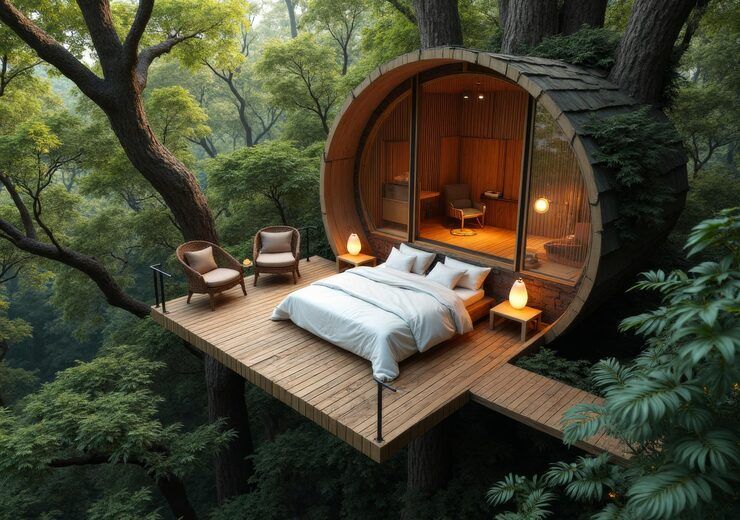
Treehouse hotels are elevated accommodation structures built around, between, or near trees, often in forests, woodlands, tropical environments, or other natural settings. They combine conventional hospitality features with architecture designed to provide a closer connection to the surrounding landscape.
Modern treehouse accommodation can range from compact cabins supported by trees or independent foundations to sophisticated structures with bedrooms, bathrooms, balconies, heating, and other facilities. Some are designed primarily for nature tourism, while others form part of larger eco-tourism destinations.
The concept exists at the intersection of luxury travel, eco tourism, sustainable travel, nature-based tourism, and hospitality management. For travelers, treehouse accommodation can provide a different setting from conventional hotels while encouraging greater awareness of the surrounding environment.
How Treehouse Hotels Are Designed
A treehouse structure must account for both building requirements and the biological characteristics of trees. Trees grow, move in the wind, respond to moisture, and can change structurally over time.
Modern designs may use:
Engineered platforms
Steel or timber support systems
Specialized tree attachments
Independent foundations
Flexible structural connections
Insulated walls
Weather-resistant roofing
Guardrails and stairs
Emergency access systems
Not every treehouse rests directly on living trees. Some elevated cabins are supported primarily by independent columns while retaining the visual characteristics of a treehouse.
Balancing Architecture and Nature
Good treehouse design requires careful consideration of the surrounding ecosystem. Construction can affect roots, soil, drainage, vegetation, wildlife movement, and water systems.
Architects and engineers may therefore assess:
Tree health
Soil conditions
Wind exposure
Rainfall
Fire risk
Local wildlife
Access routes
Drainage
Structural loads
The result is a form of accommodation that requires both hospitality planning and specialized construction knowledge.
Why Treehouse Hotels Matter Today
Growth of Nature-Based Tourism
Nature-based tourism has become increasingly important as travelers look for accommodation connected with forests, mountains, wetlands, and other natural environments.
Treehouse hotels are relevant to people researching:
Luxury travel
Eco tourism
Sustainable hotels
Nature retreats
Forest accommodation
Wellness travel
Adventure tourism
Family travel
Unique accommodation
The appeal is often based on the setting rather than the accommodation alone. A treehouse can provide views of forests, wildlife habitats, mountains, or coastal landscapes.
Sustainability Considerations
Treehouse accommodation is sometimes associated with environmentally responsible tourism, but the label alone does not establish that a property is sustainable.
Environmental performance can depend on:
Construction methods
Energy sources
Water consumption
Waste management
Building materials
Transportation access
Land disturbance
Wildlife management
Heating and cooling systems
A property may have a small physical footprint while still having significant environmental impacts if energy, water, waste, or transportation systems are poorly managed.
Accessibility and Guest Needs
Elevated accommodation can present accessibility challenges. Stairs, ladders, narrow pathways, and uneven terrain may make some properties unsuitable for travelers with mobility limitations.
Travelers should check accessibility information before selecting accommodation.
Other considerations can include:
Child safety
Balcony design
Emergency access
Weather exposure
Heating and cooling
Bathroom accessibility
Fire evacuation
Nearby medical facilities
| Accommodation Factor | Why It Matters |
|---|---|
| Structural design | Supports guest safety |
| Tree health | Important for tree-supported structures |
| Weather resistance | Protects the building |
| Fire safety | Important in forest environments |
| Accessibility | Determines suitability for different guests |
| Water systems | Affects environmental performance |
| Energy use | Influences sustainability |
| Wildlife | Requires responsible management |
Recent Developments in Treehouse Hospitality
Sustainable Hospitality Continues to Expand
During 2025 and 2026, sustainability remained an important theme across the global hospitality industry. Hotel developers and tourism organizations increasingly focused on energy efficiency, water management, waste reduction, biodiversity, and responsible destination planning.
Treehouse accommodation fits naturally into this conversation because many properties are located in sensitive natural environments.
However, sustainable hospitality increasingly depends on measurable practices rather than marketing descriptions alone.
Green Building and Certification
Hotel developments can use established sustainability frameworks to evaluate energy, water, materials, indoor environmental quality, and site impacts.
Examples include:
LEED
BREEAM
Green Globe
EarthCheck
Local green-building standards
Certification requirements vary, and a property's participation in one program does not automatically mean that every aspect of the accommodation has the same environmental performance.
Nature-Positive Tourism
Another growing theme in hospitality is biodiversity protection. Instead of focusing only on reducing environmental damage, some tourism projects increasingly consider how accommodation can coexist with habitats and contribute to conservation.
For treehouse hotels, this can involve:
Protecting mature trees
Preserving native vegetation
Reducing nighttime light
Managing visitor movement
Protecting wildlife corridors
Controlling waste
Avoiding unnecessary land clearing
Digital Hospitality Technology
Treehouse properties increasingly use digital tools for reservations, guest communication, weather monitoring, energy management, and maintenance.
Smart-building systems can help monitor:
Electricity
Water consumption
Indoor temperature
Humidity
Security
Maintenance requirements
Technology can improve operational efficiency, although its environmental benefit depends on how the systems are designed and used.
Laws, Building Regulations and Policies
United States as a Regulatory Example
In the United States, treehouse hotels can be affected by state and local building regulations, zoning requirements, fire codes, accessibility rules, health regulations, and land-use restrictions.
There is no single nationwide "treehouse hotel" building category that automatically determines all requirements. The applicable rules depend on the property's location, construction method, occupancy classification, and relationship to the surrounding land.
Building and Structural Requirements
A treehouse intended for overnight accommodation may need to satisfy applicable structural requirements concerning:
Foundation or support systems
Structural loads
Wind
Snow
Seismic conditions
Stairs
Guardrails
Electrical systems
Plumbing
Fire protection
Emergency access
Where a structure is attached directly to trees, additional engineering considerations may be required to account for movement and long-term tree growth.
Fire Safety
Forest-based accommodation can face additional fire risks, particularly in regions experiencing drought or wildfire conditions.
Applicable requirements can address:
Smoke alarms
Fire extinguishers
Emergency exits
Evacuation routes
Electrical systems
Fire-resistant materials
Emergency lighting
Access for emergency responders
Requirements vary by jurisdiction and building classification.
Accessibility
In the United States, applicable properties may also need to consider the Americans with Disabilities Act (ADA) and other accessibility requirements, depending on the type and location of the accommodation.
Not every treehouse structure can provide identical accessibility because terrain and elevated design can create physical constraints. Property owners must determine which requirements apply to their particular development.
Environmental and Land-Use Rules
Treehouse hotels located in forests, coastal areas, national parks, conservation zones, or other environmentally sensitive areas may require additional permissions.
Rules can concern:
Tree removal
Wildlife
Wetlands
Wastewater
Water use
Protected habitats
Land development
Noise
Lighting
Travelers should distinguish between private accommodation and structures located within protected public lands because the regulatory frameworks can differ significantly.
Tools and Resources for Treehouse Hotel Planning
Accommodation Research
Travelers can compare properties using information such as:
Location
Elevation
Accessibility
Room facilities
Weather
Transportation
Environmental policies
Emergency arrangements
Local attractions
Reading official property information alongside independent destination information can provide a more complete picture.
Sustainability Resources
Useful sustainability frameworks and resources include:
LEED
BREEAM
Green Globe
EarthCheck
Global Sustainable Tourism Council resources
National environmental agencies
Local tourism authorities
These resources can help travelers understand concepts such as sustainable accommodation, responsible tourism, energy efficiency, and biodiversity.
Weather and Nature Planning
Forest and mountain treehouses can be affected by weather conditions.
Useful resources include:
National weather agencies
Local forecasts
Wildfire alerts
Storm warnings
Trail conditions
Park information
Wildlife guidance
Travelers should check local alerts before traveling to remote forest destinations.
Travel Insurance
Travel insurance can be relevant when accommodation is located in remote environments or when an itinerary includes hiking, climbing, outdoor recreation, or other activities.
People researching travel insurance for adventure tourism should review policy wording carefully, particularly exclusions relating to outdoor activities, remote locations, medical evacuation, and weather-related disruption.
Guest Preparation Checklist
Before staying in an elevated nature property, travelers can consider:
Check accessibility information.
Review emergency procedures.
Check weather conditions.
Confirm transportation arrangements.
Review nearby medical facilities.
Understand fire-safety instructions.
Follow wildlife guidance.
Bring appropriate outdoor clothing.
Review travel insurance conditions.
Follow property-specific safety instructions.
Frequently Asked Questions
What is a treehouse hotel?
A treehouse hotel is accommodation located in an elevated structure associated with trees or a forest environment. Some structures are supported directly by trees, while others use independent foundations or support columns.
Are treehouse hotels safe?
Safety depends on structural engineering, construction quality, maintenance, fire protection, weather resistance, emergency access, and property management. Travelers should follow the property's safety instructions and consider weather and environmental conditions.
Are treehouse hotels environmentally friendly?
Not automatically. Environmental performance depends on construction, energy use, water management, waste systems, transportation, land disturbance, and biodiversity practices. A treehouse appearance alone does not prove sustainability.
Are treehouse hotels accessible?
Accessibility varies significantly. Some properties provide accessible pathways and facilities, while others require stairs, ladders, or travel across uneven terrain. Travelers with accessibility requirements should check property-specific information before traveling.
Does travel insurance cover a stay at a treehouse hotel?
Accommodation itself is generally treated differently from adventure activities, but coverage varies between policies. If the trip includes hiking, climbing, remote-area activities, or other recreation, travelers should review relevant activity exclusions and medical-evacuation provisions.
Conclusion
Treehouse hotels combine hospitality, architecture, nature tourism, and environmental planning. Their elevated designs can provide travelers with distinctive views and closer contact with forests and other natural environments.
The modern treehouse hospitality sector increasingly intersects with sustainability, biodiversity, green-building standards, digital property management, and responsible tourism. However, environmentally themed accommodation should be evaluated based on measurable practices rather than appearance or marketing language.
Building and operating a treehouse hotel also involves more than constructing an elevated room. Structural engineering, fire safety, accessibility, zoning, wastewater, environmental protection, and emergency access can all influence the development.
Regulations vary widely between countries and even between local jurisdictions. In the United States, applicable requirements can involve building codes, zoning rules, fire regulations, accessibility requirements, environmental regulations, and local permits.
For travelers, useful preparation includes checking accessibility, weather, transportation, emergency information, sustainability practices, and travel insurance conditions. Understanding these factors can help visitors make informed decisions while respecting the natural environments surrounding elevated accommodation.
Treehouse hotels therefore represent more than unusual lodging. They demonstrate how hospitality can interact with architecture, forests, biodiversity, and modern sustainability principles while creating distinctive nature-based travel experiences.