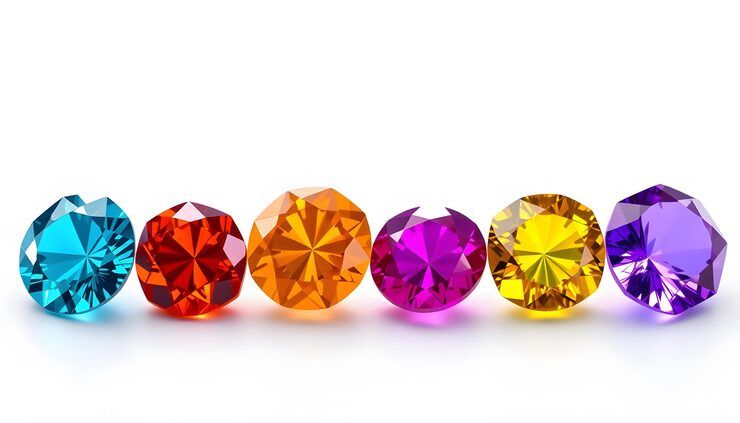
Fancy colored diamonds are diamonds whose visible color falls outside the normal D-to-Z color range or, in the case of yellow and brown diamonds, extends beyond the Z range. Unlike conventional colorless-to-light-yellow diamonds, where less visible color is generally preferred, fancy colored diamonds are evaluated primarily for the presence, strength, tone, and distribution of color.
Pink, blue, and yellow diamonds are among the best-known fancy color categories. Natural stones can also occur in green, orange, red, purple, brown, gray, and other combinations.
The color can originate naturally through trace elements, structural defects, radiation-related processes, or other geological mechanisms. Color can also be introduced or modified through laboratory treatments, so determining color origin is an important part of gemological analysis.
Pink, Blue and Yellow Diamonds
Pink diamonds are particularly notable for their rarity. Their color is generally associated with structural changes in the diamond crystal rather than a simple trace element.
Blue diamonds are commonly associated with boron impurities. GIA notes that stronger blue color is linked to higher boron concentration, although the relationship is complex.
Yellow diamonds are more common among fancy colors than pink or blue diamonds. Nitrogen-related defects are an important cause of yellow coloration.
GIA describes fancy color using three primary components:
Hue: The basic color, such as pink, blue, or yellow.
Tone: The relative lightness or darkness.
Saturation: The strength or intensity of the color.
These characteristics combine to determine the final fancy-color grade.
Fancy Color Grading
GIA's grading terminology includes:
Faint
Very Light
Light
Fancy Light
Fancy
Fancy Intense
Fancy Vivid
Fancy Dark
Fancy Deep
Fancy Intense and Fancy Vivid can represent particularly strong color appearances, although the significance of a particular grade depends on the diamond's hue and other characteristics.
| Color | Main Characteristic | Relative Rarity |
|---|---|---|
| Pink | Structural color origin | Extremely rare |
| Blue | Often associated with boron | Extremely rare |
| Yellow | Common fancy-color category | More widely encountered |
| Red | Very limited natural occurrence | Exceptionally rare |
| Green | Often associated with radiation effects | Very rare |
| Orange | Nitrogen-related color mechanisms | Rare |
Why Fancy Colored Diamonds Matter Today
Fancy colored diamonds are important within the colored diamond jewellery, natural fancy color diamond, pink diamond jewellery, blue diamond jewellery, and yellow diamond jewellery markets.
Their significance comes from the combination of diamond durability, unusual color, geological rarity, and specialized grading.
Color Can Be More Important Than Clarity
For conventional diamonds, clarity is often a major consideration. Fancy colored diamonds work differently.
GIA explains that color is the dominant value factor for fancy colored diamonds. A diamond with noticeable inclusions can still be highly regarded when its face-up color is attractive, although inclusions that threaten durability remain important.
This means that comparing a fancy colored diamond using only the traditional 4Cs can give an incomplete picture.
Cut and Color Interaction
Cutting a fancy color diamond involves balancing brilliance, shape, weight retention, and color intensity.
GIA notes that fancy shapes such as radiant cuts are commonly used to maximize color intensity. Deeper proportions can sometimes increase the path of light through the stone and influence the apparent strength of color.
Natural Versus Treated Color
Color origin is particularly important for pink, blue, and yellow diamonds.
Treatments can modify or introduce color. GIA identifies processes including irradiation, annealing, and HPHT treatment among techniques that can affect diamond color.
A laboratory report can therefore be useful when determining whether a diamond's color is natural or treated.
Recent Developments in Fancy Colored Diamonds
The fancy colored diamond sector has continued to develop through advances in gemological testing, laboratory-grown diamond technology, and research into unusual color mechanisms.
GIA Research During 2025
GIA published several notable fancy-color research findings during 2025. On June 5, 2025, GIA reported on a group of 26 Fancy Vivid yellow HPHT-grown diamonds examined at its Hong Kong laboratory.
The research demonstrates how laboratory-grown diamonds can be produced with strong fancy colors and why growth method and post-growth treatment need to be identified separately from color appearance.
In August 2025, GIA also documented an unusual greenish-yellow color in a CVD-grown diamond associated with a combination of growth characteristics and HPHT treatment.
Changes in Laboratory-Grown Diamond Documentation
GIA announced in June 2025 that it would change its terminology for laboratory-grown diamonds. From October 1, 2025, revised evaluation services for D-to-Z laboratory-grown diamonds began using descriptive categories such as Premium and Standard instead of the color and clarity nomenclature developed for natural diamonds.
Colored laboratory-grown diamonds continue to have dedicated documentation that can describe color, color distribution, growth type, and post-growth treatment.
Why These Developments Matter
These changes highlight an important distinction between:
Natural fancy colored diamonds
Treated natural diamonds
Laboratory-grown colored diamonds
Color-treated laboratory-grown diamonds
Imitation materials
A similar visual appearance does not necessarily mean that two diamonds have the same geological origin or treatment history.
Laws, Regulations and Jewellery Policies in India
India provides an important regulatory example because precious-metal jewellery can fall under BIS hallmarking requirements.
For a fancy colored diamond ring, bracelet, pendant, or necklace, it is useful to distinguish between the diamond and the metal setting.
BIS hallmarking primarily concerns precious-metal purity. It does not establish whether a diamond is natural, laboratory-grown, pink, blue, yellow, treated, or untreated.
Gold Hallmarking
The Bureau of Indian Standards maintains India's mandatory hallmarking framework for covered gold jewellery and gold articles. The framework has continued to receive amendments during 2025 and 2026, including amendments dated July 31, 2025, March 2, April 28, and August 3, 2026. The BIS page was updated September 1, 2026.
The April 28, 2026 amendment further amended India's Hallmarking of Gold Jewellery and Gold Artefacts Order.
Applicable gold jewellery can carry information identifying the BIS hallmark, fineness, and Hallmark Unique Identification number.
Metal Purity Versus Diamond Information
These two forms of identification answer different questions.
| Information | What It Establishes |
|---|---|
| BIS hallmark | Applicable precious-metal purity |
| HUID | Identification of a hallmarked article |
| Diamond grading report | Diamond characteristics |
| Color-origin assessment | Natural or treated color |
| Origin report | Geographic origin when scientifically established |
| Growth identification | Natural or laboratory-grown origin |
For a gold ring containing a pink diamond, for example, the BIS hallmark relates to the gold while a gemological report can address the diamond's characteristics.
International Advertising and Disclosure
The U.S. Federal Trade Commission's Jewelry Guides provide guidance on truthful descriptions and disclosure of material information for diamonds and other gemstones. This is relevant to international jewellery advertising because claims concerning diamond origin, treatments, and characteristics should be accurate and clearly presented.
For Google Ads and other digital advertising, factual descriptions are preferable to unsupported rarity, investment, or guaranteed-value claims.
Tools and Resources for Fancy Colored Diamonds
Fancy colored diamonds require specialized resources because color grading is more complex than simply determining whether a diamond is light or dark.
Useful Resources
GIA Colored Diamond Grading Reports: Provide color grade, clarity information, and color-origin assessment for eligible natural colored diamonds.
GIA Colored Diamond Origin Reports: Can provide geographic-origin information for eligible natural colored diamonds when scientific matching is possible.
GIA Report Check: Allows report information to be compared with records in the GIA database.
BIS Care App: Useful for checking HUID information on applicable hallmarked gold jewellery in India.
BIS Hallmarking Portal: Provides current information about Indian precious-metal hallmarking.
Jewellery loupe: Helps examine inclusions and surface characteristics.
Digital carat scale: Measures diamond weight.
Color comparison references: Help understand hue, tone, and saturation.
Spectroscopy: Used by gemological laboratories to investigate color origin and diamond characteristics.
Jewellery CAD software: Helps visualize colored diamonds in different metal and setting configurations.
GIA's current colored-diamond reporting system specifically identifies whether the color is natural or treated for applicable natural colored diamonds.
Factors Worth Comparing
When researching a fancy colored diamond, consider:
Hue
Tone
Saturation
Color distribution
Natural or treated color
Natural or laboratory-grown origin
Carat weight
Clarity
Cut
Shape
Fluorescence
Laboratory documentation
Geographic origin, when independently established
No single characteristic determines the complete significance of a fancy colored diamond.
Frequently Asked Questions
What is a fancy colored diamond?
A fancy colored diamond is a diamond whose color falls outside the normal D-to-Z color range or, for yellow and brown diamonds, extends beyond the Z range. GIA evaluates fancy colors according to hue, tone, and saturation.
Are pink and blue diamonds rarer than yellow diamonds?
Generally, natural pink and blue diamonds are much rarer than yellow fancy color diamonds. GIA identifies pinks and blues among the rarest fancy colors, while yellow is one of the more commonly encountered fancy colors.
Can a fancy colored diamond be laboratory-grown?
Yes. Laboratory-grown diamonds can have fancy colors such as pink, blue, green, or yellow. Some colors can result from growth conditions or post-growth treatments such as HPHT processing.
How can I determine whether a diamond's color is natural?
A reputable gemological laboratory report can identify the origin of color for eligible diamonds. GIA's colored diamond reports specifically distinguish natural color from treated color.
Does a gold hallmark certify a colored diamond?
No. A gold hallmark concerns the precious-metal component of applicable jewellery. It does not certify the diamond's color, origin, treatment, or laboratory-grown status.
Conclusion
Fancy colored diamonds are a specialized category of diamond defined by visible color rather than the absence of color. Pink, blue, and yellow diamonds illustrate three very different color categories, each with distinct geological and gemological characteristics.
Color evaluation is central to understanding these stones. Hue, tone, saturation, color distribution, cut, carat weight, clarity, and color origin can all influence how a fancy colored diamond is identified and evaluated.
Developments during 2025 and 2026 have highlighted the increasing sophistication of laboratory-grown colored diamonds and the importance of distinguishing natural color from post-growth treatment. GIA's research into HPHT-grown yellow diamonds and unusual CVD-grown color illustrates how advanced testing continues to expand gemological knowledge.
For anyone researching pink diamonds, blue diamonds, yellow diamonds, natural fancy color diamonds, or laboratory-grown colored diamonds, independent documentation is particularly useful because visual appearance alone cannot establish geological origin or treatment history.
In India, BIS hallmarking provides information about applicable precious-metal purity, while diamond laboratory reports address separate gemstone characteristics. Keeping these two areas distinct helps create clearer and more accurate jewellery documentation.
Fancy colored diamonds ultimately demonstrate how small differences in crystal structure, trace elements, geological conditions, and treatment can produce dramatically different colors in the same fundamental material: diamond.