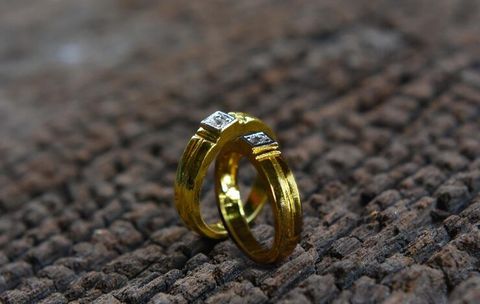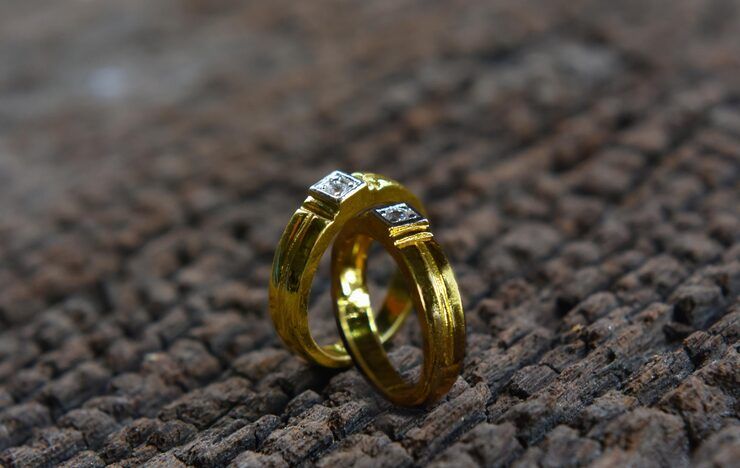
18K yellow gold rings are jewelry pieces made from an alloy containing 75% pure gold and 25% other metals. Pure gold has a naturally rich yellow color, but it is relatively soft for everyday jewelry. Combining it with metals such as silver and copper improves its practical strength while preserving its familiar golden appearance.
The term “18K” refers to the purity of the gold rather than the ring's weight, size, or design. The “K” stands for karat, a measurement that divides gold purity into 24 parts. Since 18 of those 24 parts are pure gold, 18K gold contains 75% gold by mass.
Yellow gold rings are available in various styles, including plain bands, engagement rings, wedding rings, gemstone rings, and decorative statement designs. Their appearance can range from polished and bright to brushed, textured, or intricately engraved.
What Makes 18K Yellow Gold Different?
Gold jewelry is commonly classified by karat. The proportion of pure gold affects its color, hardness, and suitability for different types of jewelry.
24K gold: Approximately 99.9% pure gold in commonly marked high-purity jewelry, with some variation by standard.
22K gold: Approximately 91.7% gold, often used for traditional jewelry.
18K gold: 75% gold, offering a balance between gold content and practical durability.
14K gold: Approximately 58.5% gold, with a larger proportion of strengthening alloy metals.
The yellow shade of an 18K ring depends partly on the metals used in the remaining 25%. Copper can deepen its warmth, while silver can produce a lighter yellow tone. Manufacturing techniques and surface finishing also influence its final appearance.
Common Types of 18K Yellow Gold Rings
18K yellow gold is used in several jewelry categories.
Engagement rings: Often feature a central diamond or colored gemstone.
Wedding bands: May have plain, engraved, patterned, or decorative surfaces.
Solitaire rings: Feature one prominent center stone.
Diamond rings: Combine yellow gold with diamonds in different settings.
Vintage-inspired rings: Use milgrain edges, filigree details, or intricate patterns.
Signet rings: Feature a flat or raised face, sometimes with a personalized emblem.
Stackable rings: Designed to be worn together in coordinated combinations.
The appropriate style depends on personal preferences, daily activities, gemstone requirements, and the desired appearance.
Why 18K Yellow Gold Rings Remain Important
18K yellow gold rings occupy an important place in fine jewelry because they combine a substantial proportion of gold with useful mechanical properties. They are chosen for engagement jewelry, wedding bands, family heirlooms, formal accessories, and everyday personal adornment.
Their appeal also reflects the long-standing cultural significance of gold. In many societies, gold jewelry is associated with celebrations, family traditions, anniversaries, and important life events. Yellow gold offers a classic appearance that works with both traditional and contemporary designs.
Durability and Everyday Wear
Although 18K gold is harder than pure gold in many common jewelry formulations, its durability depends on the alloy composition, manufacturing process, ring design, and finishing.
For everyday use, several factors matter:
Ring thickness and overall construction.
The security of gemstone settings.
Exposure to chemicals, abrasive surfaces, and repeated impacts.
The wearer's daily activities.
The condition of prongs, clasps, or other structural elements.
An 18K yellow gold ring can develop scratches and surface wear over time. Rings with raised gemstones or delicate settings may require more frequent inspection than plain bands.
Gold Purity and Appearance
Gold purity is particularly important when comparing fine jewelry. An 18K ring contains more pure gold by weight than a comparable 14K ring of the same total mass. However, higher gold content does not automatically mean that a ring is better suited to every person or activity.
The alloy metals influence hardness, color, and potential skin sensitivity. People with metal allergies should check the ring's alloy composition, especially when the manufacturer does not clearly identify the metals used.
Recent Trends in 18K Yellow Gold Rings
During 2025 and 2026, the gold jewelry market has continued to evolve through changing design preferences, higher gold prices, and growing interest in lightweight jewelry. Industry observations in India during early 2026 indicated increased attention to 18K and 14K jewelry as consumers considered different gold purity levels and design options.
Contemporary Ring Designs
Modern 18K yellow gold rings combine traditional craftsmanship with contemporary styling. Current design directions include:
Minimalist bands with smooth, polished surfaces.
Geometric rings featuring angular or asymmetrical shapes.
Oval, emerald-cut, and pear-shaped gemstone settings.
Vintage-inspired rings with detailed metalwork.
Lightweight bands designed for regular wear.
Mixed-metal designs combining yellow gold with white or rose gold.
These styles reflect a broad range of preferences rather than a single universal trend. Individual choices vary according to cultural traditions, fashion influences, and intended use.
Technology and Jewelry Manufacturing
Advances in jewelry manufacturing have made it easier to produce detailed ring designs with consistent dimensions. Computer-aided design (CAD) allows designers to develop digital models before manufacturing begins.
Other techniques include precision casting, laser engraving, and computer-assisted stone setting. These methods can support intricate patterns, customized ring shapes, and more consistent production.
Digital design tools can also help assess ring proportions and gemstone placement before a physical piece is created.
Laws and Policies Affecting Gold Jewelry
Gold jewelry regulations help establish standards for purity, product identification, and consumer protection. Requirements differ internationally, so the applicable rules depend on where the jewelry is manufactured, marked, and sold.
Gold Hallmarking in India
In India, the Bureau of Indian Standards (BIS) administers the gold hallmarking framework. Hallmarking provides an independent indication of precious-metal purity.
An 18K gold ring is associated with the purity marking 750, indicating 750 parts of gold per 1,000 parts by mass.
A BIS hallmarked gold jewelry item generally carries three important identifiers:
The BIS standard mark.
The gold purity designation, such as 18K or 750.
A six-character alphanumeric Hallmark Unique Identification (HUID) number.
The HUID helps identify an individual hallmarked article and allows its details to be checked through the official BIS CARE application.
Recent Hallmarking Developments
On March 2, 2026, India's sixth phase of mandatory hallmarking came into force, expanding coverage to 380 districts. The framework includes 18K gold jewelry alongside other specified purity grades.
Mandatory hallmarking applies according to the notified district coverage, applicable exemptions, and relevant regulatory conditions. Consumers should check the current requirements for the location concerned rather than assume that every district follows identical rules.
Internationally, gold purity markings and hallmarking arrangements vary. When examining jewelry from another country, it is useful to understand the local fineness standards and the meaning of its identifying marks.
Tools and Resources for Understanding Gold Rings
Several practical tools can help people understand gold purity, ring measurements, and jewelry maintenance.
Gold Purity Calculator
A simple calculation can determine the approximate amount of pure gold in a ring based on its total gold-alloy mass.
Formula:
Pure gold content = Total ring mass × 0.75
For example, an 18K gold ring with a gold-alloy mass of 5 grams contains approximately 3.75 grams of pure gold. Gemstones and other separately measured components should not be included in the alloy mass.
Ring Size Measurement Tools
Ring sizing charts and measurement tools help estimate the internal diameter or circumference of a ring. Measurements should account for finger shape, temperature, and the ring's width.
Wider bands can feel tighter than narrower bands of the same nominal size. Professional sizing may be useful when a precise fit is important.
Jewelry Inspection and Care Checklist
A basic maintenance checklist can help preserve the ring's appearance and condition.
Check | What to examine | Recommended action |
|---|---|---|
Surface | Scratches and dullness | Clean gently |
Gemstone setting | Loose stones or bent prongs | Arrange a professional inspection |
Hallmark | Purity mark and HUID | Verify identifying details |
Ring shape | Bending or distortion | Avoid further mechanical stress |
Metal finish | Wear or uneven polishing | Assess appropriate refinishing |
Useful reference materials include official hallmarking guidance, jewelry care instructions, ring sizing charts, and gold purity conversion calculators.
Frequently Asked Questions
Is 18K yellow gold real gold?
Yes. 18K yellow gold contains 75% pure gold by mass, with the remaining 25% consisting of alloy metals. A recognized purity mark or appropriate testing can help establish the gold content.
Is 18K yellow gold suitable for everyday wear?
It can be suitable for everyday wear, particularly when the ring has a sturdy design. However, scratches, bending, and gemstone-setting damage can occur. The ring's construction and the wearer's activities influence its durability.
What does 750 mean on an 18K gold ring?
The number 750 indicates 750 parts of gold per 1,000 parts of alloy, equivalent to 75% gold. It is a fineness designation commonly associated with 18K gold.
Can 18K yellow gold rings cause skin irritation?
Some people experience irritation or allergic reactions to particular alloy metals. The risk depends on the composition of the alloy and individual sensitivity. Anyone with a known metal allergy should check the ring's material specifications.
How should an 18K yellow gold ring be cleaned?
Use lukewarm water, mild soap, and a soft cloth or soft-bristled brush. Rinse carefully and dry with a clean, lint-free cloth. Avoid harsh chemicals and abrasive materials. Rings containing delicate gemstones may require specialized care.
Conclusion
18K yellow gold rings combine a high proportion of pure gold with alloy metals that support practical jewelry design. Their distinctive yellow appearance, range of styles, and suitability for many ring types make them relevant to both traditional and contemporary jewelry preferences.
Understanding gold purity, alloy composition, durability, and hallmarking helps people evaluate jewelry more confidently. Recent developments in manufacturing and digital design have also expanded the possibilities for detailed and customized ring styles.
With appropriate care, accurate purity identification, and attention to ring construction, 18K yellow gold rings can remain attractive and functional for many years.