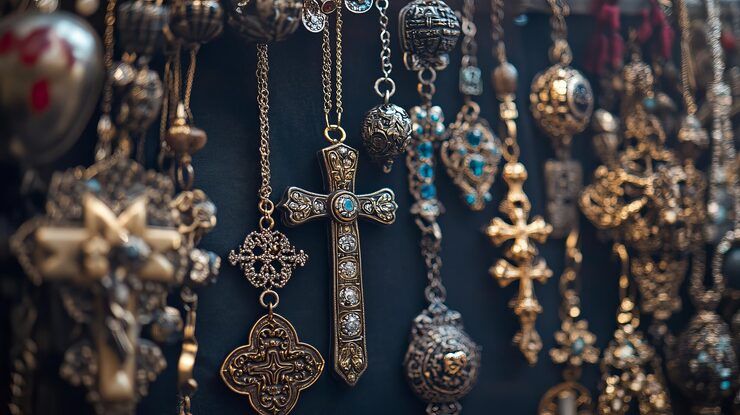
Religious pendants are jewellery pieces that feature symbols, inscriptions, figures, or motifs associated with religious traditions and spiritual practices. They can represent faith, cultural heritage, personal identity, remembrance, or connection with a particular tradition.
Common examples include crosses, Stars of David, Om symbols, crescents and stars, Buddhist motifs, Hindu deities, Christian saints, Islamic geometric designs, Sikh Khanda symbols, and other culturally significant forms. The meaning of a pendant depends strongly on its religious and cultural context.
Understanding Religious Pendants
What Religious Pendants Represent
A religious pendant can have several layers of meaning. For some people, it represents personal faith or devotion. For others, it can reflect family heritage, cultural identity, or an important life event.
The same symbol may also have different interpretations between communities, regions, or historical periods. Understanding the background of a design is therefore important when discussing religious jewellery.
Religious pendants may be produced using:
Gold and silver
Platinum
Stainless steel
Brass and other metal alloys
Wood
Ceramic
Glass
Gemstones
Enamel
Recycled or alternative materials
The construction method also varies. Some pieces are cast, while others are engraved, stamped, carved, fabricated, or created through modern digital manufacturing techniques.
Common Symbol Categories
| Tradition or Cultural Context | Examples of Pendant Motifs | Common Associations |
|---|---|---|
| Christianity | Cross, crucifix, saint imagery | Faith, devotion, remembrance |
| Judaism | Star of David, Chai | Jewish identity and heritage |
| Hindu traditions | Om, deity imagery, sacred symbols | Spiritual traditions and devotion |
| Islam | Crescent motifs, Arabic calligraphy | Cultural and religious identity |
| Buddhism | Dharma Wheel, Buddha imagery | Buddhist teachings and practice |
| Sikhism | Khanda | Sikh identity and principles |
| Other traditions | Regional or ancestral symbols | Heritage and cultural identity |
These associations are general rather than universal. Religious communities contain diverse interpretations, and the meaning of a symbol can depend on its use and context.
Why Religious Pendants Matter Today
Religious jewellery continues to appear across many cultural settings. Global travel, migration, multicultural communities, and digital communication have increased exposure to religious symbols from different parts of the world.
Cultural Identity and Heritage
For many individuals, religious pendants can provide a visible connection to family history or cultural heritage. They may be worn during religious gatherings, family occasions, festivals, ceremonies, or everyday activities.
They can also have significance across generations. A pendant passed from one family member to another may carry historical meaning beyond the physical material from which it was made.
Personal and Ceremonial Meaning
Certain religious pendants are connected with important occasions. Examples can include baptisms, confirmations, weddings, coming-of-age ceremonies, religious festivals, pilgrimages, or memorial traditions.
The importance of the pendant may therefore come from its history, symbolism, or relationship to a particular event rather than its material composition.
Education and Cultural Understanding
Religious jewellery can also support learning about world cultures. Studying the history of symbols can provide insight into architecture, literature, art, rituals, migration, and social traditions.
For researchers, educators, museums, and collectors, information about provenance and historical context can be as important as the physical object.
Materials, Craftsmanship and Design Considerations
Precious Metals and Hallmarking
Gold, silver, and platinum are widely used in jewellery. In many markets, precious-metal articles are subject to fineness requirements, marking systems, or consumer-protection rules.
A hallmark or fineness mark can provide information about the metal composition. Requirements vary by jurisdiction, so markings should be interpreted according to the applicable national system.
Symbol Accuracy
Religious symbols may have precise visual conventions. Small differences in lettering, proportions, orientation, or iconography can sometimes change the meaning or significance of a design.
When researching a religious pendant, useful information includes:
Historical origin of the symbol
Religious tradition associated with it
Language or script used
Traditional proportions
Cultural context
Appropriate terminology
Historical period
Materials and manufacturing method
Ethical Cultural Representation
Religious imagery requires cultural awareness. A symbol that has deep spiritual meaning should not automatically be treated as a purely decorative motif.
Designers, writers, retailers, museums, and advertisers can benefit from researching the background of a symbol and using accurate descriptions.
Recent Global Developments and Trends
During 2025 and 2026, jewellery discussions have increasingly included digital design, personalization, responsible material sourcing, traceability, and cultural awareness.
Digital Jewellery Design
Computer-aided design and 3D modelling have changed how jewellery concepts are developed. Designers can create detailed representations of pendants before manufacturing and examine proportions, engraving, settings, and structural features digitally.
Digital manufacturing can also help reproduce complex shapes with greater consistency.
Traceability and Responsible Materials
The jewellery industry continues to place greater attention on responsible sourcing and supply-chain transparency. Consumers and organizations increasingly look for information about where metals and gemstones originate and how materials move through supply chains.
This trend is particularly relevant to religious jewellery containing precious metals or gemstones because cultural significance can coexist with environmental and supply-chain considerations.
Personalization
Personalized pendants remain relevant across many jewellery categories. Digital engraving, custom lettering, symbolic combinations, and family-oriented designs allow jewellery to reflect individual histories.
For religious pieces, personalization can involve names, dates, script, short inscriptions, or combinations of culturally meaningful motifs. Accuracy is particularly important when working with unfamiliar languages or religious texts.
Global Laws, Regulations and Policies
Religious pendants are generally treated as jewellery products, but several areas of regulation can affect their manufacture, importation, advertising, and distribution.
Precious-Metal Regulations
Countries use different systems to regulate precious-metal purity and marking.
The United Kingdom operates hallmarking requirements for certain precious-metal articles, while the European Union has national approaches that can vary by member state. The United States has federal requirements concerning jewellery descriptions and precious-metal quality claims.
Organizations working across borders should therefore verify the rules applicable to the destination market.
Import and Customs Requirements
Jewellery containing precious metals, gemstones, or materials derived from particular sources can be subject to customs documentation and import controls.
Requirements can include:
Material declarations
Metal purity information
Country-of-origin information
Customs classification
Gemstone documentation where applicable
Restricted-material declarations
The exact requirements depend on the destination and material composition.
Cultural Heritage Protection
Some religious or culturally significant objects can fall under heritage-protection laws. Antique religious objects may receive different treatment from newly manufactured jewellery.
International frameworks concerning cultural property can also affect the movement of historical objects across borders. Collectors and institutions should verify provenance before transferring historically significant pieces internationally.
Advertising Considerations
Advertising religious jewellery should use accurate descriptions and avoid unsupported statements about spiritual, medical, financial, or supernatural outcomes.
For digital advertising, neutral descriptions focused on design, history, materials, symbolism, and cultural context are generally more appropriate than claims promising specific personal results.
Tools and Resources for Research
Several resources can help researchers, designers, collectors, and writers understand religious pendants more accurately.
Useful Research Tools
Museum databases: Useful for researching historical religious objects and jewellery.
Library catalogues: Helpful for finding books about religious art, iconography, and jewellery history.
Religious studies references: Provide background on symbols and traditions.
CAD software: Useful for creating and reviewing pendant designs.
Digital engraving tools: Help plan inscriptions and lettering.
Translation references: Useful when working with religious scripts, although important texts should be verified by qualified sources.
Hallmark databases: Help identify precious-metal marks in different countries.
Gemological references: Useful for understanding gemstones used in jewellery.
Customs databases: Helpful when researching international movement of jewellery.
Museum collection archives: Provide historical examples and provenance information.
Research Checklist
Before publishing information about a religious pendant, verify:
The correct name of the symbol
Its religious or cultural association
Historical background
Spelling and translation
Material description
Metal purity information
Applicable marking requirements
Provenance where relevant
Cultural context
Appropriate advertising language
This approach can reduce factual errors and encourage respectful treatment of religious imagery.
Frequently Asked Questions
What is a religious pendant?
A religious pendant is a jewellery piece incorporating a symbol, inscription, figure, or motif connected with a religious or spiritual tradition. Its meaning can relate to faith, heritage, identity, remembrance, or ceremonial practice.
Which materials are commonly used for religious pendants?
Gold, silver, platinum, stainless steel, brass, wood, ceramic, glass, enamel, and gemstones are among the materials used. Material selection depends on design, manufacturing method, cultural tradition, and intended use.
Are religious symbols interpreted the same way everywhere?
No. Symbolic meanings can vary between religious communities, historical periods, and geographic regions. A design should therefore be researched within its specific cultural and religious context.
Do religious pendants need hallmarks?
The requirement depends on the country, metal, weight, and applicable regulations. Some jurisdictions require or recognize official hallmarking systems for certain precious-metal articles, while others use different disclosure requirements.
What should be checked before researching or describing a religious pendant?
Researchers should verify the symbol's origin, religious association, historical context, terminology, script, material information, and relevant regulations. For antique or historically significant objects, provenance is also important.
Conclusion
Religious pendants combine jewellery design with cultural, historical, and spiritual meaning. Their significance can come from a symbol's history, a family's traditions, a religious practice, or an individual's connection with a particular community.
Understanding these pieces requires more than identifying their physical appearance. Accurate research should consider symbolism, language, craftsmanship, materials, cultural context, and applicable regulations.
Recent developments in digital design, material traceability, personalization, and responsible sourcing are also influencing the broader jewellery landscape. These developments provide new ways to document, design, manufacture, and study religious pendants while maintaining attention to cultural accuracy.
For anyone researching religious jewellery, spiritual pendant designs, gold religious pendants, silver religious jewellery, or cultural jewellery symbols, reliable historical and regulatory information is essential.
A thoughtful approach combines jewellery knowledge with cultural research. This helps ensure that religious pendants are discussed accurately, respectfully, and within their appropriate historical and social context.