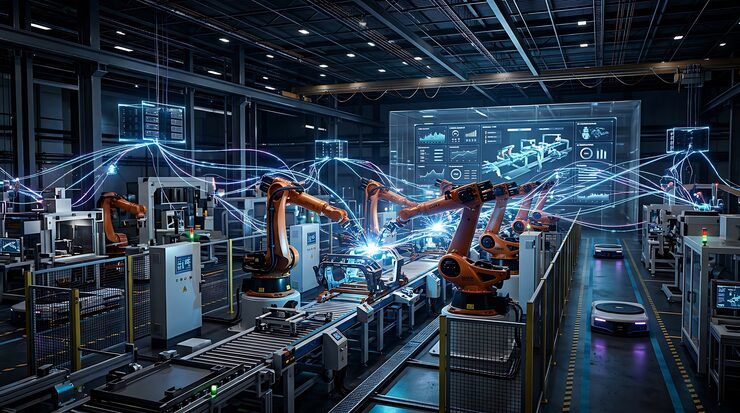
Manufacturing is undergoing a significant transformation as digital technologies become increasingly integrated into industrial operations. Smart factories represent a modern approach to production in which machines, equipment, computer systems, sensors, and people communicate through connected digital networks. These environments use real-time information to coordinate production activities, monitor equipment, and improve operational decisions.
Traditional manufacturing facilities often depend on separate machines and disconnected information systems. Production information may be recorded manually, while equipment maintenance and quality inspections are handled through different processes. This separation can make it difficult to identify problems quickly or understand overall factory performance.
Smart factories address these limitations through technologies such as Industrial Internet of Things (IIoT), artificial intelligence (AI), machine learning, robotics, cloud computing, and digital twins.
The concept is closely associated with Industry 4.0, which introduced advanced automation and connected industrial systems. In 2026, the development of Industry 5.0 is also influencing manufacturing by emphasizing human-machine collaboration, resilience, and sustainability.
A fully connected factory does not necessarily mean that every activity operates without human involvement. Instead, it creates an environment where information moves efficiently between production equipment, management systems, suppliers, and workers.
Why Smart Factories Matter in Modern Manufacturing
Smart factories are becoming important because manufacturers must manage increasingly complex production requirements. Businesses across automotive, electronics, pharmaceuticals, food processing, aerospace, and industrial machinery sectors depend on reliable production systems.
Connected manufacturing technologies help organizations understand production conditions and respond to operational changes more effectively.
Improved Production Efficiency
Industrial automation systems can coordinate repetitive activities, monitor production speed, and identify interruptions. Real-time production monitoring helps factory managers understand where delays occur and which processes require attention.
For example, connected sensors can measure machine temperature, vibration, and operating conditions. If unusual readings appear, maintenance teams can investigate before the equipment experiences a major breakdown.
Predictive Maintenance Technology
Predictive maintenance uses equipment data and machine learning algorithms to estimate when machinery may require attention.
Unlike traditional maintenance schedules, which often depend on fixed intervals, predictive systems examine actual operating conditions.
Important advantages include:
Earlier identification of equipment abnormalities.
Better maintenance planning.
Reduced unexpected production interruptions.
Improved equipment availability.
More informed maintenance decisions.
Better Product Quality
AI-powered quality inspection systems can analyze images, measurements, and production data to identify manufacturing defects.
Computer vision technology can examine components during production and identify inconsistencies that may be difficult to detect through manual inspection alone.
Workforce Productivity and Human Collaboration
Smart factories also affect industrial workers. Automated systems can handle repetitive or physically demanding activities, while employees focus on supervision, technical decisions, equipment management, and problem-solving.
This approach supports human-machine collaboration rather than treating automation as a complete replacement for human expertise.
Key Technologies Behind Fully Connected Factories
Smart manufacturing depends on several technologies working together. Each technology contributes to a different part of the production environment.
Industrial Internet of Things (IIoT)
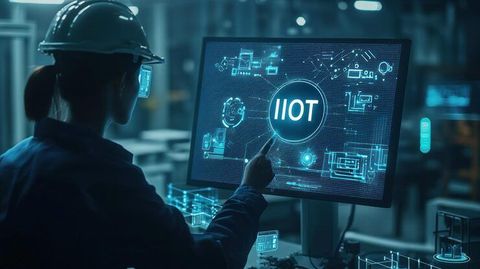
IIoT connects industrial equipment, sensors, production lines, and monitoring platforms. These connected devices collect information about machine performance, energy consumption, operating temperatures, and production conditions.
The collected information helps manufacturers understand factory operations and identify unusual patterns.
Artificial Intelligence and Machine Learning
AI and machine learning analyze large volumes of manufacturing information. These technologies can support:
Automated quality inspection.
Predictive equipment maintenance.
Production scheduling.
Industrial energy management.
Manufacturing demand forecasting.
AI systems can also identify patterns that may not be immediately visible through conventional monitoring methods.
Digital Twin Technology
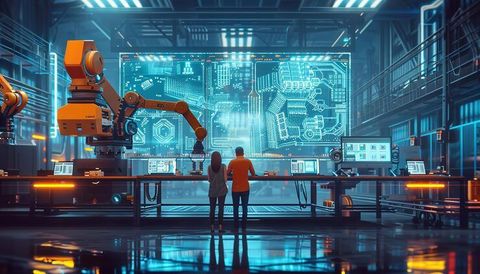
A digital twin is a virtual representation of a physical machine, production line, or entire manufacturing facility. It uses operational information to represent the condition and behavior of its physical counterpart.
Manufacturers can use digital twins to simulate production changes, examine equipment performance, and evaluate different operational scenarios before implementing physical adjustments.
Industrial Robotics and Automation
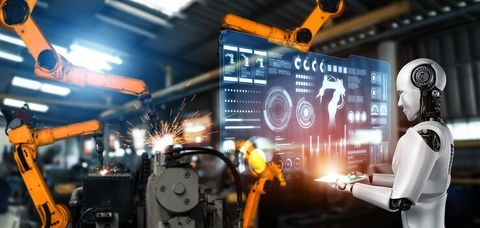
Industrial robots perform activities such as welding, material handling, assembly, packaging, and precision manufacturing.
Collaborative robots, commonly called cobots, are designed to work alongside human employees in suitable industrial environments. Their use requires appropriate risk assessments, protective measures, and workplace procedures.
Cloud Computing and Edge Computing
Cloud computing allows manufacturing information to be stored and analyzed across connected systems. Edge computing processes information closer to the machines generating it.
This distinction is important because some industrial activities require very fast responses. Local processing can reduce dependence on distant computing systems, while cloud platforms support broader analysis across multiple facilities.
Recent Developments and Smart Manufacturing Trends in 2025–2026
The manufacturing technology landscape has continued to develop during 2025 and 2026. Artificial intelligence, robotics, industrial cybersecurity, and digital twin technology have received increasing attention.
Artificial Intelligence Moves Toward Industrial Applications
On July 3, 2026, the US National Institute of Standards and Technology (NIST) published its Roadmap on Artificial Intelligence and Machine Learning for Smart Manufacturing.
The publication examines industrial AI applications involving robotics, advanced sensing, digital twins, supply chain optimization, and sustainable manufacturing. It also highlights challenges involving data management, system integration, reliability, and explainable AI.
Industrial Robot Adoption Continues Growing
On September 24, 2026, the International Federation of Robotics reported that the global operational stock of industrial robots reached approximately five million units in 2025.
The report also recorded more than 600,000 new industrial robot installations during that year, indicating the continuing expansion of industrial automation worldwide.
New Attention to Digital Twin Security
In February 2025, NIST published its report on security and trust considerations for digital twin technology.
The research discusses cybersecurity, system reliability, data protection, and the importance of establishing trustworthy digital representations. These considerations are particularly relevant when digital twins are connected to physical industrial equipment.
Manufacturing Supply Chain Traceability
On September 9, 2026, NIST finalized its Manufacturing Supply Chain Traceability Meta-Framework.
The framework supports secure information exchange and product traceability across different industries. It is intended to improve the ability of organizations to verify supply chain information while maintaining compatibility with existing industry standards.
Manufacturing Automation Outlook
A February 27, 2026, PwC industry outlook reported that the median share of industrial manufacturers expecting highly automated processes was projected to increase from 18% to 50% by 2030.
This projection reflects growing interest in advanced automation, AI, and connected industrial systems. It represents surveyed expectations rather than a guaranteed outcome.
Smart Manufacturing Technology Overview
The following table summarizes important technologies and their industrial applications.
Technology | Main application | Potential benefit |
|---|---|---|
Industrial IoT | Machine monitoring | Real-time information |
Artificial intelligence | Data analysis | Better decisions |
Digital twins | Virtual simulation | Process evaluation |
Robotics | Automated production | Consistent operations |
Edge computing | Local data processing | Faster responses |
Cloud computing | Centralized data management | Connected facilities |
Machine vision | Quality inspection | Defect identification |
5G connectivity | Industrial communication | Connected equipment |
Laws, Regulations, and Government Initiatives
Smart factories operate within regulatory environments covering machinery safety, workplace protection, cybersecurity, environmental management, and data governance. Requirements differ between countries, industries, and types of equipment.
Manufacturers should understand the rules applicable to their facilities and the markets in which their products are distributed.
European Union Machinery Regulation
The European Union's Machinery Regulation (EU) 2023/1230 establishes updated safety requirements for machinery and related products.
It addresses areas including digital technologies, machinery safety, and conformity assessment. The regulation generally applies from January 20, 2027, with certain provisions applying earlier. Manufacturers preparing connected production equipment for the European market should consider these requirements during system development.
European Union Cyber Resilience Act
The Cyber Resilience Act (EU) 2024/2847 introduces cybersecurity requirements for products with digital elements.
It is relevant to certain connected industrial hardware and software products. Reporting obligations for actively exploited vulnerabilities and severe incidents begin on September 11, 2026, while the main obligations generally apply from December 11, 2027.
United States Manufacturing Cybersecurity Guidance
In September 2025, NIST published an initial public draft of its Cybersecurity Framework 2.0 Manufacturing Profile.
The guidance provides a voluntary, risk-based approach to manufacturing cybersecurity. It covers governance, identification, protection, detection, response, and recovery.
Manufacturers can use this framework to evaluate cybersecurity risks affecting industrial control systems, connected machinery, and production networks.
Workplace and Environmental Regulations
Industrial facilities must also consider applicable occupational safety and environmental requirements.
Common regulatory areas include:
Machine guarding and industrial equipment safety.
Employee training and workplace risk management.
Hazardous material handling.
Industrial emissions and waste management.
Energy efficiency and environmental reporting.
Protection of business and operational information.
For manufacturers operating internationally, checking local regulations and applicable technical standards is important before introducing connected equipment.
Helpful Tools and Resources for Smart Factories
Manufacturers can use different software platforms, industrial technologies, and technical resources to plan and manage connected manufacturing environments.
Industrial Automation and Monitoring Platforms
Siemens Industrial Automation: Supports programmable logic controllers, industrial automation, and production monitoring.
Rockwell Automation: Provides industrial control technologies and manufacturing information systems.
Schneider Electric: Supports industrial automation, energy monitoring, and connected infrastructure.
Digital Twin and Industrial Simulation Tools
PTC ThingWorx: Supports connected industrial applications and equipment monitoring.
NVIDIA Omniverse: Supports industrial simulation and digital twin development.
Autodesk: Provides engineering and simulation technologies used in manufacturing workflows.
Cybersecurity and Technical Resources
NIST Cybersecurity Framework: Provides guidance for identifying and managing cybersecurity risks.
IEC 62443: Establishes cybersecurity standards for industrial automation and control systems.
ISO 9001: Provides a quality management framework for manufacturing organizations.
ISO 14001: Supports environmental management systems.
OPC UA: Enables structured communication and information exchange between industrial systems.
Frequently Asked Questions
What is a smart factory?
A smart factory is a digitally connected manufacturing facility that uses technologies such as IIoT, AI, robotics, sensors, and automation to monitor and coordinate production activities.
How does artificial intelligence improve manufacturing operations?
AI analyzes production information, identifies unusual equipment conditions, supports predictive maintenance, and assists with automated quality inspections. It helps manufacturing teams make more informed operational decisions.
What is the difference between Industry 4.0 and Industry 5.0?
Industry 4.0 focuses on digital connectivity, automation, and intelligent industrial systems. Industry 5.0 places additional emphasis on human-machine collaboration, sustainability, and industrial resilience.
Are smart factories completely automated?
No. Smart factories can combine automated equipment with human supervision and decision-making. Employees remain important for maintenance, engineering, quality management, and complex operational decisions.
What are the main cybersecurity risks in connected manufacturing?
Common risks include unauthorized system access, ransomware, compromised industrial networks, insecure connected devices, and operational data breaches. Network segmentation, access controls, regular security assessments, and incident response planning can help reduce these risks.
Conclusion
Smart factories are becoming an important part of modern industrial development. The combination of Industrial IoT, artificial intelligence, digital twins, robotics, and advanced connectivity is changing how manufacturing facilities monitor equipment, coordinate production, and manage operational information.
Developments throughout 2025 and 2026 demonstrate increasing interest in industrial AI, connected robotics, supply chain traceability, and cybersecurity. However, implementing these technologies also introduces challenges involving infrastructure, workforce training, data quality, interoperability, and regulatory compliance.
The future of connected manufacturing will depend not only on advanced automation but also on reliable technology integration and effective human collaboration. As industrial systems continue to evolve, smart factories are likely to play an increasingly important role in creating flexible, resilient, and digitally connected manufacturing environments.