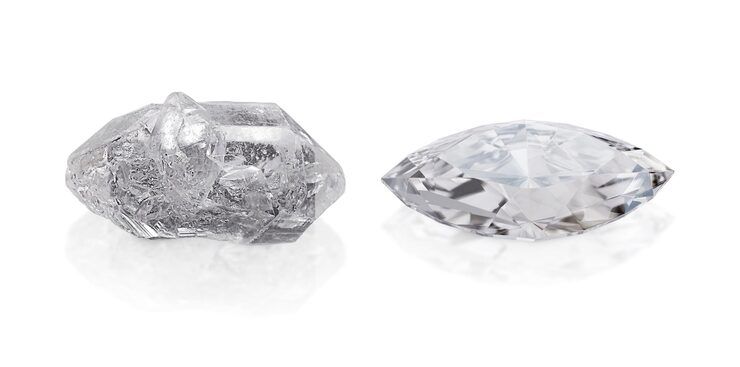
Marquise cut diamonds are distinguished by their elongated shape, curved sides, and two pointed ends. Often described as an eye-shaped or boat-shaped diamond, this cut creates a distinctive outline that differs from traditional round, oval, pear, and princess cuts.
The marquise shape has a long history in jewelry design and remains an option for engagement rings, pendants, earrings, and other fine jewelry. Its elongated outline can create the appearance of a larger face-up diamond compared with some other shapes of similar carat weight, although actual appearance depends on the diamond's proportions and dimensions.
Understanding marquise cut diamonds involves more than examining their shape. Proportions, symmetry, clarity, color, cut quality, durability, and grading documentation all influence how an individual diamond looks and performs.
Understanding the Marquise Diamond Shape
The marquise cut is a modified brilliant cut designed to reflect light through a series of carefully arranged facets. Its elongated outline typically features two pointed ends and gently curved sides.
The shape is traditionally associated with a French royal court legend involving King Louis XV, although historical accounts of its exact origin vary. The design became established in European jewelry and subsequently developed into a recognized diamond shape.
A marquise diamond generally has a larger length-to-width ratio than a round brilliant diamond. Its proportions can make a finger appear longer when the stone is set vertically in a ring.
Key Characteristics of Marquise Cut Diamonds
Several features distinguish this shape from other diamond cuts:
Elongated outline: Creates a narrow, eye-like appearance.
Two pointed ends: Give the stone its characteristic silhouette.
Brilliant-style facets: Help reflect and return light.
Variable proportions: The diamond can appear narrow or relatively broad.
Orientation flexibility: The stone can be set vertically, horizontally, or diagonally.
Potential visual spread: Some marquise diamonds appear relatively large from above for their carat weight.
The pointed ends require particular attention during setting and everyday wear because they can be more vulnerable to chipping than rounded edges.
Marquise Diamond Proportions
The length-to-width ratio is one of the most noticeable characteristics of a marquise diamond. It compares the stone's length with its width when viewed from above.
A ratio around 1.75 to 2.15 is often used as a general visual reference, but preferences vary. Some diamonds have a long, narrow appearance, while others look shorter and wider.
| Length-to-Width Ratio | General Appearance |
|---|---|
| Below 1.70 | Relatively broad |
| 1.70–1.85 | Moderately elongated |
| 1.85–2.05 | Classic elongated appearance |
| 2.05–2.20 | Long and slender |
| Above 2.20 | Very elongated |
These ranges are descriptive guidelines rather than universal grading standards. Personal preference and the individual diamond's proportions remain important.
Why Marquise Cut Diamonds Matter
Understanding the marquise cut helps jewelry buyers, designers, gemologists, and collectors evaluate diamond appearance and durability more accurately.
Visual Appearance and Light Performance
Marquise diamonds use a faceting arrangement intended to return light through the crown. Their elongated geometry can produce a distinctive pattern of brightness and contrast.
However, light performance varies between individual stones. Poor proportions, uneven symmetry, or an unfavorable facet arrangement can result in dark areas or uneven brightness.
The two ends should also be examined carefully. A well-balanced marquise diamond generally has points that align with its central axis and curved sides that appear reasonably symmetrical.
Carat Weight and Face-Up Size
Carat measures diamond weight rather than visible dimensions. Two diamonds with identical carat weights can have different face-up sizes because of differences in depth, length, width, and overall proportions.
The marquise shape can distribute weight across an elongated outline, which may create a relatively large visual footprint.
Nevertheless, a large-looking diamond is not necessarily better cut. Excessive shallowness or depth can affect appearance, durability, and light performance.
Choosing Clarity and Color
Clarity describes the presence and visibility of internal characteristics called inclusions and external characteristics called blemishes.
Because the marquise has pointed ends and an elongated outline, inclusions near vulnerable areas deserve particular attention. A diamond with a high clarity grade may still have an inclusion in a location that warrants closer inspection.
Color grading is also relevant. The elongated shape can make color distribution easier to notice in certain lighting conditions, especially toward the ends of some stones.
A laboratory grading report provides a more consistent basis for comparison than appearance alone.
Settings and Durability
Marquise diamonds can be mounted in several jewelry settings:
Prong settings with protective tips
Bezel or partial-bezel settings
Halo settings
Solitaire settings
Three-stone designs
East-west horizontal settings
Protective prongs are particularly important at the two pointed ends. The appropriate setting depends on the diamond's proportions, the intended jewelry design, and how frequently the piece will be worn.
Recent Developments in the Diamond Industry
Developments during 2025 and 2026 have continued to influence how consumers evaluate diamond origin, grading, and laboratory-grown alternatives.
Laboratory-Grown Diamond Transparency
Laboratory-grown diamonds have become an increasingly visible part of the modern diamond market. They have essentially the same chemical composition and crystal structure as natural diamonds, although their growth conditions differ.
The US Federal Trade Commission's jewelry guidance requires accurate descriptions of laboratory-grown diamonds and cautions against language that could mislead consumers about their origin.
Clear disclosure is important when comparing marquise diamonds because natural and laboratory-grown stones can have similar visual characteristics while differing in origin and market positioning.
Diamond Grading and Documentation
Independent gemological reports remain important for evaluating diamond characteristics. The Gemological Institute of America has continued updating its educational resources and grading information to help explain diamond quality and laboratory-grown diamonds.
In 2025, the diamond industry also continued discussing grading terminology, consumer transparency, and how laboratory-grown diamonds should be represented in documentation.
When evaluating a marquise diamond, a report should be checked for the stone's measurements, carat weight, color, clarity, and any identifying information. A grading report does not necessarily establish a diamond's market value.
Digital Diamond Evaluation
Digital magnification, 360-degree product views, and proportion diagrams have become common tools for examining diamond appearance remotely.
These tools can help viewers compare outline, symmetry, visible inclusions, and light behavior. However, screen images depend on lighting, photography, display settings, and image processing, so they should not replace reliable grading documentation.
Laws, Regulations, and Diamond Disclosure
Diamond-related regulations vary by country. In the United States, federal consumer-protection rules address potentially misleading jewelry descriptions and origin claims.
US Federal Trade Commission Guidance
The Federal Trade Commission's Jewelry Guides explain how terms such as “diamond,” “laboratory-grown diamond,” and related descriptions should be used in commercial communications.
The guidance is intended to reduce confusion between natural diamonds, laboratory-grown diamonds, and diamond simulants. Simulants such as cubic zirconia can resemble diamonds but do not have the same chemical composition.
Businesses should describe a diamond's origin accurately and avoid claims that imply a laboratory-grown diamond is a natural diamond.
Certification and Grading Reports
A diamond grading report documents characteristics assessed by a gemological laboratory. It can provide useful information about the individual stone, but it is not the same as a valuation or guarantee of future resale value.
When reviewing documentation, examine:
Laboratory identification
Carat weight
Measurements
Color grade
Clarity grade
Cut or proportion information where provided
Report number and matching inscription, if applicable
Different laboratories may use different grading procedures and report formats. Their results should not automatically be treated as directly interchangeable.
International Trade and Consumer Protection
Diamond imports and exports may be affected by customs rules, sanctions, anti-money-laundering requirements, and origin documentation.
The Kimberley Process Certification Scheme applies to international trade in rough diamonds and is intended to prevent conflict diamonds from entering legitimate trade. It does not function as a universal grading or authenticity certificate for every polished diamond.
Consumers should check the rules applicable to their country when documentation, import duties, or origin claims are relevant.
Tools and Resources for Evaluating Marquise Diamonds
Several resources can help explain diamond quality and support more informed comparisons.
Gemological Education
The Gemological Institute of America provides educational material about the 4Cs: carat weight, color, clarity, and cut. Its resources can help explain why two diamonds of similar weight may differ in appearance.
Proportion Calculators
A length-to-width calculator can be used by dividing the diamond's length in millimeters by its width.
For example, a diamond measuring 10.0 mm long and 5.0 mm wide has a length-to-width ratio of 2.00.
Diamond Grading Reports
Laboratory reports can help verify measurements and quality characteristics. Always ensure that the report corresponds to the specific diamond being evaluated.
Comparison Checklist
| Factor | What to Examine |
|---|---|
| Shape | Balanced outline and pleasing proportions |
| Symmetry | Alignment of the two pointed ends |
| Light performance | Brightness and distribution of dark areas |
| Clarity | Inclusion visibility and location |
| Color | Overall tint and color distribution |
| Durability | Condition of points and edges |
| Documentation | Consistent measurements and grading details |
| Setting | Protection for the pointed ends |
Frequently Asked Questions
What is a marquise cut diamond?
A marquise cut diamond is an elongated, brilliant-style diamond with two pointed ends and curved sides. Its distinctive outline makes it different from round, oval, pear, and emerald cuts.
Do marquise diamonds look larger than round diamonds?
A marquise diamond may appear larger from above than a round diamond of similar carat weight because its weight is distributed across an elongated shape. Actual visible size depends on its measurements and proportions.
What length-to-width ratio is suitable for a marquise diamond?
A ratio around 1.75 to 2.15 is a common visual reference, but there is no single ideal ratio for everyone. The preferred shape depends on whether a broader or more elongated outline is desired.
Are marquise diamond points vulnerable to damage?
Yes. The two pointed ends can be more vulnerable to chipping than rounded edges. Protective prongs or an appropriate bezel design can help reduce exposure to impacts.
Are laboratory-grown marquise diamonds real diamonds?
Yes. Laboratory-grown diamonds have essentially the same chemical composition and crystal structure as natural diamonds. They differ in how they form and should be clearly identified according to applicable disclosure rules.
Conclusion
Marquise cut diamonds combine an elongated outline, pointed ends, and brilliant-style faceting in a distinctive jewelry design. Their appearance depends on proportions, symmetry, clarity, color, light performance, and the way the stone is mounted.
Evaluating these characteristics together provides a more complete understanding than relying on carat weight or shape alone. Grading documentation and careful examination can help clarify the differences between individual diamonds.
Recent developments in laboratory-grown diamond disclosure, digital evaluation, and grading education have made accurate product descriptions increasingly important. Understanding these topics can help readers assess marquise diamonds using consistent terminology and realistic expectations.