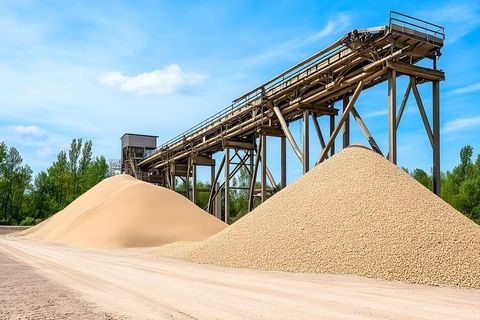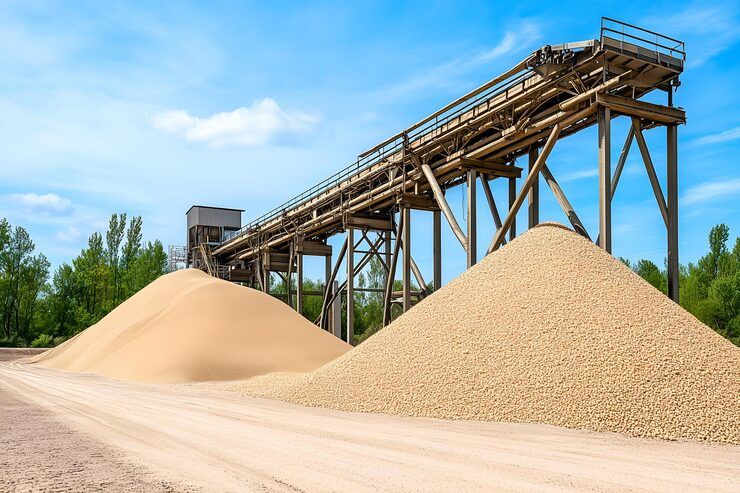
Sand screening machines are industrial equipment used to separate sand and granular materials according to particle size. These machines help construction companies, quarries, foundries, mining operations, and material-processing facilities prepare sand for specific applications.
Natural sand can contain particles of different sizes, stones, clay, organic matter, and other unwanted materials. Screening helps classify these particles so that the resulting material meets the requirements of a particular construction or industrial process.
Sand screening technology ranges from simple mechanical sieves to large automated screening plants. The appropriate equipment depends on the characteristics of the incoming material, the required particle-size distribution, processing capacity, moisture content, and operating environment.
Understanding Sand Screening Equipment
A sand screening machine separates particles by passing material over a mesh, perforated plate, or other screening surface. Smaller particles pass through the openings, while larger particles remain above the screen.
Many industrial machines use vibration to move material across the screening surface. The movement spreads the material, improves particle contact with the openings, and helps separate different size fractions.
Common types of sand screening equipment include:
Vibrating screen machines: Use controlled vibration to separate sand and aggregates into different sizes.
Rotary screening machines: Rotate a cylindrical screening surface to classify granular materials.
Trommel screens: Use a rotating drum to separate particles according to size.
Inclined vibrating screens: Use a sloped screening surface to move material through the machine.
Horizontal vibrating screens: Use a comparatively level screening surface for controlled material separation.
Multi-deck screening machines: Contain multiple screening layers that produce several particle-size fractions in one process.
Portable screening plants: Combine screening equipment with supporting structures for processing at different locations.
Each machine has different operating characteristics. Selection should account for the material being processed and the required output quality.
How Sand Screening Machines Work
A typical sand screening process involves feeding, separation, collection, and quality checking.
Material feeding: Sand enters the machine through a hopper, conveyor, or controlled feeding system.
Particle separation: The material moves across the screening surface. Particles smaller than the openings pass through, while larger particles continue along the screen.
Collection: Separate discharge points direct the screened fractions into designated stockpiles, bins, or conveyors.
Quality inspection: Samples can be examined to determine particle-size distribution and whether the material meets the intended specification.
Some screening plants also include washing systems to remove clay, silt, or other contaminants. However, screening and washing perform different functions. Screening separates particles primarily by size, while washing helps remove unwanted substances from the material.
Why Sand Screening Machines Matter
Sand screening is important because particle size influences the performance of construction materials and many industrial products.
Construction and Infrastructure
Concrete, mortar, asphalt, drainage systems, and road foundations require aggregates with appropriate grading and material characteristics.
Screening helps separate sand into consistent size ranges. This supports better control of mixtures used in construction and infrastructure projects.
However, screening alone does not guarantee that sand meets every specification. Material quality can also depend on mineral composition, particle shape, moisture, contamination, and other properties.
Industrial Applications
Screened sand is used in several industries, including:
Concrete and mortar production
Road construction
Foundry operations
Glass manufacturing
Filtration applications
Landscaping and drainage
Selected mining operations
Manufacturing of construction products
Different applications require different material specifications. For example, foundry sand and concrete sand may have distinct requirements for particle size, cleanliness, and chemical composition.
Operational Efficiency
Mechanical screening can reduce the need for manual separation and help processing facilities handle larger material volumes.
Automated feeding, multiple screening decks, and integrated conveyors can support continuous operation when the equipment is properly configured.
The actual throughput depends on screen area, mesh size, material moisture, feed consistency, particle shape, and machine settings.
Recent Developments in Sand Screening Technology
During 2025 and 2026, industrial screening technology continued to emphasize automation, energy efficiency, predictive maintenance, and improved control of material quality.
Automated Screening Systems
Modern screening plants increasingly use sensors, automated controls, and monitoring systems to track operating conditions.
These technologies can help operators identify changes in vibration, motor performance, feed rates, and material flow. Automated adjustments may improve consistency when the system is designed to support them.
The results depend on the quality of the sensors, the control system, and the characteristics of the incoming material.
Recycled Construction Materials
Construction and demolition waste has become an important source of recycled aggregates in many markets. Screening equipment helps separate reclaimed sand, crushed concrete, and other granular materials into different size fractions.
Recycled material must still be evaluated for contamination and suitability before use. Screening does not automatically remove every chemical or physical contaminant.
Dust and Energy Management
Dust extraction, enclosed transfer points, improved screen designs, and efficient electric drives are important areas of equipment development.
Dry screening of fine sand can generate airborne dust, while wet screening can create wastewater-management requirements. Facilities must therefore consider the environmental effects of the complete process rather than focusing on the screening machine alone.
Digital Maintenance Monitoring
Vibration sensors and equipment-monitoring systems can help identify unusual operating patterns before they lead to significant downtime.
Condition monitoring may detect developing problems involving bearings, motors, screen supports, or vibration mechanisms. Regular inspections remain necessary because digital monitoring does not identify every possible failure.
Laws, Regulations, and Environmental Policies
Sand screening operations are affected by regulations covering industrial machinery, worker safety, dust emissions, noise, water use, wastewater, and the extraction or processing of raw materials.
Requirements vary by country and may also differ between states, provinces, and municipalities.
Environmental Regulations in India
In India, sand-processing facilities may be subject to environmental requirements administered by the Central Pollution Control Board and the relevant State Pollution Control Board.
Applicable obligations depend on the activity, location, plant configuration, and permissions required for the facility. Sand extraction and mining activities may also be governed by state mining rules and environmental clearance requirements.
Facilities should assess dust generation, noise, water consumption, wastewater discharge, and the handling of rejected material. Applicable consent and authorization requirements should be confirmed with the relevant regulatory authorities before operations begin.
Workplace and Machinery Safety
Screening machines contain moving parts, vibration mechanisms, rotating components, and electrical systems. Appropriate safeguards are necessary to reduce the risk of injury.
Important precautions include:
Installing suitable machine guards
Using emergency-stop systems
Following lockout procedures during maintenance
Inspecting screen panels and structural supports
Providing appropriate personal protective equipment
Controlling access to moving machinery
Training operators in safe operating procedures
Dust and Noise Management
Sand handling can release fine particles into the air, particularly during dry screening and material transfer.
Facilities may use enclosed conveyors, dust extraction, suitable filtration systems, and controlled material handling to reduce emissions. Wet processing may also require measures to manage wastewater and prevent sediment from entering nearby water bodies.
Tools and Resources for Sand Screening
Technical documentation and simple calculations can help operators assess equipment suitability and monitor material quality.
Particle-Size Analysis
Sieve analysis is a standard method for determining the particle-size distribution of granular materials.
A representative sample is passed through a series of sieves with progressively smaller openings. The retained material is weighed to calculate the proportion of particles within each size range.
The results can help determine whether screened sand meets the intended grading requirements.
Equipment Evaluation Checklist
| Evaluation Factor | Information to Assess |
|---|---|
| Feed material | Natural sand, crushed sand, or recycled aggregate |
| Processing capacity | Required tonnes per hour |
| Screen configuration | Number of decks and screen dimensions |
| Mesh openings | Required particle-size separation |
| Moisture content | Dry or wet screening conditions |
| Power requirements | Motor rating and electrical supply |
| Dust control | Extraction, enclosure, and filtration |
| Maintenance | Screen replacement and bearing inspections |
| Compliance | Applicable environmental and safety requirements |
Useful Technical Resources
Manufacturer equipment manuals and technical specifications
Sieve-analysis procedures and aggregate-testing standards
Government environmental regulations
Occupational safety guidance
Plant maintenance records
Equipment monitoring and energy-consumption logs
These resources help operators evaluate performance and document compliance.
Frequently Asked Questions
What is a sand screening machine used for?
A sand screening machine separates sand and granular materials according to particle size. It is commonly used in construction, mining, quarrying, foundries, and aggregate-processing facilities.
What is the difference between a vibrating screen and a trommel screen?
A vibrating screen uses controlled vibration to move material across a screening surface. A trommel screen uses a rotating cylindrical drum with openings that allow smaller particles to pass through. The appropriate choice depends on the material and required separation.
Can sand screening machines process wet sand?
Yes. Some screening systems are designed for wet sand, while others are intended primarily for dry materials. Wet sand can behave differently because moisture may cause particles to stick together or block screen openings, so equipment configuration matters.
How is screening efficiency measured?
Screening efficiency can be evaluated by examining how effectively the machine separates particles into the intended size fractions. Feed characteristics, screen condition, material loading, moisture, and operating settings can all influence the results.
What factors should be considered when selecting sand screening equipment?
Important factors include feed material, required throughput, particle-size range, moisture content, number of screening decks, power requirements, maintenance needs, dust control, and applicable environmental regulations.
Conclusion
Sand screening machines play an important role in preparing granular materials for construction, manufacturing, mining, and other industrial applications. Vibrating screens, trommel screens, rotary systems, and multi-deck equipment provide different methods of separating particles according to size.
Recent developments in automation, digital maintenance monitoring, recycled aggregate processing, and dust management demonstrate the importance of improving both operational performance and environmental control.
Selecting appropriate equipment requires a clear understanding of the incoming material, desired particle-size distribution, processing capacity, operating conditions, and regulatory requirements. When supported by regular maintenance, representative material testing, and suitable environmental safeguards, sand screening systems can contribute to consistent material processing and responsible industrial operations.