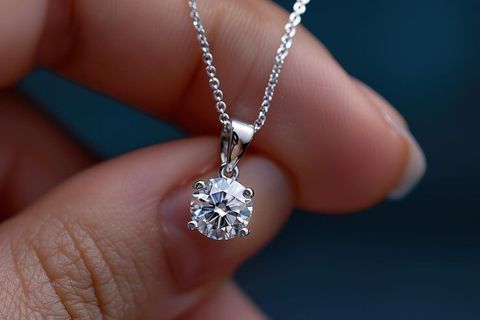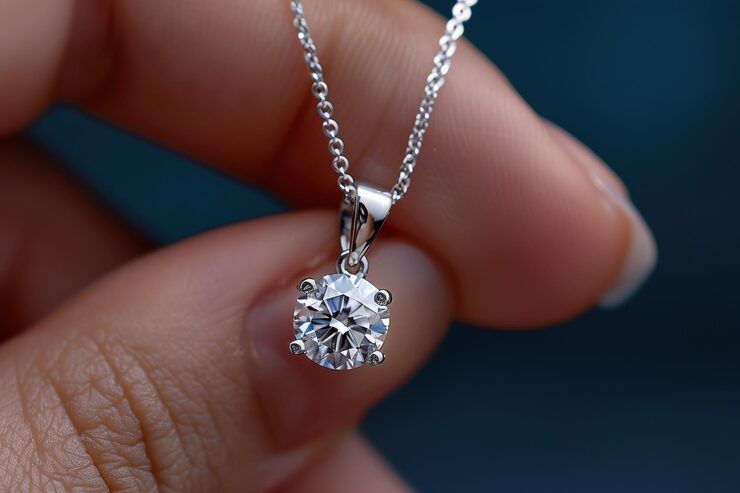
Solitaire pendants are a classic category of fine jewelry featuring a single prominent gemstone suspended from a necklace chain. Diamond solitaire pendants are particularly well known, although the design can also feature sapphires, rubies, emeralds, and other gemstones.
The defining feature is simplicity. Rather than combining several decorative elements, the pendant places visual emphasis on one central stone. Its appearance depends on gemstone shape, setting style, metal composition, chain length, and overall proportions.
Solitaire pendant designs appear in traditional jewelry collections and contemporary fine jewelry. Understanding their construction, gemstone characteristics, and certification standards can help explain how different designs are evaluated.
Understanding Solitaire Pendant Designs
A solitaire pendant generally contains one central gemstone secured in a metal setting. The pendant is attached to a chain through a bail, loop, or integrated mounting.
The design may appear minimal, but several technical elements influence its durability and appearance.
The main components include:
Center gemstone: The primary decorative element, commonly a diamond.
Setting: The metal structure holding the gemstone.
Bail: A component connecting the pendant to the chain.
Chain: The necklace supporting the pendant.
Clasp: The fastening mechanism.
Metal alloy: The material forming the pendant mounting.
Some modern designs use concealed attachments to create the appearance of a floating gemstone.
Common Solitaire Pendant Styles
Solitaire pendants are available in several configurations.
Prong setting: Metal prongs secure the gemstone while leaving much of its surface visible.
Bezel setting: A metal rim surrounds the gemstone's edge, providing a smooth profile and additional protection.
Halo-inspired solitaire design: A prominent center gemstone is surrounded by smaller decorative stones. Although commonly grouped with solitaire-inspired jewelry, this is not technically a single-stone design.
Floating pendant: The gemstone appears suspended along the chain through a concealed or integrated mounting.
Minimalist pendant: A compact setting emphasizes the gemstone without elaborate metal decoration.
Each style creates a different balance between gemstone visibility, protection, and visual appearance.
Importance of Solitaire Pendants in Fine Jewelry
Solitaire pendants remain relevant because their design can accommodate different gemstone sizes, shapes, and metal types without relying on complicated decorative structures.
They are also useful examples for understanding how gemstone grading and jewelry construction affect the finished appearance.
Understanding Diamond Quality
Diamond solitaire pendants are commonly evaluated using the four Cs: cut, color, clarity, and carat weight.
These characteristics describe different aspects of a diamond.
Cut: Refers to proportions, symmetry, polish, and light performance.
Color: Describes the degree of body color in diamonds graded within the standard D-to-Z range.
Clarity: Evaluates internal inclusions and external characteristics.
Carat weight: Measures the diamond's mass rather than its visible dimensions.
A diamond's appearance depends on the interaction of these factors. Carat weight alone does not determine brilliance or overall visual quality.
Natural and Laboratory-Grown Diamonds
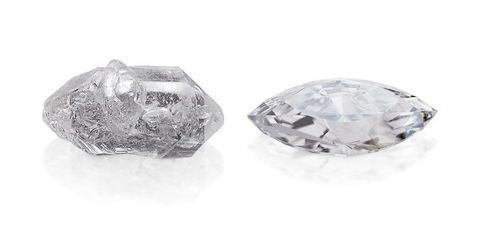
Natural diamonds form through geological processes deep within the Earth. Laboratory-grown diamonds are produced through controlled technological processes, commonly using High Pressure High Temperature (HPHT) or Chemical Vapor Deposition (CVD).
Both types are crystalline carbon and can share essentially the same optical and physical properties.
However, their origins differ, and accurate identification requires appropriate gemological examination.
Precious Metal Selection
Solitaire pendant settings commonly use gold, platinum, or other jewelry metals.
| Metal Type | Main Characteristics | Common Appearance |
|---|---|---|
| 14K Yellow Gold | Gold alloy with relatively high durability | Warm yellow |
| 18K Yellow Gold | Higher gold content than 14K | Rich yellow |
| 14K White Gold | Gold alloy containing whitening metals | Silvery white |
| 18K Rose Gold | Gold alloy containing copper | Pinkish tone |
| Platinum | Dense precious metal with strong corrosion resistance | Naturally white |
Metal choice influences appearance, weight, maintenance requirements, and the structural design of the setting.
Recent Developments in Solitaire Pendant Jewelry
During 2025 and 2026, the fine jewelry industry continued exploring laboratory-grown diamonds, gemstone traceability, minimalist designs, and improved manufacturing technology.
Laboratory-Grown Diamond Developments
Laboratory-grown diamonds have become an established category within the wider diamond jewelry industry.
Modern HPHT and CVD production methods allow manufacturers to create gem-quality diamonds under controlled conditions.
During 2025, the Gemological Institute of America announced changes to its approach to describing laboratory-grown diamonds, moving toward broader quality categories rather than continuing to use the same grading terminology applied to natural diamonds.
This development reflects the importance of distinguishing natural and laboratory-grown stones within jewelry documentation.
Minimalist Jewelry Trends
Minimalist fine jewelry remained visible in 2025 and 2026 collections, including small diamond pendants, delicate chains, bezel settings, and understated gemstone designs.
These styles emphasize proportion and versatility rather than elaborate ornamentation.
The trend also reflects interest in jewelry that can be combined with different clothing styles and layered necklace arrangements.
Digital Jewelry Manufacturing
Computer-aided design and precision manufacturing continue to influence pendant production.
Three-dimensional modeling allows designers to examine gemstone placement, prong geometry, chain connections, and metal thickness before manufacturing.
Computer-aided manufacturing and casting technologies can improve consistency, although finished jewelry still requires inspection and quality control.
Gemstone Traceability
The diamond industry continues to discuss traceability, origin documentation, and responsible sourcing.
Digital records and identification technologies can help document parts of a gemstone's journey through the supply chain.
However, the availability and completeness of traceability information vary between manufacturers and individual stones.
Laws, Regulations, and Jewelry Standards
Solitaire pendant jewelry is affected by consumer protection rules, gemstone disclosure requirements, precious metal standards, and international trade regulations.
United States Jewelry Guidelines
In the United States, the Federal Trade Commission publishes Jewelry Guides addressing descriptions of diamonds, gemstones, precious metals, and jewelry products.
The guidelines emphasize accurate disclosure of material characteristics and treatments.
Laboratory-grown diamonds must be clearly distinguished from natural diamonds through appropriate terminology.
Precious Metal Hallmarking
Hallmarking systems help identify the declared purity of precious metals.
Different countries maintain their own legal frameworks for precious metal marking.
In the United Kingdom, the Hallmarking Act 1973 establishes requirements for hallmarking qualifying precious metal articles, subject to applicable exemptions.
India also operates a hallmarking framework administered through the Bureau of Indian Standards.
Diamond Certification and Grading
Independent gemological laboratories examine diamonds and issue grading reports describing their characteristics.
Organizations such as the Gemological Institute of America and International Gemological Institute provide gemstone examination and identification information.
A grading report describes the examined stone. It does not independently guarantee the quality of the pendant's chain, clasp, or mounting.
Responsible Diamond Sourcing
The Kimberley Process Certification Scheme is an international framework addressing trade in rough diamonds associated with conflict financing.
It applies to participating jurisdictions and the international trade in rough diamonds, rather than functioning as a complete certification of every finished jewelry item.
Additional sourcing information may be available through manufacturers and supply-chain documentation.
Tools and Resources for Solitaire Pendant Evaluation
Several technical resources can help explain gemstone characteristics and jewelry construction.
Gemological Research Resources
The Gemological Institute of America provides educational information about diamond grading, gemstone identification, and the four Cs.
The International Gemological Institute publishes information about diamond identification, grading reports, and laboratory-grown diamonds.
These resources can help readers understand the terminology commonly found in gemstone documentation.
Diamond Grading Reports
A diamond grading report may contain:
Carat weight
Color grade
Clarity grade
Cut information, where applicable
Measurements
Proportions
Fluorescence observations
Identification characteristics
Report reference number
The available information depends on the laboratory, report type, and gemstone category.
Pendant Design Comparison
| Feature | Evaluation Consideration |
|---|---|
| Gemstone shape | Round, oval, pear, princess, or other cuts |
| Setting type | Prong, bezel, or integrated mounting |
| Metal | Gold, platinum, or another suitable alloy |
| Chain length | Position of the pendant on the neckline |
| Gemstone documentation | Identification and grading information |
| Clasp | Fastening mechanism and security |
| Pendant construction | Balance, attachment, and durability |
Jewelry Measurement Tools
A jewelry measurement guide can help explain chain length, pendant dimensions, and gemstone proportions.
Digital jewelry design software can also assist manufacturers with three-dimensional modeling and technical drawings.
Professional gemological instruments are used to examine gemstone characteristics that cannot be reliably identified through ordinary visual inspection.
Frequently Asked Questions
What is a solitaire pendant?
A solitaire pendant is a necklace design featuring one prominent gemstone, usually mounted in a relatively simple setting. Diamonds are common, but other gemstones can also be used.
What is the difference between a natural diamond and a laboratory-grown diamond?
Natural diamonds form through geological processes, while laboratory-grown diamonds are produced using controlled manufacturing methods. Both consist of crystalline carbon, but their origins differ and should be accurately disclosed.
Which setting is commonly used for diamond solitaire pendants?
Prong and bezel settings are among the most common. Prongs expose more of the gemstone, while bezel settings surround its edge with metal. The appropriate design depends on appearance, gemstone shape, and protection requirements.
Does a higher carat weight always mean greater brilliance?
No. Carat weight measures mass, while brilliance is strongly influenced by cut quality, proportions, and light interaction. Two diamonds with similar weights may appear different because of their cutting characteristics.
How should a solitaire pendant be maintained?
A pendant should be inspected periodically for loose stones, worn prongs, damaged clasps, or chain weakness. Gentle cleaning methods appropriate for the gemstone and metal can help maintain its appearance. Some gemstones require additional care because they are sensitive to chemicals, heat, or ultrasonic cleaning.
Conclusion
Solitaire pendants demonstrate how a simple jewelry design can involve several important technical considerations. Gemstone quality, setting construction, metal composition, chain design, and documentation all contribute to the finished piece.
Developments during 2025 and 2026 have highlighted laboratory-grown diamonds, minimalist jewelry, digital manufacturing, and greater attention to gemstone traceability.
Regulatory frameworks and gemological standards also play an important role in distinguishing gemstone origins, describing precious metals, and supporting accurate product information.
Understanding these elements provides a broader perspective on solitaire pendant jewelry, from traditional diamond designs to contemporary manufacturing methods and responsible material documentation.