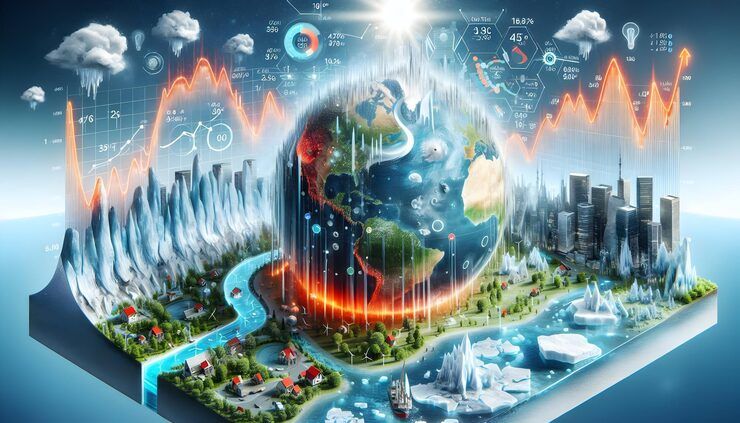
Global climate targets are commitments made by countries and international organizations to limit global warming, reduce greenhouse gas emissions, and prepare for climate-related risks. These targets exist because human activities, including burning fossil fuels, deforestation, agriculture, and industrial production, increase the concentration of heat-trapping gases in the atmosphere.
Real-world emissions data measures the greenhouse gases actually released into the atmosphere over a particular period. Comparing this data with climate targets helps determine whether countries and the global economy are reducing emissions quickly enough to meet their stated objectives.
What Are Climate Targets?
Climate targets establish specific environmental goals for governments, industries, and economies. They may focus on reducing emissions by a particular year, increasing renewable energy generation, improving energy efficiency, or achieving net-zero emissions.
The 2015 Paris Agreement established an international framework for limiting global temperature increases. Its central temperature goal is to hold warming well below 2°C above pre-industrial levels while pursuing efforts to limit it to 1.5°C.
Countries communicate their climate commitments through nationally determined contributions, commonly called NDCs. These plans describe intended actions to reduce emissions and, in many cases, strengthen resilience to climate change.
What Does Real-World Emissions Data Show?
Emissions data provides a measurable picture of progress. It includes carbon dioxide (CO₂), methane (CH₄), nitrous oxide (N₂O), and other greenhouse gases.
Different measurements are important:
Annual emissions: Greenhouse gases released during a particular year.
Cumulative emissions: Total emissions accumulated over multiple years.
Carbon intensity: Emissions produced per unit of economic output or energy.
Net emissions: Emissions remaining after accounting for qualifying removals.
Per-capita emissions: Emissions divided by a population's size.
These measurements answer different questions. A country can reduce emissions per unit of economic output while its total emissions continue to increase. Similarly, annual emissions can decline without falling quickly enough to achieve a long-term climate target.
Why Comparing Climate Targets With Emissions Matters
Climate targets describe intended outcomes, while emissions data shows what is happening in practice. Comparing the two helps policymakers, researchers, businesses, and communities identify gaps between commitments and actual progress.
Understanding the Global Emissions Gap
The emissions gap is the difference between projected global greenhouse gas emissions under current policies or commitments and the lower emissions levels associated with particular temperature goals.
When emissions remain above the levels required by a climate pathway, more substantial reductions may be necessary in subsequent years. Delayed action can increase the difficulty of reducing emissions because infrastructure, energy systems, and industrial processes often operate for decades.
Who Is Affected?
Climate progress affects countries and communities differently.
Governments: Use emissions inventories to assess national targets and develop environmental policies.
Businesses and manufacturers: Evaluate energy use, industrial emissions, and transition risks.
Investors and financial institutions: Examine climate-related risks and corporate emissions disclosures.
Researchers: Compare observed trends with climate models and temperature pathways.
Households and communities: Experience the effects of extreme heat, changing rainfall, air pollution, and other environmental pressures.
Why Different Emissions Measurements Matter
Measurement | What it explains | Main limitation |
|---|---|---|
Annual emissions | Current emissions levels | Does not show historical accumulation |
Cumulative emissions | Long-term contribution to warming | Requires consistent historical data |
Per-capita emissions | Average emissions per person | Hides differences within populations |
Carbon intensity | Emissions relative to economic output | Can improve while total emissions rise |
Net emissions | Emissions after qualifying removals | Depends on how removals are measured |
A balanced assessment should examine several indicators rather than relying on a single headline figure.
Recent Updates in Global Climate Targets and Emissions
Climate assessments published during 2025 and 2026 highlight a continuing gap between international climate ambitions and measured emissions trends.
Global Emissions Trends in 2025
The Global Carbon Budget 2025, published in November 2025, projected fossil fuel and industrial carbon dioxide emissions at approximately 38.1 billion tonnes for the year, an increase of about 1.1% compared with 2024. Total CO₂ emissions, including land-use changes, were projected at approximately 42.2 billion tonnes.
These figures show that growth in fossil fuel emissions continued despite the expansion of renewable energy in many regions. Changes in emissions from deforestation and other land-use activities also influenced the overall total.
Climate Projections Published in 2026
The United Nations Environment Programme published its Emissions Gap Report 2026 in October 2026. The assessment examined the additional reductions needed to limit the duration and extent of a potential temperature overshoot above 1.5°C.
Its lowest-possible-overshoot pathway indicates that global greenhouse gas emissions would need to decline by approximately:
18% by 2030 compared with 2025 levels.
45% by 2035 compared with 2025 levels.
69% by 2040 compared with 2025 levels.
These figures describe a demanding pathway rather than a forecast of reductions that are already occurring. They demonstrate the scale of action required to return global temperatures to 1.5°C by the end of the century under the report's scenario.
Temperature Records and Climate Indicators
The World Meteorological Organization reported in March 2026 that 2015–2025 were the eleven warmest years in the observational record. The year 2025 was approximately 1.43°C warmer than the 1850–1900 average.
Annual temperature figures can vary because of natural climate variability, but long-term warming is primarily driven by human-caused greenhouse gas emissions. Temperature observations and emissions inventories therefore provide complementary information about climate progress.
Laws and Policies Affecting Global Climate Targets
International climate targets operate through agreements, national legislation, government programs, and sector-specific regulations. The legal status and implementation methods differ between countries.
The Paris Agreement
Adopted in 2015, the Paris Agreement requires participating countries to prepare and communicate nationally determined contributions and pursue domestic measures aimed at achieving their climate commitments.
Countries are expected to update their NDCs periodically, with successive contributions representing progression and reflecting their highest possible ambition. The agreement also establishes transparency arrangements for reporting emissions and tracking progress.
National Climate Policies
Governments use several policy approaches to reduce greenhouse gas emissions:
Renewable energy targets and clean electricity standards.
Energy efficiency requirements for buildings, appliances, and industrial facilities.
Vehicle emissions standards and transport electrification policies.
Carbon pricing mechanisms and emissions trading systems.
Forest protection, ecosystem restoration, and land-use measures.
Climate reporting and emissions disclosure requirements.
The effectiveness of these policies depends on their design, implementation, enforcement, and coverage.
Climate Policy in India
India's climate framework includes its updated NDC, the goal of achieving net-zero emissions by 2070, renewable energy expansion, energy efficiency initiatives, and the National Action Plan on Climate Change.
India's updated NDC includes a target to reduce the emissions intensity of its GDP by 45% from the 2005 level by 2030. It also includes a goal of achieving approximately 50% cumulative installed electric power capacity from non-fossil fuel-based energy resources by 2030, subject to the conditions stated in its commitment.
These targets use different measurements. Emissions intensity measures emissions relative to economic output, while installed capacity describes the maximum rated power generation capability. Neither measure alone establishes whether total annual greenhouse gas emissions have declined.
Tools and Resources for Climate Data Analysis
Reliable climate assessment requires consistent datasets, transparent assumptions, and clear distinctions between historical observations and future projections.
Useful Climate Monitoring Tools
Global Carbon Budget: Provides estimates of global and national CO₂ emissions, carbon sinks, and carbon budget trends.
Climate Watch: Supports comparisons of country-level greenhouse gas emissions, climate commitments, and policy indicators.
Our World in Data: Presents historical emissions data, per-capita comparisons, and interactive charts.
Climate Action Tracker: Assesses government climate targets and policies against global temperature goals.
IPCC assessment reports: Summarize scientific evidence on climate change, emissions pathways, impacts, and mitigation.
Greenhouse gas calculators: Estimate emissions associated with electricity use, transport, buildings, and organizational activities.
Example of a Climate Target Comparison
The following table illustrates how common targets and measurements should be interpreted.
Indicator | Reference point | What it measures |
|---|---|---|
Paris Agreement | Pre-industrial temperature levels | Long-term global warming objectives |
India's emissions intensity target | 2005 GDP emissions intensity | Emissions relative to economic output |
India's net-zero goal | 2070 | Long-term balance between emissions and removals |
Global emissions inventory | Annual reporting period | Estimated greenhouse gases released |
Climate pathway | Defined baseline year | Emissions reductions needed to meet a temperature objective |
When comparing figures, check the baseline year, gases included, geographical coverage, accounting methods, and whether the value is measured, estimated, or projected.
Frequently Asked Questions
What is the difference between a climate target and an emissions target?
A climate target describes a desired environmental outcome, such as limiting global warming. An emissions target specifies a reduction in greenhouse gases by a certain date or relative to a baseline year.
Are global greenhouse gas emissions declining?
Not consistently across all gases and sectors. Fossil fuel CO₂ emissions reached a projected record high in 2025, according to the Global Carbon Budget 2025. Some countries and sectors have achieved reductions, but global progress remains insufficient for the most ambitious temperature pathways.
Why do countries use different baseline years?
Baseline years reflect national circumstances, historical data availability, and the design of particular commitments. Comparing targets requires adjusting for these differences rather than treating all percentage reductions as equivalent.
Can renewable energy expansion achieve climate targets alone?
Renewable energy can substantially reduce emissions from electricity generation, but climate goals also require progress in transport, industry, buildings, agriculture, land use, and other sectors. Energy storage, grid improvements, and energy efficiency can also play important roles.
How can real-world emissions progress be measured?
Progress can be evaluated using national greenhouse gas inventories, energy statistics, atmospheric measurements, and sector-level reporting. Researchers compare these observations with climate targets and modelled pathways to determine whether reductions are sufficient.
Conclusion
Comparing global climate targets with real-world emissions data reveals the difference between international commitments and measurable environmental progress. Although renewable energy deployment and climate policies have advanced, global fossil fuel emissions and greenhouse gas concentrations remain major challenges.
Recent assessments from 2025 and 2026 indicate that significantly faster emissions reductions are necessary to limit long-term warming and reduce climate risks. Understanding baseline years, emissions intensity, cumulative emissions, and temperature pathways helps readers interpret climate statistics accurately.
Ultimately, meaningful climate progress depends on measurable reductions, transparent reporting, effective national policies, and sustained international cooperation. Regularly comparing commitments with verified emissions data is essential for evaluating whether current actions are sufficient to achieve global climate objectives.