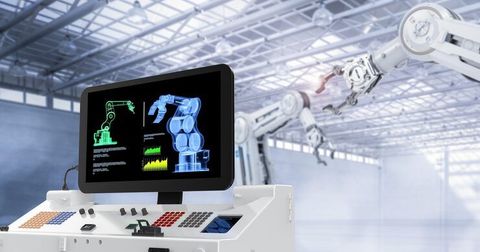
Object recognition using vision sensors is a technology that enables machines to identify, locate, and distinguish objects using images or visual information. It combines cameras, image processing software, artificial intelligence (AI), and machine vision algorithms to interpret what a camera observes. These systems can recognize shapes, colors, patterns, surface features, and other visual characteristics.
Vision-based object recognition is an important part of modern industrial automation, robotics, smart manufacturing, and computer vision. It helps automated equipment understand its surroundings and make decisions based on visual information rather than relying entirely on manual inspection or fixed mechanical sensors.
For example, a production line may use a vision sensor to identify different components moving along a conveyor belt. A robotic arm can then select the correct component, place it in a designated position, or direct it to another stage of production.
How Vision Sensors Recognize Objects
A typical object recognition system follows several stages. First, a camera captures an image. The system then processes the image to improve its quality, identify relevant features, and determine which objects are present.
Depending on the application, recognition software may use traditional image processing, machine learning, or deep learning models.
The main steps generally include:
Image acquisition: A camera captures images or video of the surrounding environment.
Image preprocessing: Software adjusts brightness, contrast, or noise levels to improve image quality.
Feature extraction: The system identifies useful visual characteristics, such as edges, textures, shapes, or patterns.
Object detection: Algorithms locate objects within an image and may draw bounding boxes around them.
Object classification: The system assigns recognized objects to categories, such as metal components, packages, or electronic parts.
Position estimation: Some systems calculate an object's location and orientation for robotic handling or measurement.
Decision-making: The system sends information to a controller or another application to determine the next action.
Not every vision sensor performs all these steps. Some industrial sensors provide simple pattern matching, while advanced vision systems can recognize multiple objects in complex environments.
Common Types of Vision Sensors
Different vision sensors are designed for different inspection and automation requirements.
2D vision sensors: Analyze flat images to identify shapes, labels, colors, and surface features.
3D vision sensors: Estimate depth, dimensions, and spatial position using techniques such as stereo imaging or structured light.
Smart cameras: Combine image capture and processing within a single device.
Industrial machine vision cameras: Capture images for detailed inspection, measurement, and automated analysis.
Depth cameras: Estimate the distance between the camera and objects in a scene.
Multispectral imaging systems: Capture information across selected wavelength bands for specialized identification tasks.
The appropriate sensor depends on the object's size, speed, material, lighting conditions, required accuracy, and operating environment.
Importance of Object Recognition in Modern Industry
Object recognition technology helps businesses improve product quality, automate repetitive tasks, and manage complex manufacturing processes. By identifying objects consistently, vision systems can reduce dependence on manual visual inspection and support faster decision-making.
Applications Across Different Industries
Object recognition using vision sensors is used in a wide range of industrial and commercial environments.
Automotive manufacturing: Identifies vehicle components, checks assembly positions, and supports robotic part handling.
Electronics manufacturing: Detects missing components, incorrect placements, and visible defects on circuit boards.
Food processing: Recognizes products by shape, color, size, or surface characteristics during sorting and packaging.
Warehousing and logistics: Identifies packages, reads labels, and helps determine the position of items for automated picking.
Pharmaceutical manufacturing: Supports packaging inspection, label verification, and identification of selected products.
Agriculture: Helps distinguish crops, identify weeds, assess fruit maturity, and guide automated harvesting equipment.
Medical imaging: Computer vision algorithms can identify patterns in medical images to support qualified healthcare professionals.
Benefits and Practical Limitations
Vision-based recognition can improve inspection consistency, reduce some forms of human error, and help robots adapt to changing object positions. However, performance depends on image quality, training data, sensor capabilities, and the complexity of the environment.
Common challenges include:
Poor lighting, reflections, shadows, and motion blur.
Objects that look similar or partially overlap.
Changes in object appearance, color, or orientation.
Dust, vibration, and temperature variations in industrial environments.
Incorrect predictions when AI models encounter unfamiliar objects.
Processing delays that affect fast-moving production lines.
A reliable implementation should include testing under realistic conditions, ongoing performance monitoring, and a process for handling uncertain or incorrect predictions.
Recent Developments in Vision Sensors and AI
During 2025 and 2026, industrial machine vision continued to develop through advances in AI-powered image analysis, 3D perception, edge computing, and easier-to-configure vision software.
AI-Powered Object Detection
Deep learning models can identify objects using learned visual patterns rather than relying exclusively on manually defined rules. This can be useful when objects vary in appearance or when defects are difficult to describe with simple geometric measurements.
In October 2026, industry discussions around machine vision highlighted AI-assisted development, 3D imaging, robotic perception, and simulation-based system evaluation as important areas of progress.
Emerging applications include:
Recognizing multiple object categories within one image.
Detecting unusual products or unexpected visual patterns.
Improving robotic guidance when objects are positioned irregularly.
Using simulated images to help test vision applications before deployment.
Simplifying model configuration through more accessible development tools.
These developments do not guarantee accurate recognition in every environment. Model performance must be validated using representative images and realistic operating conditions.
Growth of Edge AI and 3D Vision
Edge AI processes image data close to the camera or machine rather than relying entirely on a remote server. This can reduce communication delays and allow some applications to continue operating when network connectivity is interrupted.
Three-dimensional vision systems provide depth information that ordinary 2D images cannot directly supply. This is useful for robotic picking, bin picking, dimensional measurement, and locating objects with different orientations.
Technology | Main capability | Example application |
|---|---|---|
AI object detection | Identifies and locates objects | Package recognition |
Edge AI vision | Processes images near the sensor | Real-time inspection |
3D machine vision | Estimates depth and spatial position | Robotic bin picking |
Multispectral vision | Captures selected wavelength bands | Agricultural analysis |
Vision-language models | Connects visual information with language-based instructions | Flexible scene interpretation |
The suitability of each approach depends on accuracy requirements, computing resources, response time, and environmental conditions.
Laws, Standards, and Policies Affecting Vision Sensors
Object recognition systems may be subject to rules concerning machinery safety, personal data, workplace monitoring, and product quality. The applicable requirements depend on how the system is used and where it operates.
Regulations and Standards in India
Digital Personal Data Protection Act, 2023: This legislation establishes a framework for processing digital personal data. The Digital Personal Data Protection Rules were notified in November 2025, with implementation occurring in phases. Vision systems that capture identifiable people or process personal data should be assessed against applicable privacy and data protection requirements.
Industrial machinery safety: Vision sensors used with industrial robots must be considered as part of the complete machine's safety design. ISO 10218-1:2025 addresses industrial robot safety, while ISO 10218-2:2025 covers the integration and safety of industrial robot applications.
Workplace and operational safety: Facilities should assess risks associated with moving machinery, robotic arms, unexpected movement, and human interaction. Ordinary object recognition should not be assumed to provide a safety-rated protective function.
Quality and industry requirements: Manufacturers may need to follow relevant product standards, inspection procedures, and sector-specific requirements. Compliance depends on the application rather than the presence of a camera alone.
Organizations should review current regulations and technical standards before deploying systems that monitor people, control machinery, or make consequential decisions.
Tools and Resources for Object Recognition
Developers, engineers, and researchers can use several tools to build, evaluate, and maintain computer vision applications.
Common Development Tools
OpenCV: Supports image processing, feature detection, camera calibration, and computer vision applications.
TensorFlow: Provides machine learning tools for training and deploying image recognition models.
PyTorch: Supports deep learning development, experimentation, and object detection models.
Ultralytics YOLO: Provides widely used model architectures and workflows for object detection and related vision tasks.
Roboflow: Supports dataset preparation, image annotation, and computer vision model development.
3D camera calibration tools: Help establish the relationship between camera coordinates and real-world measurements.
Useful project resources also include image annotation templates, model evaluation reports, lighting assessment checklists, camera calibration records, and sensor maintenance logs.
Performance Measurements
Vision systems should be evaluated using measurable indicators rather than relying on demonstrations alone.
Metric | What it measures |
|---|---|
Precision | How many predicted detections are correct |
Recall | How many relevant objects are detected |
Mean average precision (mAP) | Overall object detection performance across defined evaluation conditions |
Inference time | Time taken to process an image |
Frame rate | Number of images processed per second |
False detection rate | Frequency of incorrect object detections |
The importance of each metric depends on the application. A fast warehouse robot may prioritize low processing delay, while a quality inspection system may prioritize reliable detection of small defects.
Frequently Asked Questions
What is object recognition using vision sensors?
It is a process in which cameras and computer vision algorithms identify objects from images or video. The system may classify objects, locate them, estimate their dimensions, or determine their orientation.
What is the difference between object detection and object recognition?
Object detection identifies the location of objects within an image, often using bounding boxes. Object recognition is a broader term that includes identifying or classifying objects. Some systems perform both functions simultaneously.
Can vision sensors recognize objects in real time?
Yes. Many systems can process images in real time when the camera, software, and computing hardware are appropriately configured. Performance depends on image resolution, model complexity, processing capacity, and the number of objects being analyzed.
Are 3D vision sensors better than 2D cameras?
Not in every situation. A 2D camera may be sufficient for reading labels or identifying colors, while a 3D sensor is useful when depth, height, or spatial positioning matters. The appropriate choice depends on the task and required accuracy.
What factors affect object recognition accuracy?
Lighting, camera position, image resolution, object overlap, motion blur, training data quality, and differences between testing and operating environments can all affect accuracy. Regular testing and monitoring help identify performance problems.
Conclusion
Object recognition using vision sensors is an important technology in industrial automation, robotics, quality inspection, logistics, agriculture, and other fields. By combining cameras with image processing and artificial intelligence, these systems can identify objects and provide information for automated decisions.
Advances in edge AI, 3D vision, and deep learning are expanding the range of applications. However, successful implementation requires suitable sensor selection, reliable data, realistic performance testing, and attention to safety and privacy requirements.
A well-designed vision system should be evaluated according to its intended purpose, operating environment, accuracy requirements, and response time. These considerations help organizations use object recognition technology responsibly and effectively.