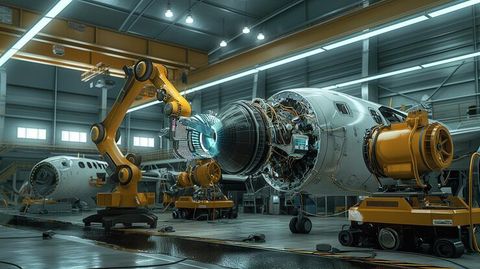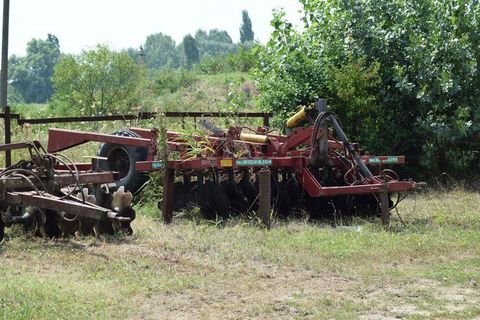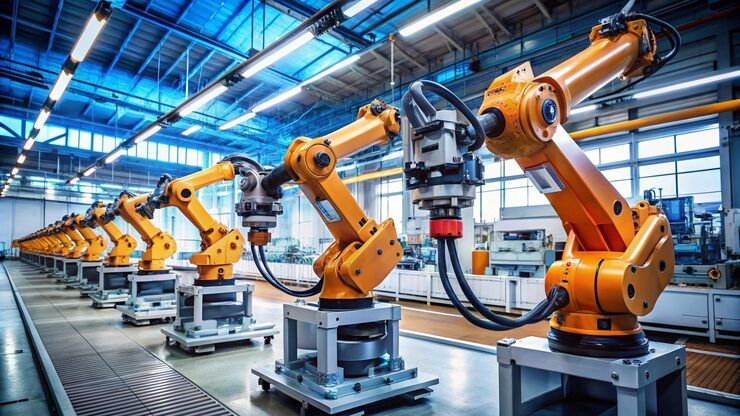
Machines, robotics, and industrial automation are closely connected technologies that help industries perform manufacturing, inspection, material handling, packaging, and other repetitive operations. They combine mechanical equipment, electronic controls, sensors, software, and computer systems to improve consistency and manage complex industrial processes.
Traditional machinery often performs a specific mechanical task, while robotics introduces programmable movement and the ability to handle different operations. Industrial automation connects machines and controls so that processes can operate with limited manual intervention.
Modern manufacturing facilities may use individual automated machines or integrated production lines containing robotic arms, conveyors, machine vision systems, sensors, and centralized control platforms. The appropriate configuration depends on production requirements, product complexity, operating conditions, and safety considerations.
Understanding Industrial Automation Technology
Industrial automation refers to the use of control systems and equipment to operate industrial processes. These systems may control temperature, pressure, speed, position, material flow, and production sequences.
Several technologies work together in an automated facility:
Industrial machinery: Performs physical operations such as cutting, molding, assembly, and packaging.
Robotic systems: Carry out programmable movements, material handling, welding, inspection, or assembly.
Programmable logic controllers (PLCs): Execute control logic for machines and production equipment.
Human-machine interfaces (HMIs): Allow operators to monitor equipment and interact with control systems.
Sensors and actuators: Measure physical conditions and initiate mechanical or electrical actions.
Machine vision: Uses cameras and image-processing software to inspect products or guide robotic movement.
Industrial networks: Connect equipment, controllers, monitoring platforms, and production systems.
These components can function independently or as part of an integrated manufacturing system.
Common Types of Industrial Robots
Different robot designs are suited to different tasks.
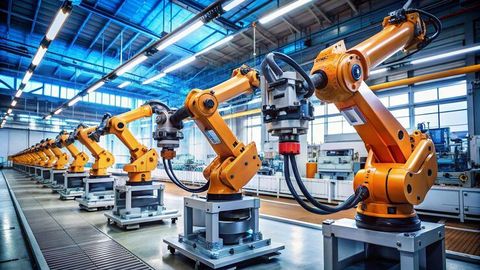
Articulated robots use multiple rotary joints and are commonly found in welding, painting, assembly, and material handling.
Cartesian robots move along linear axes and are useful for precise positioning, machine loading, and certain packaging operations.
SCARA robots are often used for high-speed assembly and pick-and-place operations.
Collaborative robots, commonly called cobots, are designed for applications in which people and robots may work in shared spaces under suitable safety measures.
Autonomous mobile robots (AMRs) transport materials through facilities using onboard sensors, navigation software, and mapping systems.
The choice of robot depends on payload, reach, speed, precision, environmental conditions, and the complexity of the intended task.
How an Automated Production System Works
A typical industrial automation system follows a connected sequence.
Sensors collect information about machine conditions or product position. A controller processes the information according to its programmed logic and sends commands to motors, valves, robotic joints, or other actuators.
The equipment then performs the required operation. Feedback from sensors helps the control system monitor whether the process is operating within defined parameters.
For example, an automated packaging line may identify a product using a sensor, position it on a conveyor, fill or seal its container, inspect the result with a camera, and direct the finished item toward the appropriate packaging area.
Why Industrial Automation Matters
Industrial automation has become important because manufacturers must manage production quality, operational consistency, equipment utilization, workplace risks, and changing production requirements.
Productivity and Process Consistency
Automated equipment can perform repetitive tasks at consistent speeds and follow defined operating parameters. This can reduce variation in suitable processes and help manufacturers monitor output more systematically.
However, automation does not eliminate every production problem. Equipment downtime, incorrect programming, sensor faults, material variation, and poor system integration can still affect results.
Quality Control
Machine vision, precision sensors, and automated measurement systems can inspect products during production.
Potential applications include:
Detecting surface defects
Measuring component dimensions
Checking labels and packaging
Verifying assembly positions
Identifying missing components
Monitoring process temperatures
Recording production measurements
Automated inspection can process large numbers of items, but its effectiveness depends on camera quality, lighting, calibration, training data, and inspection requirements.
Workplace Safety
Robots can handle certain hazardous or physically demanding tasks, including repetitive lifting, exposure to high temperatures, and operations involving potentially dangerous machinery.
Nevertheless, automated equipment introduces its own risks, such as unexpected movement, crushing hazards, electrical exposure, and maintenance-related accidents. Appropriate guarding, risk assessments, and safety controls remain essential.
Predictive Maintenance
Industrial sensors can monitor vibration, temperature, current, pressure, and other equipment characteristics. Software can analyze these measurements to identify unusual operating patterns that may indicate developing faults.
Predictive maintenance can support maintenance planning, but predictions require reliable data and appropriate interpretation. It does not guarantee that every equipment failure will be detected in advance.
Recent Developments in Industrial Automation
Developments during 2025 and 2026 have emphasized physical artificial intelligence, autonomous robots, digital twins, and more connected manufacturing systems.
Industrial Robotics and Artificial Intelligence
On March 6, 2025, NVIDIA announced new technologies and partnerships supporting physical AI, including systems intended to help developers simulate, train, and deploy robots in industrial environments.
These technologies combine AI models, simulation environments, and robotics software. They are intended to improve how robots perceive surroundings, understand instructions, and respond to changing conditions.
Industrial applications still require testing, validation, and safeguards before AI-enabled robots can be used reliably in production.
Smart Manufacturing and Digital Twins
Digital twins are virtual representations of physical machines, production lines, or entire facilities. They can combine engineering models with operational data to simulate performance, evaluate process changes, and investigate possible faults.
During 2025 and 2026, digital-twin platforms and AI-assisted engineering tools continued to develop as manufacturers explored ways to connect design, simulation, production, and maintenance.
The accuracy of a digital twin depends on the quality of its underlying models and data. A simulation should not automatically be treated as a perfect representation of real operating conditions.
Human-Robot Collaboration
Collaborative robotics remains an important area of industrial development. Cobots can be programmed for tasks such as assembly, machine tending, inspection, and material handling.
Newer systems increasingly incorporate improved sensors, vision capabilities, and simplified programming interfaces. However, collaboration does not mean that a robot is inherently safe around people. Each application requires an appropriate risk assessment and safety measures.
Energy and Resource Efficiency
Industrial automation is also being used to monitor electricity consumption, compressed-air systems, material waste, and production efficiency.
Connected sensors and energy-management software can help identify inefficient operating patterns. Actual improvements depend on equipment condition, process design, operating schedules, and the quality of the data collected.
Laws, Policies, and Industrial Safety Standards
Industrial automation is affected by workplace safety legislation, machinery regulations, electrical requirements, cybersecurity considerations, and standards for robot integration. Exact legal obligations depend on the country, industry, and type of installation.
United States Machinery and Workplace Safety
In the United States, the Occupational Safety and Health Administration (OSHA) establishes workplace safety requirements relevant to industrial machinery, machine guarding, hazardous energy control, and workplace operations.
Employers must evaluate applicable requirements for their equipment and processes. Lockout/tagout procedures are particularly important when machinery is inspected, cleaned, repaired, or maintained.
The National Institute for Occupational Safety and Health (NIOSH) also publishes research and guidance on industrial robot safety and workplace risk reduction.
International Robotics Standards
Several international standards provide guidance for industrial robot safety and integration.
ISO 10218: Addresses safety requirements for industrial robots and their integration.
ISO/TS 15066: Provides additional guidance relevant to collaborative industrial robot applications.
IEC 60204-1: Covers electrical equipment of machines.
ISO 13849-1: Addresses safety-related parts of control systems.
Standards may be adopted or referenced differently across jurisdictions. Organizations should verify the current editions and the standards applicable to their installation.
India's Manufacturing and Safety Framework
In India, industrial facilities must consider applicable occupational safety, electrical safety, environmental, and factory-related requirements. The precise obligations depend on the industry, location, equipment, and current legislation.
Manufacturers introducing robotic systems should assess machine guarding, emergency stops, electrical isolation, worker training, maintenance procedures, and emergency response arrangements.
Tools and Resources for Industrial Automation
Technical resources can help engineers, manufacturers, students, and facility managers understand automation systems and evaluate possible applications.
Engineering and Programming Tools
Common resources include:
PLC programming environments: Used to develop and test machine-control logic.
Robot simulation software: Helps evaluate reach, movement, cycle times, and collision risks.
CAD software: Supports mechanical design and equipment layout.
Machine vision software: Processes camera images for inspection and robot guidance.
SCADA platforms: Monitor and control industrial processes.
Manufacturing execution systems (MES): Track production activities, work orders, and process information.
Predictive maintenance platforms: Analyze equipment condition and operational data.
The appropriate software depends on the equipment manufacturer, control architecture, application requirements, and compatibility with existing systems.
Industrial Automation Evaluation Table
| Evaluation Factor | What to Assess |
|---|---|
| Production requirements | Output volume and operating schedule |
| Robot capability | Payload, reach, speed, and precision |
| Integration | Compatibility with existing equipment |
| Safety | Risk assessment and protective systems |
| Maintenance | Spare parts, diagnostics, and inspection needs |
| Energy consumption | Electricity and compressed-air requirements |
| Data management | Monitoring, reporting, and cybersecurity |
| Workforce training | Programming, operation, and maintenance skills |
Cybersecurity and System Monitoring
Connected industrial systems can introduce cybersecurity risks. Unauthorized access, compromised control devices, and network interruptions can affect production and safety.
Organizations should use appropriate network segmentation, access controls, software updates, backup procedures, and incident-response planning. Industrial cybersecurity frameworks can help facilities structure these activities around their operational risks.
Frequently Asked Questions
What is the difference between robotics and industrial automation?
Robotics focuses on programmable machines that perform physical movements and tasks. Industrial automation is broader and includes robots, controllers, sensors, software, conveyors, and integrated systems that control industrial processes.
Which industries use industrial robotics?
Industrial robots are used in automotive manufacturing, electronics, food processing, pharmaceuticals, metal fabrication, logistics, packaging, and other industries. Their applications depend on production requirements and safety considerations.
Can small manufacturers use automation?
Yes. Smaller facilities may automate individual operations, such as inspection, packaging, or machine loading, without installing a fully automated production line. Suitability depends on process stability, production volume, technical requirements, and available resources.
How does predictive maintenance work?
Predictive maintenance uses sensor measurements and operational data to identify patterns associated with equipment deterioration. Maintenance teams use this information to investigate potential faults and plan interventions before a failure disrupts production.
Are collaborative robots safe to use near people?
Collaborative robots can support applications involving shared workspaces, but safety depends on the complete installation. Risk assessments, suitable protective measures, correct programming, and worker training are necessary.
Conclusion
Machines, robotics, and industrial automation are central technologies in modern manufacturing. They support repetitive production tasks, quality inspection, material handling, equipment monitoring, and increasingly complex industrial processes.
Developments in physical AI, digital twins, collaborative robotics, and predictive maintenance are expanding the ways manufacturers design and operate automated systems. At the same time, effective implementation requires careful engineering, reliable data, cybersecurity controls, workforce training, and compliance with applicable safety requirements.
The most appropriate automation approach depends on the specific process rather than the novelty of the technology. Evaluating production needs, equipment compatibility, maintenance requirements, safety risks, and measurable performance objectives provides a sound foundation for making informed industrial automation decisions.