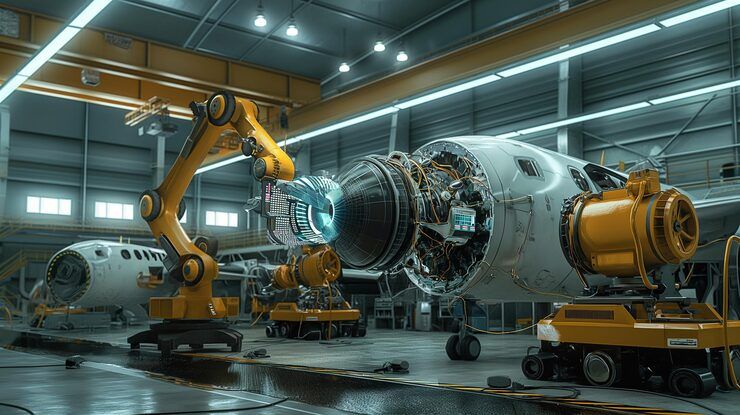
Aircraft fuselage panels form part of the outer structure of an aircraft. These panels must meet demanding requirements for strength, weight, dimensional accuracy, fatigue resistance, and surface quality. Manufacturing methods therefore play an important role in aircraft performance, structural integrity, and production efficiency.
For decades, chemical milling has been used to manufacture lightweight aircraft structures. The process removes selected areas of metal through controlled chemical reactions, allowing manufacturers to create thin sections and variable-thickness panels without applying substantial mechanical cutting forces.
Digital machining provides another approach. Computer numerical control (CNC) machines remove material using programmed cutting tools, while computer-aided design (CAD) and computer-aided manufacturing (CAM) software translate engineering designs into precise manufacturing instructions.
Digital machining is gaining importance because it combines programmable material removal with digital measurement, automated inspection, and repeatable production processes. However, it is not replacing chemical milling in every application. The appropriate method depends on panel geometry, alloy characteristics, production volume, certification requirements, and the overall manufacturing process.
How Chemical Milling Works
Chemical milling begins with a metal sheet or plate, often made from an aerospace aluminium alloy. Selected areas are protected with a chemical-resistant masking material, while exposed areas are treated with a controlled etchant.
The chemical reaction gradually removes material from the exposed surfaces. By controlling the masking pattern, exposure time, and processing conditions, manufacturers can create recessed areas and thinner sections.
Common advantages include:
Low mechanical cutting forces
Ability to create broad, shallow recesses
Processing of relatively complex panel contours
Reduced risk of conventional cutting-tool deformation
Suitability for certain thin-sheet structures
Nevertheless, chemical milling requires careful management of chemicals, masking materials, waste streams, etching uniformity, and dimensional tolerances.
How Digital Machining Works
Digital machining uses engineering models and CNC equipment to remove material according to programmed toolpaths.
The manufacturing sequence commonly includes:
Creating or importing a three-dimensional CAD model
Defining material specifications and dimensional tolerances
Generating toolpaths using CAM software
Selecting cutting tools and machining parameters
Securing the workpiece in a suitable fixture
Machining the panel through controlled cutting operations
Inspecting dimensions and surface characteristics
Recording production and quality data
Advanced five-axis CNC systems can move the cutting tool or workpiece along multiple coordinated axes. This capability can help manufacturers machine complex contours, angled features, and integrated structural details with fewer repositioning operations.
Why the Manufacturing Shift Matters
The shift toward digital machining reflects broader changes in aerospace engineering, including greater demand for traceability, repeatable production, complex structural designs, and efficient material utilization.
Precision and Repeatability
Aircraft fuselage panels must fit accurately with adjacent structures, frames, stringers, and fasteners. Small dimensional deviations can complicate assembly or require additional corrective work.
CNC machining uses programmed toolpaths and controlled machine movements to reproduce specified geometry. When supported by suitable fixtures, calibration, tooling, and inspection, it can provide consistent dimensional results across production batches.
Chemical milling can also achieve demanding tolerances, but the final dimensions depend on factors such as etching rate, chemical concentration, temperature, masking accuracy, and exposure duration.
Material Utilization
Material efficiency is particularly important in aerospace manufacturing because large portions of a thick metal blank may be removed to create a lightweight component.
Digital machining can be integrated with near-net-shape blanks, optimized toolpaths, and design strategies that reduce unnecessary stock removal. The actual material savings depend on the starting geometry, machining allowance, and component design.
Chemical milling also reduces selected material thickness, but it removes metal through a chemical process and generates liquid waste that must be managed appropriately.
Design Flexibility
Digital manufacturing makes it easier to modify machining instructions when an approved engineering design changes. Engineers can update CAD models, regenerate toolpaths, and verify revised manufacturing operations before production.
This flexibility is useful when aircraft structures contain complex contours, pockets, variable-thickness sections, or features that require precise alignment.
However, design changes still require the appropriate engineering review, process validation, and production approval. Software flexibility does not remove aerospace certification obligations.
Recent Developments in Aerospace Manufacturing
Digital machining has attracted renewed attention as aircraft manufacturers seek more consistent production methods for large, lightweight structural panels.
Advances in Mirror Milling
On October 5, 2026, aerospace manufacturing company Fives published an industry update describing digital machining technology designed to replace conventional chemical milling for certain large aluminium and composite fuselage panels. The approach uses specialized mirror-milling equipment to machine complex surfaces with coordinated tool movements and support systems. <Cite refs={["turn197407search2","turn197407search12"]}/>
Mirror milling uses controlled machining from one side of a panel while providing support from the opposite side. This arrangement helps manage deflection when working with thin materials.
Fives reported potential production-time reductions of up to 65% and energy-use reductions of up to 50%. These figures are manufacturer-reported potential results, not guaranteed savings across every aircraft program or production facility. Actual outcomes depend on panel design, machine configuration, production conditions, and the existing chemical-milling process.
Increasing Automation and Digital Integration
A 2025 aerospace manufacturing survey from the Royal Aeronautical Society identified CNC machining and robotic manufacturing among the technologies used by aerospace companies. Its results also reflected continuing interest in automation and digital production methods. <Cite refs={["turn197407search13"]}/>
Digital machining can integrate with several technologies:
CAD and CAM software
Automated toolpath generation
In-process measurement
Machine monitoring
Digital production records
Coordinate measuring machines
Manufacturing data analysis
Together, these technologies can improve process visibility and help manufacturers identify deviations before components reach final assembly.
Sustainability and Process Control
Chemical milling requires controlled chemical baths, masking materials, ventilation, waste treatment, and monitoring of process conditions. Mechanical machining reduces reliance on chemical etching for the material-removal stage, although it still requires energy, cutting fluids or other cooling strategies where applicable, and management of metal chips.
The environmental result depends on the full manufacturing process. A meaningful comparison should include electricity use, material waste, chemical handling, tooling, equipment utilization, and downstream finishing requirements.
Aerospace Manufacturing Regulations and Quality Standards
Aircraft structural components are subject to strict design, production, inspection, and traceability requirements. Switching from chemical milling to digital machining does not remove these obligations.
Aircraft Certification Requirements
In the United States, the Federal Aviation Administration (FAA) regulates aircraft production approvals under 14 CFR Part 21. The rules address certification procedures for aircraft products and parts, including production approval and conformity requirements. <Cite refs={["turn197407search3","turn197407search14"]}/>
Manufacturers must demonstrate that components conform to approved design data and applicable production requirements. A change in manufacturing process may therefore require engineering assessment, validation, customer approval, or other formal review, depending on the component and approval framework.
Requirements differ by jurisdiction. In Europe, the European Union Aviation Safety Agency (EASA) oversees relevant aircraft certification and production-organization approvals under the applicable European framework.
Aerospace Quality Management
Aerospace manufacturers commonly use AS9100 quality management requirements to control production processes, documentation, risk, inspection, and traceability.
Additional customer requirements may apply to specialized manufacturing operations. Nadcap, administered by the Performance Review Institute, provides industry-managed accreditation programs for critical aerospace processes, including chemical processing and certain machining categories. <Cite refs={["turn197407search5","turn197407search6"]}/>
Chemical milling may remain subject to applicable chemical-processing accreditation requirements even when other panel features are machined digitally.
Environmental Compliance
Chemical processing facilities must comply with applicable environmental, worker-safety, hazardous-material, and wastewater regulations.
In the United States, requirements can involve the Environmental Protection Agency, the Occupational Safety and Health Administration, state authorities, and local wastewater regulators.
Digital machining can reduce some chemical-processing burdens, but facilities must still manage metal waste, machine fluids, noise, energy use, and workplace safety.
Tools and Resources for Digital Aerospace Machining
Manufacturers evaluating digital machining can use engineering software, inspection systems, technical standards, and official regulatory resources.
CAD and CAM Software
Computer-aided design and manufacturing software helps engineers define panel geometry, simulate cutting operations, generate toolpaths, and check possible collisions before machining begins.
Useful capabilities include:
Three-dimensional modelling
Toolpath simulation
Five-axis machining support
Material-removal simulation
Fixture design
Production documentation
CNC Machining and Inspection Equipment
Five-axis CNC machines, mirror-milling systems, laser measurement devices, and coordinate measuring machines can support precision manufacturing and verification.
The correct equipment depends on panel dimensions, material properties, thickness variation, dimensional tolerances, and production volume.
Technical and Regulatory Resources
The following resources provide useful background:
FAA: Aircraft certification and production approval information.
EASA: European aircraft certification and production requirements.
SAE International: Aerospace engineering standards, including AS9100-related standards and manufacturing guidance.
Performance Review Institute: Nadcap accreditation information.
Royal Aeronautical Society: Aerospace manufacturing research and industry surveys.
Manufacturers should consult the current editions of relevant standards and the requirements specified by the aircraft manufacturer.
Frequently Asked Questions
Why is digital machining replacing chemical milling?
Digital machining can provide programmable material removal, repeatable toolpaths, and integration with automated inspection. It may also reduce chemical consumption and shorten production cycles in suitable applications. However, chemical milling remains useful for certain thin panels and geometries.
What is mirror milling in aircraft manufacturing?
Mirror milling is a specialized machining method in which a cutting tool removes material from one side of a panel while a supporting system acts on the opposite side. It helps control deformation when machining thin, large structural components.
Does digital machining reduce aircraft manufacturing waste?
It can reduce chemical waste and may improve material utilization when combined with suitable blank design and optimized toolpaths. However, machining produces metal chips and can require cutting fluids and energy. Total waste reduction depends on the complete manufacturing process.
Is chemical milling becoming obsolete?
No. Chemical milling remains relevant where its characteristics suit the component design, manufacturing requirements, and approved production process. Digital machining is an alternative for selected applications rather than a universal replacement.
Do aerospace manufacturers need approval to change machining methods?
Potentially, yes. A manufacturing-process change must be evaluated against applicable certification requirements, approved engineering data, customer specifications, and quality procedures. The required approval depends on the component, jurisdiction, and nature of the change.
Conclusion
Digital machining is changing aircraft fuselage panel production by combining CNC precision, advanced toolpath programming, automated inspection, and digital manufacturing records. These capabilities can help manufacturers manage complex geometries, improve repeatability, and reduce dependence on chemical etching for selected components.
Recent developments in mirror milling illustrate the potential to machine large, thin panels while controlling deformation. Reported improvements in production time and energy use are promising, but they must be assessed against actual factory conditions and validated production data.
Chemical milling remains an established process with advantages for particular panel designs. The most appropriate manufacturing method depends on engineering requirements, material characteristics, production scale, environmental considerations, and aerospace certification obligations.
As aircraft manufacturing continues to adopt digital technologies, the key objective is not simply replacing one process with another. It is achieving reliable, traceable, and efficient production while maintaining the structural integrity and safety standards required for aircraft operation.