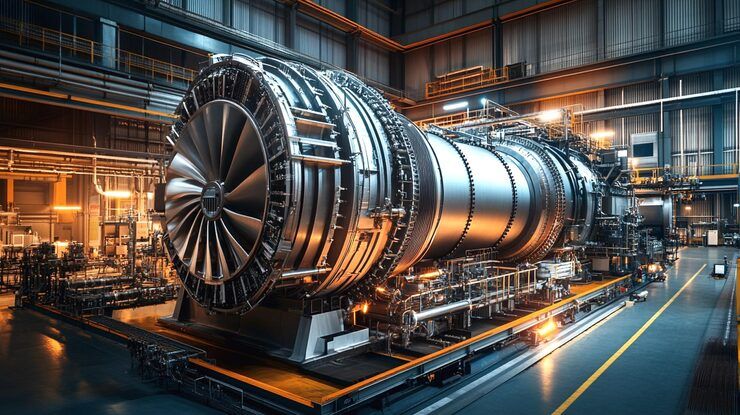
A steam turbine is a rotating mechanical device that converts the thermal energy of pressurized steam into mechanical energy. This energy can drive an electrical generator, power industrial machinery, or support other processes that require rotational motion. Steam turbines are widely used in power plants, manufacturing facilities, chemical processing, and large industrial energy systems.
The basic principle is straightforward. Water is heated to produce steam, which expands through specially shaped stationary and rotating blades. As the steam transfers energy to the blades, the turbine shaft rotates. When connected to a generator, this rotation produces electricity.
Steam turbines have played an important role in electricity generation for more than a century. Although renewable energy technologies are expanding, steam turbines remain relevant because they can work with several heat sources, including coal, natural gas-fired boilers, nuclear reactors, concentrated solar thermal systems, biomass, and industrial waste heat.
Main Components of a Steam Turbine
A steam turbine contains several components that work together to convert steam energy into useful output.
Rotor and blades: Transfer energy from expanding steam into rotational movement.
Casing: Encloses the turbine and directs steam through the appropriate stages.
Nozzles and stationary blades: Guide steam and convert pressure energy into velocity where applicable.
Bearings: Support the rotating shaft and maintain proper alignment.
Governor and control valves: Regulate steam admission and help control rotational speed and output.
Condenser: In condensing systems, converts exhaust steam back into water for reuse.
Lubrication system: Reduces friction and protects bearings and other moving components.
The design of these components varies according to steam pressure, temperature, output requirements, and operating conditions.
Types of Steam Turbines
Steam turbines are commonly classified by their exhaust conditions and intended applications.
Condensing steam turbines expand steam to a low exhaust pressure, usually using a condenser. They are widely used in electricity generation because the low exhaust pressure allows more energy to be extracted from the steam.
Back-pressure steam turbines discharge steam at a pressure suitable for industrial processes. They can generate electricity while supplying useful heat or steam to factories.
Extraction steam turbines remove steam from selected stages for heating or industrial use. Some designs allow extraction pressure to be controlled according to process requirements.
Impulse and reaction turbines differ in how they convert steam energy into rotor movement. Impulse designs primarily use steam velocity to transfer energy to the rotor, while reaction designs also rely on pressure changes across moving blades.
Why Steam Turbines Matter Today
Steam turbines remain important in power generation and industrial energy management because they can deliver large amounts of mechanical power from a continuous steam supply. Their usefulness extends beyond conventional electricity production to combined heat and power systems, industrial steam networks, and facilities that recover energy from existing heat sources.
Electricity Generation and Industrial Applications
Steam turbine generators convert mechanical rotation into electricity. They are used in thermal power stations, nuclear power plants, biomass facilities, and some concentrated solar thermal installations.
Industrial facilities may also use steam turbines to drive compressors, pumps, and other rotating equipment. In combined heat and power systems, a facility can generate electricity and use the remaining steam or heat for manufacturing processes.
Industries that commonly use steam turbine technology include:
Power generation and utility infrastructure.
Chemical and petrochemical processing.
Pulp and paper manufacturing.
Steel and other energy-intensive industries.
Sugar production and biomass processing.
District heating and large institutional energy systems.
Efficiency and Energy Recovery
Steam turbine performance depends on steam pressure, temperature, flow rate, exhaust conditions, blade design, and operating stability. Higher steam temperatures and pressures can improve the potential for energy conversion, provided that equipment materials and safety systems support those conditions.
Heat recovery can also improve overall plant efficiency. Instead of releasing all available heat into the environment, combined heat and power systems use part of that energy for heating or industrial production.
The following table illustrates how different configurations serve different purposes.
Turbine configuration | Typical application | Main characteristic |
|---|---|---|
Condensing | Electricity generation | Low-pressure exhaust |
Back-pressure | Industrial power and process steam | Useful exhaust steam |
Extraction | Power and process heating | Steam withdrawn between stages |
Reheat | Large power stations | Steam reheated between expansion stages |
Geared or direct-drive | Industrial machinery | Designed around driven equipment requirements |
Actual performance varies by plant design and operating conditions. Turbine efficiency should not be confused with the overall efficiency of the entire power station, which also depends on the heat source, boiler or reactor, condenser, pumps, and auxiliary equipment.
Recent Developments in Steam Turbine Technology
Steam turbine technology continues to evolve in response to electricity demand, industrial efficiency targets, and changes in power generation. Developments during 2025 and 2026 have highlighted the importance of advanced monitoring, flexible operation, and new power infrastructure.
Digital Monitoring and Predictive Maintenance
Digital monitoring systems collect information about turbine vibration, bearing temperatures, steam pressure, rotor speed, and other operating parameters. Analytical software can help engineers identify unusual patterns before they develop into serious equipment problems.
Recent developments include wider use of artificial intelligence (AI) for equipment condition monitoring and performance analysis. In October 2025, industry reporting highlighted the expansion of AI-based monitoring across a large fleet of power plants, reflecting growing interest in data-driven turbine maintenance.
Predictive maintenance can help operators plan inspections and reduce unexpected interruptions. However, software recommendations should be evaluated alongside physical inspections, engineering assessments, and established safety procedures.
Growing Demand for Reliable Electricity
In January 2026, an agreement involving JSW Thermal Energy and Toshiba JSW concerned two 800-megawatt steam turbine generators for the Salboni thermal power project in West Bengal, India. This illustrates the continued role of large steam turbine generators in conventional electricity infrastructure.
Other developments have focused on power systems supporting energy-intensive facilities, including data centers. Steam turbines can contribute to these systems through conventional steam generation or as part of combined-cycle power plants, where exhaust heat from gas turbines produces steam for additional electricity generation.
Flexible Power Plant Operation
Power plants increasingly need to respond to changing electricity demand and variations in renewable energy production. Flexible operation can involve adjusting output, managing startup and shutdown procedures, and maintaining equipment within safe operating limits.
For steam turbines, frequent changes in load can affect thermal stress, component fatigue, and maintenance requirements. Modern control systems help operators balance flexibility with equipment reliability.
Laws, Safety Standards, and Energy Policies in India
Steam turbine installations in India are affected by electricity regulations, industrial safety requirements, environmental standards, and applicable boiler and pressure-system rules. The relevant requirements depend on the plant type, fuel, capacity, location, and operating arrangement.
Electricity Sector Regulations
The Electricity Act, 2003 establishes the broader legal framework for electricity generation, transmission, distribution, and regulation in India.
The Central Electricity Authority (CEA) develops technical and safety regulations relevant to power generation infrastructure. Important regulatory frameworks include:
CEA Technical Standards for Construction of Electrical Plants and Electric Lines Regulations, 2022: Establish technical requirements for covered electricity infrastructure, subject to subsequent amendments.
CEA Measures Relating to Safety and Electric Supply Regulations, 2023: Address electrical safety requirements relevant to power installations.
CEA Safety Requirements for Construction, Operation and Maintenance of Electrical Plants and Electric Lines: Provide requirements relevant to covered plant operations and maintenance, including applicable turbine-generator safety practices.
CEA Flexible Operation of Coal-Based Thermal Power Generating Units Regulations: Address operating flexibility for covered coal-based generating units.
During 2025 and 2026, the CEA's technical standards for electrical plant construction were subject to amendments. Plant owners should determine which provisions are in force and applicable to their installations rather than relying solely on older technical documents.
Environmental and Industrial Safety Requirements
Steam turbines do not necessarily produce combustion emissions themselves, but the boilers, reactors, and other heat sources supplying them may be subject to environmental requirements.
Relevant considerations include:
Emission limits for covered thermal power plants.
Boiler inspection and pressure-system safety requirements.
Electrical protection, grounding, and generator safety.
Turbine overspeed protection and vibration monitoring.
Maintenance documentation and personnel training.
Applicable fire protection and emergency shutdown arrangements.
Operators should consult the relevant electricity authority, environmental regulator, boiler inspectorate, and plant-specific approvals to establish their obligations.
Tools and Resources for Steam Turbine Analysis
Engineering tools help operators evaluate turbine efficiency, steam conditions, energy output, and equipment health. The correct tool depends on whether the task involves preliminary calculations, detailed design, maintenance, or operational monitoring.
Useful Engineering Tools
Steam property calculators: Estimate steam enthalpy, entropy, pressure, temperature, and steam quality. These properties are essential for understanding turbine energy conversion.
Turbine efficiency calculators: Estimate isentropic efficiency by comparing actual performance with the ideal expansion process.
Heat rate calculators: Help evaluate the thermal energy input required to produce a unit of electricity.
Vibration analysis software: Examines shaft movement, bearing behavior, and vibration frequency patterns to identify possible mechanical problems.
Computer-aided engineering software: Supports turbine component design, fluid-flow analysis, structural assessment, and thermal simulations.
Maintenance tracking templates: Record inspections, lubrication activities, equipment readings, maintenance history, and corrective actions.
Basic Steam Turbine Performance Calculations
The mechanical power produced by a turbine can be estimated using the steam mass flow rate and the enthalpy difference across the turbine.
Here, \(P\) represents the idealized power transfer rate, \(\dot{m}\) is the steam mass flow rate, and the enthalpy values represent the inlet and outlet steam conditions. When mass flow is measured in kilograms per second and enthalpy in kilojoules per kilogram, the result is in kilowatts.
Actual shaft power will be affected by internal losses and mechanical efficiency.
Performance parameter | What it indicates | Why it matters |
|---|---|---|
Steam inlet pressure | Pressure entering the turbine | Influences expansion conditions |
Steam temperature | Thermal condition of inlet steam | Affects energy content and material limits |
Mass flow rate | Steam passing through the turbine | Helps determine potential power output |
Isentropic efficiency | Actual expansion performance relative to an ideal process | Supports performance assessment |
Exhaust pressure | Pressure at the turbine outlet | Influences usable energy extraction |
Shaft vibration | Mechanical movement during operation | Helps identify developing faults |
Reliable calculations require accurate measurements and appropriate steam property data. Engineers should also consider measurement uncertainty, auxiliary power consumption, and the difference between turbine output and net plant output.
Frequently Asked Questions
What is the main purpose of a steam turbine?
A steam turbine converts the energy of expanding steam into rotational mechanical energy. This energy commonly drives an electrical generator, although turbines can also power industrial compressors, pumps, and other machinery.
What is the difference between a steam turbine and a gas turbine?
A steam turbine extracts energy from steam produced by an external heat source. A gas turbine generates power by expanding hot combustion gases through its turbine stages. Both can drive electrical generators, and they may operate together in a combined-cycle power plant.
How is steam turbine efficiency measured?
Efficiency can be evaluated using thermodynamic calculations that compare actual turbine performance with an ideal expansion process. Plant-level performance can also be assessed using heat rate, fuel consumption, electricity output, and auxiliary energy requirements.
What causes steam turbine vibration?
Potential causes include rotor imbalance, shaft misalignment, bearing wear, deposits, mechanical looseness, and changes in operating conditions. Vibration should be assessed using suitable instruments and established maintenance procedures because severe vibration may indicate a safety or reliability concern.
Can steam turbines operate with renewable energy?
Yes. Steam turbines can generate electricity using steam produced by biomass combustion, concentrated solar thermal systems, and certain geothermal applications. They can also form part of systems that recover industrial waste heat. The feasibility depends on the heat source, steam conditions, operating profile, and plant design.
Conclusion
Steam turbines remain an important technology for electricity generation and industrial energy conversion. Their ability to operate with different heat sources makes them relevant to conventional power stations, combined heat and power facilities, biomass plants, and selected renewable energy applications.
Advances in digital monitoring, predictive maintenance, and flexible operation are helping operators assess performance and manage equipment reliability. At the same time, steam turbine installations must comply with applicable technical, environmental, electrical, and industrial safety requirements.
Understanding turbine configurations, steam properties, operating parameters, and maintenance practices provides a strong foundation for evaluating this technology. Careful engineering and effective operational management can help steam turbines deliver dependable power while supporting broader energy efficiency objectives.