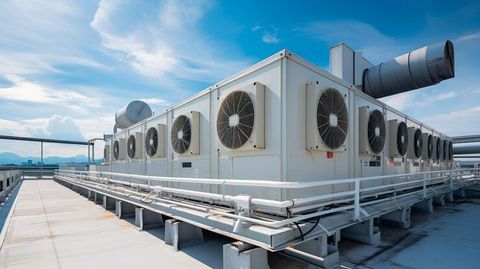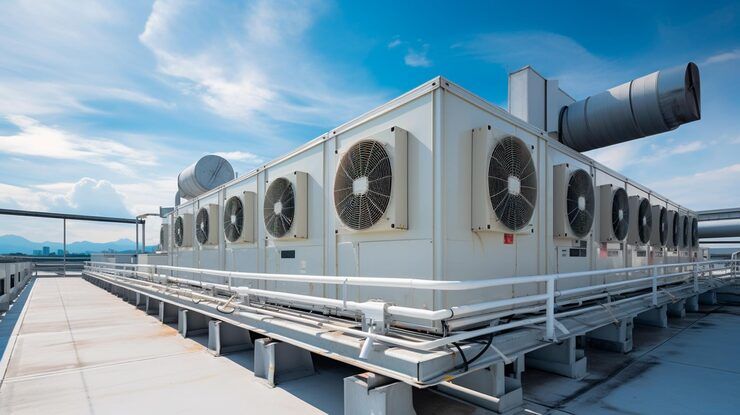
Air-cooled chillers are mechanical cooling systems designed to remove heat from water or another circulating fluid and release that heat into the surrounding air. They are widely used in commercial buildings, manufacturing facilities, hospitals, data centers, hotels, laboratories, and other locations requiring controlled cooling.
Unlike water-cooled chillers, which reject heat through a cooling tower or similar water-based arrangement, air-cooled systems use fans and outdoor coils to transfer heat directly into the atmosphere. This difference affects installation requirements, energy use, maintenance, equipment selection, and operating conditions.
Understanding Air-Cooled Chillers
How Air-Cooled Chillers Work
An air-cooled chiller generally operates through a refrigeration cycle involving four main components:
Compressor
Condenser coil
Expansion device
Evaporator
The evaporator removes heat from chilled water or another circulating fluid. The refrigerant then carries that heat toward the compressor and condenser.
At the condenser, fans move outdoor air across the condenser coils. Heat is transferred from the refrigerant into the surrounding air, allowing the refrigerant to continue through the cycle.
The chilled fluid is then circulated through equipment such as air-handling units, fan-coil units, process equipment, or data-center cooling systems.
Common Air-Cooled Chiller Configurations
Different configurations are used according to cooling capacity, temperature requirements, building design, and operating conditions.
| Configuration | Typical Characteristics | Common Applications |
|---|---|---|
| Scroll Chiller | Compact design and modular capacity | Offices, retail, smaller facilities |
| Screw Chiller | Suitable for larger cooling loads | Commercial and industrial facilities |
| Reciprocating Chiller | Used in selected smaller systems | Specialized cooling applications |
| Variable-Speed Chiller | Adjusts compressor speed according to demand | Energy-conscious buildings |
| Modular Chiller | Multiple units operate as a coordinated system | Buildings with changing loads |
Modern industrial air-cooled chillers, commercial HVAC chillers, high-efficiency chillers, and variable-speed chillers increasingly use electronic controls and monitoring systems.
Why Air-Cooled Chillers Matter Today
Cooling demand continues to increase as buildings become more densely occupied, industrial processes become more automated, and computing infrastructure generates larger heat loads.
Air-cooled chillers can be particularly useful where a facility does not have sufficient space or infrastructure for cooling towers.
Building Cooling
Large commercial buildings often require centralized chilled-water systems. Chillers can provide cooling to multiple zones through pumps, air-handling equipment, and terminal units.
Applications include:
Office buildings
Hotels
Shopping centers
Hospitals
Universities
Airports
Laboratories
Public buildings
Industrial Cooling
Industrial processes may require stable fluid temperatures to protect equipment and maintain consistent production conditions.
Examples include plastics processing, food production, pharmaceutical manufacturing, electronics production, and machinery cooling.
Data Center Cooling
Data centers are becoming an important area for advanced cooling technology. Higher computing density, artificial intelligence workloads, and accelerated computing can produce substantial heat loads.
In August 2026, the U.S. Department of Energy highlighted the COOLERCHIPS 1.5 program, which is developing advanced cooling technologies for high-power AI data centers, including systems designed around very high rack heat loads and reduced water use.
Air-cooled chillers can therefore be part of broader chilled-water or secondary-loop architectures used for demanding computing environments.
Important Performance Factors
Selecting an air-cooled chiller requires more than looking at nominal cooling capacity. Actual performance depends on operating conditions and system design.
Cooling Capacity
Cooling capacity indicates how much heat the chiller can remove under defined conditions. Capacity is commonly expressed in tons of refrigeration, kilowatts, or other engineering units.
Energy Efficiency
Important efficiency measurements can include:
COP
EER
IPLV
Integrated efficiency metrics
Part-load performance
Part-load efficiency is particularly important because many facilities do not operate at maximum cooling demand throughout the year.
Ambient Temperature
Air-cooled chillers reject heat directly into outdoor air. As outdoor temperatures rise, the condenser must work against a higher heat-rejection temperature.
This makes climate conditions an important factor when evaluating air-cooled chiller efficiency.
Refrigerant Selection
Refrigerant selection has become increasingly important because governments and regulatory bodies are reducing the use of high-global-warming-potential refrigerants.
Manufacturers are therefore evaluating alternatives with lower environmental impact while maintaining appropriate efficiency and safety characteristics.
Recent Global Developments in 2025–2026
Increasing Attention to Low-GWP Refrigerants
Refrigerant regulations are changing the design landscape for chillers in major markets.
The European Union's F-gas Regulation 2024/573 entered into force on March 11, 2024, and establishes progressively tighter controls on fluorinated greenhouse gases. For stationary chillers above 12 kW, restrictions on equipment using fluorinated gases with a GWP of 750 or more begin from January 1, 2027, subject to specified exceptions.
This is encouraging greater attention to lower-GWP refrigerants and alternative refrigeration technologies.
U.S. Refrigerant Transition
The United States is also implementing HFC restrictions through the American Innovation and Manufacturing Act.
EPA's current technology-transition information identifies a January 1, 2025 compliance date for comfort-cooling chillers using refrigerants with a GWP of 700 or greater. For certain industrial process chillers with exiting fluid temperatures at or above −30°C, a January 1, 2026 compliance date applies. Other temperature ranges have later dates.
EPA also reported regulatory developments during 2026 involving industrial process refrigeration and semiconductor-manufacturing chillers.
Smarter Controls and Variable-Speed Technology
Digital controls are becoming increasingly important in modern chiller plants. Variable-speed compressors, electronically controlled fans, sensors, and automated sequencing can help equipment respond to changing cooling demand.
This approach can reduce unnecessary operation at full capacity and improve part-load performance when correctly designed and commissioned.
Cooling for High-Density Computing
AI and accelerated computing are increasing interest in advanced thermal-management systems. The U.S. Department of Energy's 2026 COOLERCHIPS 1.5 program specifically targets advanced cooling technologies capable of managing demanding AI-related heat loads.
This trend is encouraging development of both air-based and liquid-assisted cooling architectures.
Global Laws, Policies and Standards
Air-cooled chillers are affected by several categories of international and regional requirements, including refrigerant rules, energy-efficiency requirements, electrical safety standards, environmental regulations, and building codes.
European Union
The EU F-gas Regulation establishes restrictions on fluorinated greenhouse gases and includes specific requirements for refrigeration and air-conditioning equipment.
The European Commission identifies restrictions for stationary chillers based on refrigerant GWP and cooling capacity. Certain restrictions begin in 2027, while additional requirements are scheduled for later years.
EU Ecodesign requirements also address energy efficiency and information requirements for relevant cooling products and high-temperature process chillers.
United States
The U.S. EPA regulates HFC use under the AIM Act and its Technology Transitions Program.
The EPA also maintains requirements under Section 608 of the Clean Air Act covering stationary refrigeration and air-conditioning equipment, including refrigerant handling, recovery, leak-related requirements, recordkeeping, and technician certification.
International Framework
The Kigali Amendment to the Montreal Protocol is another major international framework influencing refrigerant transition. Countries participating in the agreement have established schedules for reducing HFC consumption.
Because national implementation differs, organizations operating across multiple markets need to review the rules applicable to each installation location.
Tools and Resources for Air-Cooled Chillers
Engineers and facility managers can use several technical resources when designing, evaluating, or monitoring chiller systems.
Useful Engineering Tools
Chiller sizing calculators: Estimate required cooling capacity from building or process loads.
Psychrometric tools: Help analyze air temperature, humidity, and cooling requirements.
Energy modeling software: Estimates annual HVAC energy performance.
Refrigerant property databases: Provide thermodynamic information for selected refrigerants.
BMS platforms: Monitor temperatures, pressures, flow rates, alarms, and operating status.
Power meters: Measure electrical consumption and help calculate real-world efficiency.
Temperature sensors: Track chilled-water supply and return conditions.
Flow meters: Measure chilled-water circulation.
Vibration monitoring tools: Help identify developing mechanical problems.
Manufacturer selection software: Helps compare capacity and operating conditions for specific equipment families.
ASHRAE resources: Provide widely used technical guidance for HVAC system design and operation.
Key Parameters to Compare
When evaluating an air-cooled chiller system, useful parameters include:
Cooling capacity
Entering and leaving water temperatures
Ambient design temperature
COP
Part-load efficiency
Compressor type
Refrigerant and GWP
Sound level
Fan configuration
Electrical requirements
Footprint
Operating temperature range
Controls integration
Maintenance requirements
Applicable regulatory requirements
A technically suitable system should be evaluated under the actual climate and load profile rather than by capacity alone.
Frequently Asked Questions
What is an air-cooled chiller?
An air-cooled chiller is a refrigeration system that removes heat from circulating fluid and rejects that heat into outdoor air through condenser coils and fans.
What is the difference between air-cooled and water-cooled chillers?
Air-cooled chillers reject heat directly into outdoor air. Water-cooled systems normally transfer heat to condenser water, which then rejects heat through a cooling tower or another heat-rejection arrangement.
Are air-cooled chillers suitable for industrial applications?
Yes. They can be used for process cooling, equipment temperature control, manufacturing facilities, electronics production, and other industrial applications when the required capacity and operating conditions are appropriate.
Why are low-GWP refrigerants becoming important?
Governments are reducing the use of refrigerants with high global warming potential. Regulations in regions such as the EU and United States are establishing restrictions that are influencing equipment design and refrigerant selection.
How can chiller efficiency be evaluated?
Efficiency can be assessed using measures such as COP, EER, and part-load performance. Actual electricity use should also be considered alongside cooling output, operating temperatures, ambient conditions, and system controls.
Conclusion
Air-cooled chillers remain an important technology for commercial buildings, industrial facilities, data centers, and process cooling applications. Their ability to reject heat directly into outdoor air can simplify plant architecture where water-based heat rejection is not appropriate.
The technology is also changing. Variable-speed compressors, intelligent controls, digital monitoring, improved heat exchangers, and lower-GWP refrigerants are becoming increasingly important in modern chiller design.
Developments during 2025 and 2026 show that refrigerant regulation and high-density computing are two major influences on cooling technology. The EU is implementing progressively tighter F-gas requirements, while U.S. EPA rules are changing refrigerant requirements for several chiller categories.
At the same time, increasing computing density is creating new requirements for thermal management. Programs such as COOLERCHIPS 1.5 demonstrate the growing research focus on efficient cooling for advanced computing infrastructure.
For organizations researching industrial chillers, commercial HVAC systems, air-cooled chiller efficiency, low-GWP refrigerants, or chiller plant design, the most important considerations include cooling load, climate, refrigerant requirements, energy performance, controls, operating conditions, safety, and applicable regional regulations.
As global cooling demand continues to evolve, air-cooled chiller technology is likely to remain closely connected with energy efficiency, refrigerant transition, digital controls, and advanced thermal-management strategies.