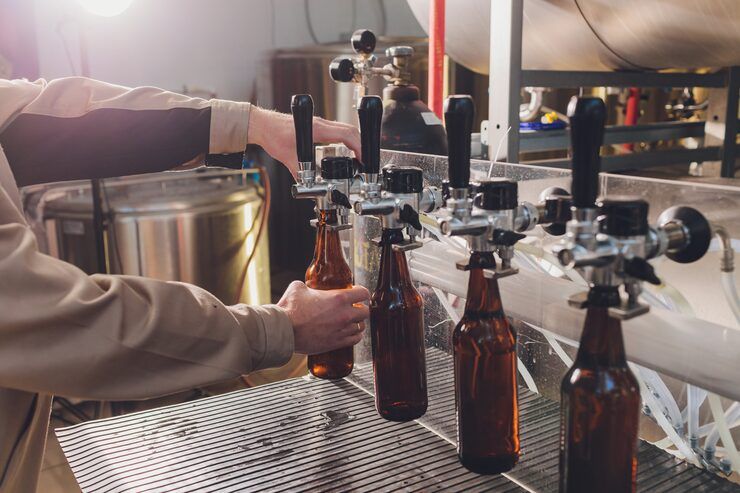
Beer filling machines are industrial systems designed to transfer beer from a storage or processing vessel into containers such as glass bottles, aluminum cans, and kegs. They are an important part of brewery packaging because the filling process must control volume, pressure, foam, oxygen exposure, and container handling.
Modern filling equipment can range from compact systems used by small breweries to highly automated production lines used by large beverage manufacturers. The appropriate configuration depends on container format, production volume, beer characteristics, packaging design, and required process controls.
Beer is sensitive to oxygen and excessive agitation. For this reason, many filling systems use controlled pressure and carefully designed filling sequences to reduce foaming and maintain product consistency.
How the Filling Process Works
A typical beer filling operation can include several stages:
Container cleaning or preparation
Container positioning
Pressure balancing
Beer filling
Foam management
Gas flushing
Container closure
Level or weight inspection
Labeling and coding
Package inspection
For bottles and cans, filling valves or filling heads control the transfer of beer into each container. Carbon dioxide may be used during parts of the process to help manage pressure and reduce oxygen exposure.
Common Filling Machine Types
| Machine Type | Typical Container | Main Characteristic |
|---|---|---|
| Bottle filler | Glass bottles | Controlled filling through dedicated valves |
| Can filler | Aluminum cans | High-speed filling with integrated seaming |
| Counter-pressure filler | Bottles or cans | Uses pressure balancing before filling |
| Rotary filler | Bottles or cans | Multiple filling heads operate continuously |
| Keg filler | Stainless-steel kegs | Designed for reusable draft containers |
| Monoblock system | Bottles or cans | Combines multiple packaging operations |
The selection of equipment depends on the brewery's packaging format, production scale, available floor space, and desired level of automation.
Why Beer Filling Machines Matter Today
The filling stage directly affects packaging efficiency and beer quality. Inconsistent filling can lead to variations in container volume, excessive foam, product loss, or increased exposure to oxygen.
Maintaining Product Quality
Beer can lose desirable characteristics when exposed to oxygen. Modern filling systems therefore focus on controlled gas conditions, pressure management, and minimized turbulence.
Counter-pressure filling is particularly important for carbonated beverages because the container can be brought closer to the pressure of the product before filling begins.
Improving Production Consistency
Automated filling equipment can maintain consistent filling cycles across many containers. Sensors and electronic controls can monitor operating conditions and detect deviations.
Important parameters may include:
Filling pressure
Product temperature
Gas pressure
Filling time
Container position
Product level
Foam formation
Closure integrity
Supporting Different Brewery Sizes
Small breweries may use semi-automatic systems with a limited number of filling heads, while larger facilities may use continuous rotary fillers integrated with conveyors, seamers, rinsers, inspection equipment, and packaging systems.
This range allows packaging architecture to be matched with production requirements rather than using one configuration for every brewery.
Reducing Material and Product Loss
Accurate filling can reduce unnecessary beer loss caused by overfilling, excessive foam, rejected containers, or inconsistent operation.
Modern equipment can also integrate automatic controls that stop filling when a container is incorrectly positioned or when a process parameter moves outside a defined range.
Recent Developments in Beer Filling Technology
During 2025 and 2026, beverage packaging continued moving toward greater automation, digital monitoring, resource efficiency, and flexible packaging formats. These developments are relevant to breweries of different sizes because packaging equipment is increasingly connected with broader production-control systems.
Greater Automation
Modern beverage packaging lines increasingly use sensors, programmable controllers, machine vision, and automated data collection.
A connected filling line can monitor operating information such as:
Production throughput
Filling accuracy
Equipment status
Container rejection rates
Pressure conditions
Cleaning cycles
Downtime events
This information can help production teams identify process variations and improve maintenance planning.
Flexible Container Formats
Consumer packaging continues to include cans, bottles, and other container configurations. Cans have remained particularly important because of their lightweight structure and efficient transport characteristics.
Filling systems are therefore increasingly designed around quick format changes and adaptable controls where multiple container sizes are processed.
Resource Efficiency
Breweries are also examining water, energy, compressed air, and carbon dioxide consumption throughout packaging operations.
Efficiency improvements can include:
Optimized rinsing cycles
Improved pneumatic controls
Reduced water consumption
Efficient refrigeration integration
Better compressed-air management
Automated shutdown during production pauses
Digital Quality Monitoring
Machine vision and electronic inspection are becoming increasingly useful for identifying incorrectly positioned containers, damaged packaging, incorrect levels, and closure-related abnormalities.
Digital records can also provide production history for individual batches and packaging runs.
Global Laws, Regulations and Standards
Beer filling machines operate within a broader regulatory environment covering food and beverage safety, packaging, labeling, worker protection, machinery safety, environmental requirements, and alcohol regulation. Requirements vary significantly between countries.
United States
In the United States, breweries must consider federal requirements administered by agencies such as the Food and Drug Administration and the Alcohol and Tobacco Tax and Trade Bureau.
FDA requirements can apply to food-contact materials and sanitary production conditions, while TTB regulates various aspects of alcoholic beverage production and labeling.
Machinery installations may also need to consider workplace safety requirements established by the Occupational Safety and Health Administration.
European Union
In the European Union, machinery placed on the market must comply with applicable European requirements, while food-contact materials are subject to specific regulatory frameworks.
The EU also has extensive requirements concerning food hygiene, packaging materials, worker safety, and environmental performance.
For equipment manufacturers and breweries, documentation, risk assessment, conformity procedures, and appropriate technical standards can be important parts of equipment deployment.
United Kingdom
The United Kingdom maintains its own regulatory framework following Brexit. Breweries need to consider UK requirements relating to food hygiene, packaging, machinery safety, labeling, and alcoholic beverages.
International Standards
International standards can provide useful technical guidance for equipment design, electrical safety, food-contact materials, quality management, and machinery risk reduction.
Breweries operating internationally should evaluate the rules applicable to each market rather than assuming that compliance in one jurisdiction automatically satisfies another.
Tools and Resources for Beer Filling Operations
Several technical resources can help breweries understand filling performance, packaging requirements, and production planning.
Useful Tools
Beer carbonation calculators: Estimate carbonation requirements based on temperature and desired carbonation level.
Tank-pressure calculators: Help evaluate pressure relationships during carbonated beverage filling.
Container-volume calculators: Assist with determining nominal and actual filling volumes.
Packaging-line calculators: Help estimate theoretical throughput based on filling heads and cycle time.
Dissolved oxygen meters: Monitor oxygen levels in packaged beer.
Pressure gauges and sensors: Track product and gas pressures.
Temperature sensors: Monitor conditions affecting carbonation and filling behavior.
Machine-vision systems: Inspect container position, fill levels, closures, and packaging quality.
PLC monitoring systems: Control filling sequences and machine operations.
Production dashboards: Display throughput, downtime, rejects, and operating conditions.
HACCP templates: Help breweries structure food-safety hazard analysis.
Brewing association resources: Organizations such as the Brewers Association and national brewing bodies publish technical and regulatory information.
Important Equipment Specifications
When evaluating beer filling equipment, several technical factors are relevant:
Container type
Number of filling heads
Filling technology
Production throughput
Product temperature range
Pressure range
Carbon dioxide integration
Cleaning compatibility
Changeover requirements
Automation level
Inspection capability
Data-recording functions
Electrical requirements
Machine footprint
Throughput should be evaluated together with actual operating conditions. Theoretical filling speed does not necessarily represent practical output because cleaning, container changes, maintenance, inspection, and production interruptions also affect overall performance.
Frequently Asked Questions
What is a beer filling machine?
A beer filling machine is equipment that transfers beer from a tank or processing system into containers such as bottles, cans, or kegs while controlling filling conditions.
Why is counter-pressure filling used for beer?
Counter-pressure filling helps balance pressure between the beer system and the container before filling. This can reduce excessive foaming and help preserve carbonation during packaging.
What affects beer filling accuracy?
Filling accuracy can be affected by product temperature, pressure, beer carbonation, filling-valve design, container dimensions, machine settings, and the condition of sensors and control systems.
Are beer filling machines fully automated?
Not always. Systems range from manual and semi-automatic equipment to highly automated packaging lines. Larger production facilities generally integrate filling with conveyors, inspection, closure, labeling, coding, and packaging equipment.
What regulations apply to beer filling equipment?
Requirements depend on the country and may cover food-contact materials, beverage hygiene, machinery safety, workplace protection, alcohol production, packaging, labeling, and environmental management. Breweries should review the requirements applicable to their specific market and facility.
Conclusion
Beer filling machines are an important part of modern brewery packaging. Their primary role is to transfer beer into containers while maintaining controlled pressure, minimizing excessive foam, supporting accurate filling, and protecting product quality.
Modern systems increasingly combine filling equipment with sensors, programmable controls, machine vision, inspection technology, and production data systems. These capabilities can improve process consistency and provide better visibility into packaging operations.
The technology also continues to evolve around resource efficiency and flexible packaging. Breweries are increasingly considering water consumption, energy use, compressed air, carbon dioxide management, container formats, and digital monitoring when developing packaging operations.
Regulatory requirements remain an important consideration. Rules governing food safety, alcoholic beverages, machinery, packaging, worker protection, and environmental practices differ across jurisdictions. A brewery operating internationally therefore needs to evaluate the requirements of each target market.
For organizations researching beer filling machines, automatic bottle filling equipment, can filling machines, counter-pressure filling technology, or beverage packaging machinery, the most important technical considerations include filling accuracy, pressure control, container compatibility, throughput, cleaning requirements, automation, inspection, safety, and regulatory compliance.
As brewery packaging becomes increasingly automated and data-driven, filling technology will remain an important connection between brewing operations and the final packaged product.