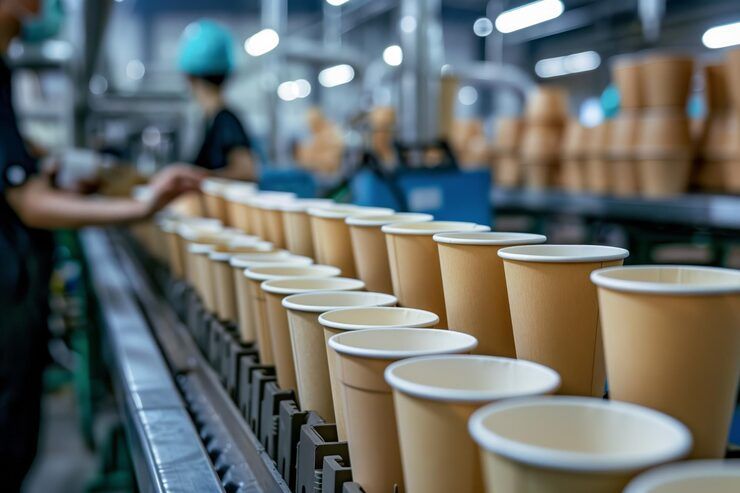
Paper cup forming machines are automated or semi-automated production systems that convert coated or treated paperboard into finished paper cups. The manufacturing process generally involves feeding pre-cut paper blanks, forming the cup wall, sealing the side seam, attaching the bottom, and shaping the rim.
These machines are used for cups designed for beverages, food portions, takeaway applications, events, offices, and other packaging environments. Their development reflects the wider shift from manual fabrication toward high-speed, repeatable packaging production.
A typical machine combines mechanical forming components, heating or sealing mechanisms, sensors, motors, pneumatic systems, and programmable controls.
How Paper Cup Forming Works
The exact process varies according to machine design, but a typical production sequence includes:
Feeding printed or unprinted paper blanks
Forming the paper blank into a cylindrical shape
Sealing the side seam
Feeding and attaching the circular bottom
Heating or mechanically sealing the bottom
Curling the upper rim
Inspecting the finished cup
Collecting and stacking completed cups
Modern systems can use programmable logic controllers, servo motors, sensors, and automated fault detection to coordinate these stages.
Important Machine Components
A paper cup forming system commonly includes:
Paper-feeding mechanism
Side-wall forming unit
Bottom-paper feeding system
Heat-sealing or ultrasonic sealing equipment
Knurling or bottom-sealing unit
Rim-curling mechanism
Servo or motor-driven systems
Temperature controllers
Sensors
PLC control panel
Cup collection system
The combination of these components determines the machine's production characteristics, dimensional consistency, energy use, and compatibility with particular paper materials.
Why Paper Cup Forming Machines Matter Today
Paper cups are part of the wider food-packaging industry, where manufacturers increasingly focus on material efficiency, hygiene, production consistency, and environmental requirements.
Automated forming equipment can help manufacturers produce standardized cup dimensions at a consistent rate. It also reduces the amount of repetitive manual forming involved in high-volume production.
Applications Across Packaging
Paper cup forming technology is used for cups intended for:
Hot beverages
Cold beverages
Water
Ice cream
Desserts
Food portions
Sampling applications
Institutional catering
Events and hospitality
The technology is relevant to high-value industrial search areas such as paper cup manufacturing machines, automatic paper cup machines, disposable cup manufacturing equipment, and paper packaging machinery.
Importance of Material Selection
Paper cup production is closely connected to the characteristics of the paperboard and barrier layer.
Traditional cups commonly use paperboard with a polymer coating to provide liquid resistance. Newer material strategies include water-based coatings, dispersion coatings, and other barrier technologies intended to improve recyclability or reduce dependence on conventional plastic layers.
The material must still provide adequate stiffness, sealing performance, liquid resistance, and food-contact suitability.
| Machine Factor | Why It Matters |
|---|---|
| Forming speed | Determines production throughput |
| Paperboard thickness | Influences stiffness and forming behavior |
| Coating type | Affects sealing and liquid resistance |
| Cup diameter | Determines forming configuration |
| Bottom design | Influences leakage resistance |
| Rim curling | Affects drinking comfort and structural quality |
| Temperature control | Influences heat-sealing consistency |
| Automation | Supports repeatability and monitoring |
Recent Paper Cup Manufacturing Developments
The paper packaging sector continued to evolve during 2025 and 2026 as regulations, sustainability goals, material science, and consumer preferences influenced packaging design.
EU Packaging Regulation Developments
The European Union's Packaging and Packaging Waste Regulation, Regulation (EU) 2025/40, entered into force on February 11, 2025. The regulation establishes requirements intended to reduce packaging waste and improve packaging sustainability across the European market. (environment.ec.europa.eu)
The regulation is relevant to paper cup manufacturers because packaging producers increasingly need to consider recyclability, material composition, packaging minimization, and labeling requirements when supplying products into regulated markets.
India’s Packaging Environment
India has also continued strengthening its framework around plastic waste and packaging materials. The Central Pollution Control Board maintains the Plastic Waste Management framework and related guidance for producers, importers, brand owners, recyclers, and other stakeholders.
For paper cups, the precise regulatory position depends on the material composition of the cup and barrier coating. A paper cup containing a plastic layer can fall into a different regulatory context from a cup using a different barrier technology.
Development of Alternative Coatings
During 2025 and 2026, packaging research continued to focus on coatings and barrier technologies that can provide liquid resistance while supporting improved end-of-life handling.
For paper cup manufacturing, this has increased interest in:
Water-based barrier coatings
Dispersion-coated paperboard
Bio-based barrier materials
Reduced-plastic packaging structures
Fiber-based alternatives
Improved recyclability
Lightweight paperboard
However, recyclability depends on the complete packaging structure and the capabilities of the relevant recycling system. A paper-based appearance alone does not automatically mean that a cup is recyclable in every location.
Automation and Production Monitoring
Paper cup machinery is also moving toward greater automation. Servo-driven systems, touch-screen controls, automatic fault detection, machine sensors, and production monitoring can help manufacturers identify process variations.
Digital controls can also support more consistent temperature management during heat-sealing and better synchronization between forming stages.
Laws, Standards and Policies in India
India provides an important regulatory example because food-contact packaging is influenced by food-safety requirements, packaging-material standards, waste-management rules, and manufacturing controls.
Food-Contact Packaging Requirements
The Food Safety and Standards Authority of India (FSSAI) regulates materials that come into contact with food. Its packaging regulations establish requirements for materials used for food packaging and specify that materials intended for direct food contact must meet applicable safety requirements.
The FSSAI framework includes requirements related to paper and board materials used for food contact, including migration and overall compliance considerations. (fssai.gov.in)
For paper cups intended for beverages or food, manufacturers should therefore verify that the paperboard, coatings, inks, adhesives, and other components are suitable for the intended food-contact application.
Plastic Waste Management
India's Plastic Waste Management Rules and subsequent amendments are relevant when paper cups incorporate plastic components or coatings that fall within the applicable definition of plastic packaging.
The Central Pollution Control Board provides guidance and registration information related to Extended Producer Responsibility for plastic packaging. (cpcb.nic.in)
The regulatory treatment depends on the complete material structure rather than simply the product being marketed as a paper cup.
Single-Use Plastic Restrictions
India's restrictions on identified single-use plastic items came into force on July 1, 2022. Paper cups are not automatically prohibited simply because they are used once; however, products incorporating regulated plastic components need to be evaluated against the applicable rules. (moef.gov.in)
Manufacturers should therefore examine the current rules for their particular cup construction, coating, and intended market.
Tools and Resources for Paper Cup Manufacturing
A paper cup production line requires material planning, dimensional control, production monitoring, and quality testing.
Useful Tools
Cup-dimension calculators: Help determine paper blank and cup geometry.
Production-capacity calculators: Estimate output from machine speed and operating hours.
Paperboard GSM calculators: Help evaluate paper weight and material requirements.
Material-specification sheets: Record paperboard thickness, coating, stiffness, and barrier characteristics.
CAD software: Helps develop cup dimensions and tooling geometry.
PLC monitoring systems: Track machine operation and production conditions.
Temperature monitoring equipment: Helps verify heat-sealing conditions.
Leak-testing equipment: Checks finished cups for liquid leakage.
Compression-testing equipment: Evaluates structural strength.
FSSAI resources: Useful for reviewing food-contact packaging requirements.
CPCB resources: Useful for understanding applicable plastic-packaging and environmental requirements.
Key Specifications to Evaluate
When researching automatic paper cup forming machines, useful parameters include:
Cup capacity
Cup diameter
Cup height
Paperboard GSM
Coating type
Production speed
Side-seam technology
Bottom-sealing method
Rim-curling system
Temperature control
Servo configuration
PLC system
Fault detection
Power consumption
Compatible cup sizes
Production speed should not be evaluated independently. Actual output can depend on paper quality, cup dimensions, machine configuration, operator intervention, downtime, material changes, and quality-control requirements.
Frequently Asked Questions
What is a paper cup forming machine?
A paper cup forming machine is an automated or semi-automated system that converts paperboard blanks into finished cups. The process typically includes side-wall forming, seam sealing, bottom attachment, bottom sealing, and rim curling.
What materials are used to make paper cups?
Paper cups generally use food-contact-grade paperboard combined with a barrier layer. Depending on the design, the barrier can involve polyethylene, water-based coatings, dispersion coatings, or other materials designed to resist liquid penetration.
Are paper cups recyclable?
Recyclability depends on the cup's complete material structure and the recycling infrastructure available in the relevant region. Fiber-based materials can still require specialized processing when they contain barrier coatings or other materials.
What determines paper cup machine production capacity?
Production capacity depends on machine configuration, operating speed, cup dimensions, paperboard characteristics, changeover requirements, downtime, and quality-control procedures. The rated machine speed does not necessarily represent actual continuous output.
What regulations apply to paper cups in India?
Requirements can involve food-contact packaging rules administered by FSSAI as well as environmental and plastic-packaging rules administered through India's waste-management framework. The applicable requirements depend on the cup's material composition and intended use. (fssai.gov.in)
Conclusion
Paper cup forming machines combine paper converting, precision forming, sealing, temperature control, automation, and quality inspection into a single manufacturing workflow. Their role has expanded alongside the growth of fiber-based packaging and the continuing development of food and beverage packaging technologies.
Recent regulatory developments in Europe and India demonstrate why material selection has become increasingly important. Paperboard, coatings, adhesives, inks, and other components must be considered together when assessing food-contact suitability, environmental requirements, and recyclability.
Automation is also changing paper cup production. Modern systems increasingly incorporate servo drives, sensors, programmable controls, digital monitoring, and automated quality checks.
For organizations researching paper cup manufacturing machines, the main technical considerations include cup dimensions, paperboard characteristics, coating technology, sealing method, machine speed, automation, quality control, and regulatory requirements.
The future of paper cup manufacturing is likely to involve a combination of higher production automation, improved barrier materials, better resource efficiency, and greater attention to packaging circularity. Understanding both the machine technology and the regulatory environment is therefore essential for responsible paper-based packaging production.