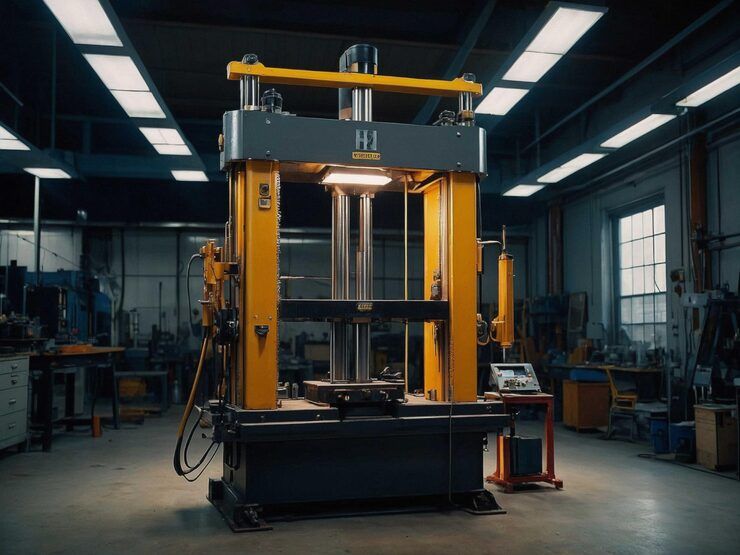
Hydraulic press machines are industrial systems that use pressurized fluid to generate force for compressing, shaping, forming, assembling, or testing materials. They are widely used in manufacturing, metalworking, automotive production, recycling, construction materials, and other industrial processes that require controlled pressure.
These machines operate according to Pascal's principle, which states that pressure applied to a confined fluid is transmitted throughout the fluid. By using hydraulic cylinders and pistons with different effective areas, a hydraulic press can generate a large output force from a comparatively smaller input force.
Hydraulic pressing technology is useful when a manufacturing process requires substantial force, controlled movement, or the ability to maintain pressure during a forming operation. The appropriate machine depends on the material, component dimensions, production rate, required accuracy, and operating environment.
Understanding Hydraulic Press Technology
A typical hydraulic press consists of a hydraulic power unit, a pump, a fluid reservoir, control valves, hydraulic cylinders, a frame, and a pressing surface. Sensors and electronic controls may also be included in modern systems.
The pump moves hydraulic fluid through the circuit, while valves regulate pressure, direction, and flow. The cylinder converts fluid pressure into linear movement, allowing the ram to apply force to a workpiece.
Important components include:
Hydraulic pump: Circulates fluid through the system.
Hydraulic cylinder: Converts fluid pressure into mechanical movement.
Control valves: Regulate fluid flow and pressure.
Reservoir: Stores hydraulic fluid.
Press frame: Supports the load and maintains structural alignment.
Ram and platen: Apply force to the material or workpiece.
Pressure sensors: Monitor operating conditions.
Safety controls: Help prevent hazardous machine movement.
The design of each component affects machine capacity, precision, operating speed, and reliability.
How a Hydraulic Press Works
The operating process generally begins when a pump supplies hydraulic fluid to the cylinder. The fluid creates pressure against the piston, causing the ram to move toward the workpiece.
As the ram contacts the material, the applied force increases until the required forming, compression, or assembly operation is completed.
A simplified relationship is:
Force = Pressure × Effective Piston Area
For example, if a hydraulic cylinder operates at a pressure of 20 megapascals and has an effective piston area of 0.01 square metres, its ideal theoretical force is 200,000 newtons, or 200 kilonewtons.
Actual performance depends on friction, hydraulic losses, mechanical alignment, and the machine's rated operating limits.
Types of Hydraulic Press Machines
Hydraulic presses are classified according to their frame design, movement, application, and control system.
C-Frame Hydraulic Press
A C-frame press has an open-sided frame that provides convenient access to the work area. It is commonly used for light to medium industrial operations, including assembly, straightening, punching, and component insertion.
Its open design can simplify loading and unloading, although frame deflection must be considered when high forces are applied.
H-Frame Hydraulic Press
An H-frame press uses a more enclosed, rigid frame structure. It is frequently used for workshop pressing, metal straightening, bearing installation, and other operations requiring substantial force.
The design supports a broad range of workpieces and can accommodate different tooling arrangements.
Four-Column Hydraulic Press
Four-column presses use four guide columns to support and align the moving platen. They are commonly found in applications involving compression molding, deep drawing, composite processing, and large components.
Their guided structure helps maintain platen alignment, although correct installation and maintenance remain essential.
Specialized Hydraulic Presses
Other configurations are designed for specific manufacturing processes.
Deep-drawing presses: Shape sheet metal into hollow components.
Forging presses: Form metal under high compressive force.
Compression-molding presses: Shape rubber, plastics, and composite materials.
Baling presses: Compress materials into compact bundles.
Laboratory presses: Prepare samples for material testing and research.
Servo-hydraulic presses: Combine hydraulic power with electronic control for improved motion management.
Importance in Modern Manufacturing
Hydraulic press machines support industrial processes where force, repeatability, and controlled material deformation are important.
Metal Forming and Automotive Production
Automotive manufacturing uses hydraulic presses for forming sheet metal, producing selected structural components, and assembling certain parts.
Metalworking facilities also use these machines for straightening, pressing bushings, forming brackets, and other operations involving controlled mechanical force.
Rubber and Composite Manufacturing
Hydraulic presses are widely used to apply heat and pressure during certain rubber and composite molding processes. The required temperature, pressure, and cycle time depend on the material formulation and product design.
Correct process control helps maintain consistent dimensions and material properties.
Recycling and Material Processing
Hydraulic presses can compress scrap metal, cardboard, plastics, and other materials into manageable bundles. In rubber recycling, specialized hydraulic equipment may also support compression and processing operations.
These applications can reduce the volume of certain materials during storage and transportation, depending on the waste stream and downstream handling requirements.
Recent Developments in Hydraulic Press Technology
Industrial press technology continues to evolve through automation, energy management, sensor integration, and improved process monitoring.
Digital Monitoring and Predictive Maintenance
Modern hydraulic systems increasingly use pressure sensors, temperature monitoring, position feedback, and programmable controls to observe operating conditions.
These measurements can help maintenance teams identify abnormal pressure changes, overheating, fluid contamination, or developing mechanical problems before they cause major interruptions.
Predictive maintenance depends on reliable measurements and suitable analysis. Sensors alone cannot guarantee that a machine will operate without failure.
Energy-Efficient Hydraulic Systems
Variable-speed pump drives and demand-based hydraulic controls can reduce unnecessary energy consumption when compared with some conventional fixed-speed arrangements.
The actual savings depend on the machine design, operating cycle, load profile, and control strategy.
Automation and Production Integration
Hydraulic presses can be integrated with robotic loading, automatic material handling, programmable recipes, and manufacturing execution systems.
Automation can improve process consistency and reduce manual handling, but it also introduces additional requirements for guarding, interlocks, programming, and system validation.
Because technology adoption varies across manufacturers and industries, equipment specifications should be assessed individually rather than assuming every modern press includes these features.
Laws, Standards, and Workplace Safety
Hydraulic press machines involve high forces and potentially hazardous moving parts. Applicable requirements depend on the country, industry, machine design, and installation environment.
Industrial Safety in the United States
The US Occupational Safety and Health Administration establishes workplace safety requirements relevant to industrial machinery.
Requirements concerning machine guarding, hazardous energy control, and employee training can apply to hydraulic press operations. Lockout/tagout procedures are particularly important during maintenance when unexpected machine movement or the release of stored hydraulic energy could cause injury.
Employers must determine which requirements apply to their equipment and workplace.
Machinery Safety in the European Union
The European Union has established machinery safety requirements covering design, conformity assessment, documentation, and safe use.
Regulation (EU) 2023/1230 on machinery is scheduled to apply from January 20, 2027, replacing the Machinery Directive 2006/42/EC. Manufacturers and industrial operators should verify the applicable legal framework and transition requirements for their circumstances.
Industrial Safety in India
In India, hydraulic press installations may be affected by applicable occupational safety legislation, factory requirements, electrical safety provisions, and relevant technical standards.
Requirements can vary according to the facility, state, machine category, and industry. Operators should consult the appropriate authorities and qualified safety professionals to determine their obligations.
Essential Safety Practices
Install appropriate guards and interlocks.
Keep hands away from the pressing area during operation.
Use suitable tooling and workpiece restraints.
Inspect hydraulic hoses and connections.
Follow approved isolation procedures during maintenance.
Train operators in emergency stopping and safe operating procedures.
Never exceed the manufacturer's rated pressure or load.
Investigate unusual noise, leakage, vibration, or temperature changes.
Tools and Resources for Hydraulic Press Applications
Technical resources can help engineers evaluate press capacity, energy consumption, and maintenance requirements.
Hydraulic Force Calculator
A hydraulic force calculation uses cylinder pressure and effective piston area to estimate output force.
For a cylinder with a piston diameter of 100 millimetres, the piston area is approximately 0.00785 square metres. At 20 megapascals of pressure, the ideal theoretical force is approximately 157 kilonewtons.
Actual force may be lower because of system losses and operating conditions. The cylinder, frame, tooling, and complete machine must remain within their rated limits.
Maintenance Checklist
A routine inspection plan may include:
Checking hydraulic fluid level and condition
Inspecting hoses, seals, and fittings
Checking filters and cooling systems
Examining ram alignment
Testing guards and emergency stops
Reviewing pressure and temperature readings
Recording maintenance activities
Investigating unexpected changes in cycle time
Maintenance intervals should follow the equipment manufacturer's instructions and the actual operating environment.
Equipment Evaluation Table
Evaluation Factor | Key Consideration |
|---|---|
Rated force | Maximum approved pressing capacity |
Stroke length | Required ram travel |
Daylight opening | Available workpiece and tooling space |
Operating speed | Required production cycle |
Control system | Manual, programmable, or automated operation |
Energy use | Power demand under typical loads |
Safety features | Guards, interlocks, and emergency controls |
Maintenance | Inspection intervals and component availability |
Frequently Asked Questions
What is a hydraulic press machine used for?
It is used for compressing, shaping, forming, assembling, straightening, and testing materials. Common applications include metalworking, automotive manufacturing, rubber molding, composite production, and material baling.
How does a hydraulic press generate force?
A pump supplies pressurized fluid to a cylinder. The pressure acts on the piston area to produce force, which moves the ram toward the workpiece.
What is the difference between a hydraulic press and a mechanical press?
A hydraulic press uses pressurized fluid to generate and control force. A mechanical press generally uses a motor-driven mechanical system, such as a crank or flywheel mechanism, to move the ram. Their speed, force characteristics, and suitability depend on the application.
How is hydraulic press capacity measured?
Capacity is commonly expressed in kilonewtons or tonnes-force. Engineers calculate theoretical force using hydraulic pressure and effective piston area, then consider system losses and the machine's rated limits.
What maintenance does a hydraulic press require?
Typical maintenance includes checking fluid condition, inspecting hoses and seals, monitoring pressure and temperature, examining moving components, and testing safety devices. The exact schedule depends on the manufacturer's instructions and operating conditions.
Conclusion
Hydraulic press machines are important industrial tools for controlled pressing, forming, compression, and assembly. Their applications range from automotive metalworking and rubber molding to composite manufacturing and material recycling.
Developments in digital monitoring, energy-efficient hydraulics, and automated production are expanding the ways these machines can be controlled and maintained. However, effective performance still depends on correct machine selection, appropriate tooling, careful process design, and regular inspection.
Understanding hydraulic force, frame configuration, operating requirements, and applicable safety standards helps manufacturers choose suitable equipment and establish safer working practices. A well-managed hydraulic press system can support consistent industrial production while reducing avoidable equipment problems and workplace hazards.