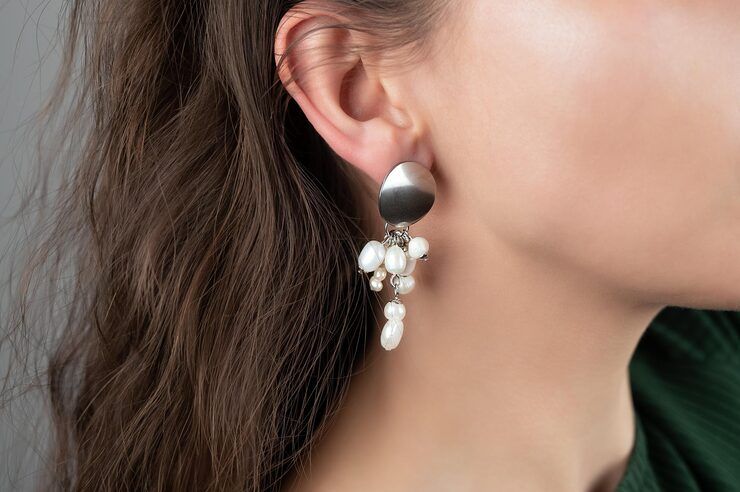
Pearl drop earrings are jewellery pieces in which one or more pearls hang below an earring fitting. The pearl may be attached directly beneath a stud, suspended from a metal element, or incorporated into a more elaborate design containing gemstones and decorative components.
The style is known for its vertical silhouette. A small pearl can create a subtle appearance, while a larger pearl can produce a more prominent effect. Designers also use different pearl shapes, including round, oval, button, baroque, and drop forms.
Pearl earrings can be made with cultured freshwater pearls, Akoya pearls, South Sea pearls, Tahitian pearls, and, in much rarer circumstances, natural pearls.
How Pearl Drop Earrings Are Constructed
A typical pearl drop earring contains several components:
Pearl or pearl cluster
Earring post or hook
Metal setting
Connecting wire or loop
Backing or fastening mechanism
Optional diamonds or colored gemstones
The connection between the pearl and the metal component is particularly important. Pearls are organic gemstones and are softer than many traditional jewellery materials, so their mounting requires appropriate handling.
Major Pearl Types
| Pearl Type | Typical Characteristics | Common Jewellery Use |
|---|---|---|
| Freshwater | Wide range of shapes and colors | Earrings, necklaces |
| Akoya | Usually round with strong luster | Classic pearl jewellery |
| South Sea | Larger size and soft, rich luster | Fine jewellery |
| Tahitian | Naturally dark body colors | Contemporary jewellery |
| Natural | Formed without human cultivation | Rare and collectible pieces |
The term "cultured" does not mean artificial. Cultured pearls are genuine pearls formed through human-assisted cultivation within mollusks.
Important Pearl Quality Factors
Pearl quality is generally evaluated using several characteristics rather than a single measurement.
Important factors include:
Luster
Surface quality
Shape
Size
Color
Nacre quality and thickness
Matching between multiple pearls
Orient
Overall symmetry
Luster is particularly important because it describes the quality and intensity of light reflected from the pearl's surface.
Why Pearl Drop Earrings Matter Today
Pearl drop earrings remain relevant because their vertical design can complement different face shapes, hairstyles, and clothing styles. They can also range from simple minimalist designs to elaborate fine-jewellery pieces.
The category is relevant to the broader pearl jewellery, fine jewellery, cultured pearl earrings, South Sea pearl earrings, and luxury pearl jewellery markets.
Versatility in Jewellery Design
Pearl drops can be incorporated into many design approaches:
Classic pearl drop earrings
Diamond and pearl earrings
Gold pearl earrings
Silver pearl earrings
Long pearl drop earrings
Minimalist pearl drops
Baroque pearl earrings
Multi-pearl drop designs
Contemporary geometric pearl earrings
The shape and length of the drop influence the visual character of the earring. A short drop can create a restrained profile, while a longer design produces more movement.
Natural Versus Cultured Pearls
Natural pearls form without deliberate human intervention and are comparatively rare. Cultured pearls are created through controlled cultivation in which a mollusk is introduced to a process that stimulates pearl formation.
Both can be genuine pearls. The distinction concerns how the pearl originated.
Why Pearl Luster Matters
Pearl luster is created by light interacting with the layers of nacre. A pearl with strong, sharp reflections generally appears more visually vibrant than one with a dull or chalky surface.
Surface condition also matters. Blemishes can influence appearance, while shape affects how the pearl sits within the overall earring design.
Recent Pearl Jewellery Developments in 2025–2026
Pearls continued to appear prominently in contemporary jewellery discussions during 2025 and 2026, particularly as designers combined traditional pearl forms with modern silhouettes.
Contemporary Pearl Styling
Modern pearl jewellery increasingly extends beyond traditional round white pearl strands. Designers have incorporated baroque shapes, mixed gemstones, asymmetric arrangements, and architectural metal settings.
Pearl drop earrings are particularly adaptable to this direction because the drop structure allows designers to combine a pearl with chains, geometric elements, diamonds, or colored gemstones.
Baroque and Irregular Pearls
Irregular pearls have continued to attract attention in contemporary jewellery because their shapes can provide a more individual appearance than perfectly round pearls.
Baroque pearls can vary considerably in shape, surface character, size, and luster. Their natural irregularity can become a central design feature rather than something concealed.
Lightweight Jewellery
The wider jewellery market has also experienced changes associated with elevated precious-metal prices. The World Gold Council reported that global jewellery demand volume declined during 2025 while jewellery demand value reached a record level. Its 2026 research has also highlighted lightweight jewellery as an adaptation in several markets.
This broader trend can influence pearl earrings through slimmer metal components, smaller fittings, and designs that emphasize the pearl itself rather than substantial metal structures.
Personalization and Mixed Materials
Contemporary jewellery styling increasingly combines pearls with:
Yellow gold
White gold
Rose gold
Platinum
Diamonds
Colored gemstones
Textured metal
Geometric components
Pearl drop earrings therefore fit both traditional and contemporary jewellery categories.
Laws, Hallmarking and Jewellery Policies in India
India provides an important regulatory example because precious-metal components used in jewellery can fall under the BIS hallmarking framework.
Hallmarking primarily concerns the precious-metal content of the jewellery. It does not establish the pearl's species, origin, cultivation method, luster, treatment, or quality.
BIS Hallmarking
The Bureau of Indian Standards states that hallmarking is the official determination and recording of the proportionate precious-metal content in covered articles. Gold and silver are currently included within India's hallmarking framework.
For gold jewellery, BIS identifies six permitted fineness grades:
14K — 585
18K — 750
20K — 833
22K — 916
23K — 958
24KS — 995
Therefore, an 18K gold pearl-drop earring and a 22K gold pearl-drop earring can contain the same type of pearl while having different gold-purity specifications.
HUID Identification
Since July 1, 2021, the hallmark on covered gold jewellery consists of the BIS logo, purity/fineness information, and a six-digit alphanumeric HUID. BIS states that consumers can verify HUID information using the BIS Care App.
For earrings sold as a pair, BIS states that each article in the pair should have its own hallmark and HUID where applicable.
Recent 2026 Hallmarking Changes
India's mandatory hallmarking framework continued to receive amendments during 2025 and 2026. BIS lists amendments dated July 31, 2025, March 2, April 28, and August 3, 2026. The current mandatory-hallmarking page was updated September 1, 2026.
On March 2, 2026, BIS added seven districts to the sixth phase of mandatory hallmarking coverage, including districts in Punjab, Uttar Pradesh, Maharashtra, Tripura, Bihar, Rajasthan, and Madhya Pradesh.
These rules concern applicable precious-metal jewellery and should not be interpreted as a quality certification for the pearl itself.
Tools and Resources for Pearl Drop Earrings
Understanding pearl earrings involves examining both the pearl and the metal components.
Useful Resources
BIS Care App: Useful for verifying HUID information on applicable hallmarked gold jewellery.
BIS Hallmarking Portal: Provides current information about India's hallmarking framework.
Pearl identification guides: Help distinguish freshwater, Akoya, South Sea, Tahitian, and natural pearls.
Digital calipers: Useful for measuring pearl diameter and earring dimensions.
Jewellery scales: Help determine the overall weight of earrings.
Pearl grading references: Explain luster, surface quality, shape, color, and size.
Gemological laboratories: Can provide independent identification and assessment for qualifying gemstones and jewellery.
Jewellery loupe: Useful for examining pearl surfaces, drill holes, settings, and metal components.
Pearl-care guides: Provide handling and storage recommendations.
Measurements Worth Comparing
When researching pearl drop earrings, useful specifications include:
Pearl diameter
Pearl shape
Pearl type
Pearl color
Luster
Surface quality
Nacre characteristics
Earring length
Metal purity
Earring weight
Closure type
Gemstone details
Pearl size alone does not determine quality. A smaller pearl with excellent luster and surface quality can have very different characteristics from a larger pearl with weaker luster or more visible surface marks.
Pearl Care
Pearls are relatively soft compared with many gemstones. They can be scratched by harder materials and may be affected by chemicals.
Good general care practices include:
Keep pearls separate from harder jewellery.
Wipe them gently after wearing.
Avoid prolonged exposure to perfumes and cosmetics.
Avoid harsh cleaning chemicals.
Store them in a soft pouch or lined compartment.
Avoid ultrasonic cleaning unless a qualified professional confirms suitability.
Handle pearl drops carefully around their connecting components.
Because pearl nacre is sensitive, routine gentle handling is preferable to aggressive cleaning.
Frequently Asked Questions
What are pearl drop earrings?
Pearl drop earrings are earrings in which one or more pearls hang below an earring fitting. They can feature freshwater, Akoya, South Sea, Tahitian, or natural pearls and can use gold, silver, platinum, or other metals.
What is the difference between freshwater and Akoya pearls?
Freshwater pearls are generally cultivated in freshwater mussels and can occur in many shapes. Akoya pearls are cultivated primarily in saltwater oysters and are commonly associated with round shapes and strong luster.
Are cultured pearls real pearls?
Yes. Cultured pearls are genuine pearls formed within mollusks through human-assisted cultivation. The distinction from natural pearls relates to how pearl formation begins.
What should be considered when choosing pearl drop earrings?
Important characteristics include pearl type, luster, surface quality, shape, size, color, matching, earring length, metal purity, closure design, and the quality of the connection between the pearl and its setting.
Can pearl earrings be cleaned with jewellery cleaners?
Many conventional jewellery cleaners are not appropriate for pearls. Gentle wiping with a soft, damp cloth is generally safer. Pearls should be protected from harsh chemicals, abrasive materials, and unnecessary exposure to strong cleaning methods.
Conclusion
Pearl drop earrings combine the organic character of pearls with the structure and flexibility of modern jewellery design. Their vertical form allows designers to create everything from simple everyday earrings to elaborate pieces incorporating gold, diamonds, colored gemstones, and architectural metal elements.
Understanding pearl quality requires attention to more than size. Luster, surface condition, shape, color, nacre characteristics, and pearl type all contribute to the appearance and character of a pearl.
The jewellery landscape during 2025 and 2026 has also shown continued interest in contemporary pearl designs, irregular pearl shapes, mixed materials, and lightweight jewellery. These developments allow traditional pearl forms to be incorporated into more modern silhouettes.
In India, BIS hallmarking provides an important framework for identifying the purity of applicable precious-metal components. It does not certify the pearl's origin or quality, so metal documentation and pearl identification should be treated as separate areas of evaluation.
For anyone researching pearl drop earrings, cultured pearl earrings, South Sea pearl earrings, or fine pearl jewellery, the most useful factors to examine are pearl type, luster, surface quality, shape, size, metal purity, setting construction, and care requirements.
The enduring appeal of pearl drops comes from the combination of natural pearl characteristics, graceful movement, adaptable proportions, and the ability to connect traditional pearl jewellery with contemporary design.