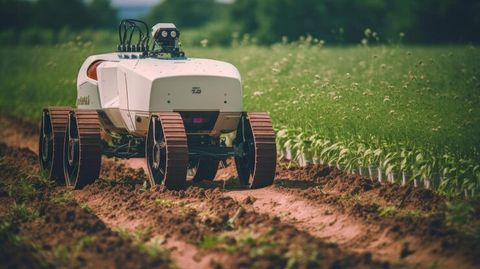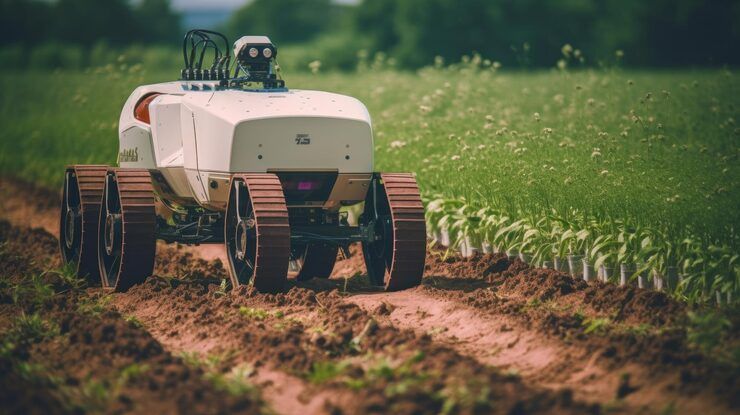
Agricultural robotics refers to the use of robots, automated machinery, artificial intelligence (AI), sensors, and computer vision to perform or support farming activities. These technologies help farmers manage crops, monitor soil conditions, control weeds, harvest produce, and collect information about agricultural land. Agricultural robotics is part of a broader movement toward precision agriculture, where technology helps guide decisions using detailed information about fields and crops.
Traditional farming relies heavily on human observation, mechanical equipment, and experience. Although these methods remain important, modern agricultural operations increasingly use automated systems to handle repetitive or time-sensitive tasks. Robots can operate in greenhouses, orchards, open fields, livestock facilities, and controlled agricultural environments.
Agricultural robotics exists to address practical challenges, including labor shortages, changing weather conditions, pressure on natural resources, and the need to produce food efficiently. Its development combines mechanical engineering, agricultural science, machine learning, satellite navigation, and industrial automation.
Main Types of Agricultural Robots
Autonomous tractors: Use positioning systems, sensors, and navigation software to assist with field operations.
Weeding robots: Identify unwanted plants and remove them mechanically or through targeted treatment.
Harvesting robots: Detect ripe produce and use robotic arms or specialized mechanisms to collect it.
Crop-monitoring robots: Gather information about plant health, soil conditions, and crop development.
Agricultural drones: Capture aerial images and help assess field conditions, crop variability, and irrigation patterns.
Livestock robots: Support activities such as feeding, monitoring animals, and cleaning certain agricultural facilities.
Each system serves a different purpose. A robot designed for delicate fruit harvesting, for example, requires different sensors and movement controls from a machine designed to navigate large grain fields.
Why Agricultural Robotics Matters Today
Agriculture faces several interconnected challenges. Farmers must manage production while responding to unpredictable rainfall, soil degradation, water limitations, and changing labor availability. Agricultural robotics can help address some of these pressures by improving the consistency and precision of selected operations.
Improving Productivity and Operational Efficiency
Robotic equipment can perform repetitive tasks with consistent movement and programmable operating patterns. Depending on the system and field conditions, this can reduce the time needed for activities such as crop inspection, mechanical weeding, planting, and material handling.
Autonomous machinery may also support extended operating periods when weather, safety requirements, and equipment specifications permit. However, real-world performance depends on field layout, crop type, machine reliability, and the need for human supervision.
Supporting Precision Agriculture
Precision agriculture uses information from sensors, satellite navigation, cameras, and mapping systems to guide farming decisions. Agricultural robots can collect data at plant level rather than treating an entire field as uniform.
For example, a crop-monitoring robot may identify areas with unusual leaf color or slower growth. Farmers can then investigate whether the pattern relates to pests, irrigation, nutrient availability, or another factor.
This approach can help improve the targeting of agricultural inputs and reduce unnecessary field operations. The results depend on the quality of the data and the accuracy of the decisions made from it.
Managing Water and Agricultural Resources
Water management is increasingly important in regions affected by drought, irregular rainfall, or groundwater pressure. Robots equipped with cameras and environmental sensors can help monitor crop conditions and identify variations across a field.
When combined with soil-moisture sensors and irrigation management systems, these observations may help farmers decide where closer inspection or irrigation adjustments are needed. Robotics does not replace sound water-management practices, but it can provide additional information for them.
Comparing Common Agricultural Robotics Applications
Application | Main function | Potential benefit |
|---|---|---|
Autonomous tractors | Navigate and perform field operations | Consistent field coverage |
Robotic weeders | Detect and remove unwanted plants | More targeted weed management |
Harvesting robots | Identify and collect suitable produce | Support for repetitive harvesting tasks |
Crop-monitoring robots | Inspect plants and gather field data | Earlier identification of crop variations |
Agricultural drones | Survey fields from above | Faster visual assessment of large areas |
Livestock robots | Automate selected routine activities | More consistent monitoring and handling |
These benefits are potential outcomes rather than guaranteed results. Suitability depends on farm size, crop characteristics, operating conditions, and the capabilities of the equipment.
Recent Developments in Agricultural Robotics
Agricultural robotics research is advancing through improvements in artificial intelligence, computer vision, autonomous navigation, and energy-efficient machine design. During 2025 and 2026, researchers have placed particular emphasis on making robots more reliable in changing field conditions and helping different automated systems work together.
Artificial Intelligence and Computer Vision
AI-powered agricultural robots increasingly use cameras and machine-learning models to distinguish crops from weeds, recognize plant features, and interpret their surroundings. These capabilities can support precision weeding, crop inspection, selective harvesting, and targeted field operations.
A research review published in Applied Soft Computing in May 2026 examined developments in AI for agricultural machinery and robotics, including visual control and intelligent decision-making.
The practical challenge is ensuring that these systems remain reliable when lighting changes, plants overlap, dust obscures cameras, or crops differ from the examples used during training.
Autonomous Navigation and Safer Operation
In March 2026, a review in the Journal of Field Robotics examined navigation and control strategies used by agricultural robots, including systems tested in real agricultural environments. Reliable movement across uneven ground and around obstacles remains a major technical requirement.
Newer approaches combine satellite positioning, cameras, radar, and LiDAR sensors. By combining information from different sources, a robot can improve its understanding of field boundaries and nearby objects, although performance still depends on sensor quality and environmental conditions.
Solar-Powered Agricultural Robots
Research published in March 2026 examined how solar energy and photovoltaic systems could support autonomous agricultural robots. The research considered energy management, environmental effects, and the practical limitations of operating solar-powered machines.
Solar-assisted designs may help extend operating time in suitable conditions. However, sunlight availability, battery storage, weather, equipment weight, and energy requirements influence whether a particular design is practical.
Collaborative and Multi-Robot Farming
Another developing area is the use of multiple robots that share information or perform different tasks within the same agricultural operation. For example, an aerial drone could survey a field while a ground robot inspects selected areas.
Research published in Frontiers in Plant Science on 19 August 2026 reviewed collaborative agricultural robots, including aerial platforms, ground vehicles, robotic arms, and underground systems. It highlighted challenges involving communication, coordinated control, energy use, and safety.
These developments indicate a shift toward connected agricultural automation rather than relying on individual machines for isolated tasks.
Laws, Regulations, and Government Policies
Agricultural robotics is affected by several areas of regulation. The exact requirements depend on the country, the machine's capabilities, where it operates, and whether it uses drones, chemical application equipment, or autonomous vehicles.
Machinery Safety and Autonomous Equipment
Agricultural machinery may need to meet applicable safety, braking, equipment, and operating requirements. As machines become more autonomous, safe stopping, obstacle detection, operator supervision, and emergency controls become particularly important.
In the European Union, Commission Delegated Regulation (EU) 2025/1117, dated 3 April 2025, amended requirements relating to braking and functional safety for agricultural and forestry vehicles. Its relevance depends on the vehicle and applicable regulatory provisions.
Agricultural Drones and Chemical Application
Drone operations may be subject to aviation rules, pilot qualifications, aircraft registration, and restrictions on the substances or equipment carried.
In the United States, agricultural drone operations involving chemical dispensing can fall under Federal Aviation Administration requirements, including applicable provisions of Parts 107 and 137. Additional authorizations or exemptions may be necessary depending on the aircraft and operation.
Farm operators should also check pesticide-label requirements and environmental rules before using robotic or drone-based spraying equipment.
Government Support and Research Programs
Government initiatives can encourage agricultural innovation through research grants, demonstration projects, precision agriculture programs, and digital farming initiatives. Eligibility and funding arrangements differ between countries and change over time.
Farmers and agricultural technology developers should verify:
Applicable agricultural machinery and workplace safety rules.
Drone registration and operating permissions.
Pesticide and environmental protection requirements.
Data privacy and cybersecurity obligations for connected equipment.
Current government research, agricultural modernization, and technology-adoption programs.
Following these requirements helps ensure that agricultural automation is introduced responsibly. Compliance should be checked with the relevant national or regional authority before equipment is deployed.
Tools and Resources for Agricultural Robotics
Farmers, researchers, and agricultural technology professionals can use several digital tools to understand robotics, evaluate field conditions, and develop automation projects.
Agricultural Mapping and Data Analysis
Geographic Information Systems (GIS): Tools such as QGIS help map fields, analyze boundaries, and examine spatial agricultural data.
Satellite navigation: Global Navigation Satellite Systems (GNSS) help autonomous tractors and field robots determine their positions.
Crop monitoring platforms: Agricultural mapping and remote-sensing software can help identify variations in crop growth and field conditions.
Soil monitoring tools: Soil-moisture sensors and environmental monitoring systems provide information for irrigation planning and crop management.
Robotics Development and Simulation
ROS 2: A robotics software framework used to develop robot applications, integrate sensors, and manage communication between components.
Gazebo: A simulation environment for testing robot movement, sensors, and navigation before conducting field trials.
OpenCV: A computer vision library that supports image processing and plant-recognition experiments.
Python: A programming language frequently used for agricultural data analysis, machine learning, and robotics research.
Research and Learning Resources
Useful sources for further learning include university agricultural engineering departments, agricultural extension publications, peer-reviewed research journals, and government agriculture agencies.
When evaluating an agricultural robotics system, examine its navigation accuracy, operating environment, maintenance requirements, battery performance, compatibility with existing machinery, and ability to complete the intended task.
Frequently Asked Questions About Agricultural Robotics
What is agricultural robotics?
Agricultural robotics is the application of robotic machines, sensors, automation, and artificial intelligence to farming activities. These systems can support planting, crop monitoring, weeding, harvesting, irrigation management, and livestock care.
How does artificial intelligence help agricultural robots?
Artificial intelligence helps robots interpret images, recognize plants, identify potential obstacles, and make decisions based on sensor information. Its effectiveness depends on the quality of the training data, the operating environment, and the reliability of the robotic system.
Can small farms use agricultural robotics?
Yes. Smaller farms can explore compact robotic equipment, automated irrigation controllers, crop-monitoring sensors, and shared agricultural technology arrangements. The most appropriate option depends on farm layout, crop type, technical support, and available resources.
Are agricultural robots completely autonomous?
Not always. Some systems perform specific tasks independently under controlled conditions, while others require an operator to supervise movement, configure operations, or respond to unexpected situations. Human oversight remains important when safety or environmental conditions change.
What is the future of agricultural robotics?
Future development is likely to focus on more reliable autonomous navigation, improved crop recognition, collaborative robots, energy-efficient equipment, and integration with precision agriculture platforms. Wider adoption will depend on practical field performance, safety, reliability, and suitability for different farming systems.
Conclusion
Agricultural robotics is becoming an important part of modern farming by combining mechanical automation, artificial intelligence, computer vision, and precision agriculture. These technologies can support more consistent field operations, improve crop monitoring, and help farmers make decisions using detailed agricultural data.
Recent developments in autonomous navigation, solar-assisted robotics, and collaborative systems demonstrate continuing progress. However, challenges involving reliability, energy management, environmental variability, safety, and integration with existing agricultural practices remain significant.
A practical approach is to identify a specific farming challenge, evaluate the available technology, and assess its performance under real operating conditions. With appropriate planning, training, and regulatory compliance, agricultural robotics can contribute to more informed, adaptable, and resource-conscious farming practices.