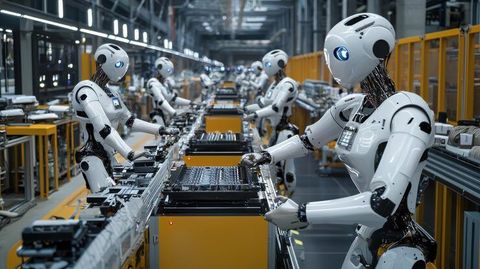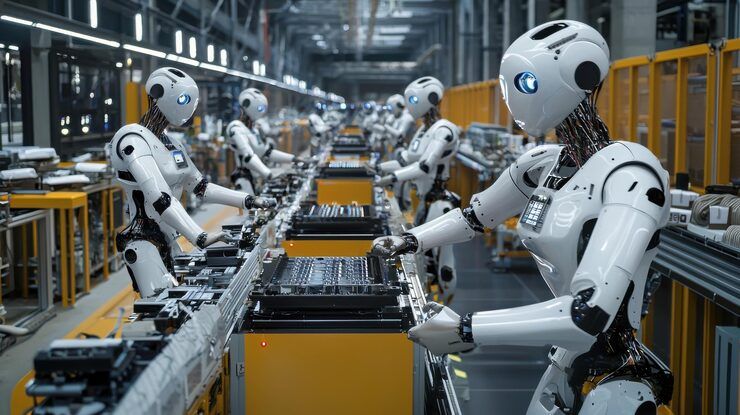
AI-powered factory robots are industrial machines that use artificial intelligence, sensors, cameras, and computer software to perform manufacturing tasks with varying levels of independence. Unlike traditional industrial robots that follow fixed instructions, AI-enabled robots can analyze information, recognize patterns, and adjust certain actions when production conditions change.
These systems combine robotics engineering, computer vision, machine learning, industrial automation, and real-time data processing. They are increasingly associated with smart factories, Industry 4.0, and intelligent manufacturing systems.
Traditional robots commonly repeat programmed movements to weld metal, assemble components, or move materials. AI-powered systems can also identify different objects, detect irregularities, and respond to changes in their surroundings. Their capabilities depend on their sensors, software, training data, and the task they are designed to perform.
How AI-powered factory robots work
An AI-powered industrial robot typically operates through several connected technologies:
Sensors and cameras: Collect information about objects, equipment, temperature, position, and movement.
Computer vision: Helps identify components, inspect surfaces, and recognize objects on production lines.
Machine learning: Uses patterns in data to support classification, prediction, and selected decision-making tasks.
Robotic control systems: Translate instructions into physical movements, including gripping, lifting, cutting, and assembling.
Industrial connectivity: Connects robots with production equipment, manufacturing execution systems, and other factory software.
For example, a robot on an electronics assembly line may use a camera to identify a component, determine its orientation, and position it accurately. Another system may examine manufactured parts and flag visible defects for further inspection.
AI does not mean every robot can learn or operate independently without supervision. Many industrial robots still rely on predefined programs, engineered limits, and human approval for important decisions.
Common types of factory robots
AI-powered manufacturing includes several categories of robotic equipment.
Robotic arms: Perform welding, painting, assembly, and material handling.
Collaborative robots (cobots): Are designed for applications where people and robots work in shared or nearby spaces, subject to appropriate safety measures.
Autonomous mobile robots (AMRs): Navigate factory environments to move components, tools, and materials.
Machine vision inspection robots: Examine products for defects, dimensions, or assembly errors.
AI-enabled picking robots: Identify and handle objects with different shapes, sizes, or orientations.
Why AI Robotics Matters in Modern Manufacturing
Manufacturers operate in environments where product quality, equipment availability, production speed, and workplace safety are important. AI-powered factory robots can help address these requirements by combining automated movement with data-driven analysis.
Improving production efficiency
Industrial automation can reduce repetitive manual handling and maintain consistent movement patterns during long production cycles. AI can support adjustments when components vary slightly or production conditions change.
For example, an automotive factory may use robotic arms for welding while a vision system checks the position of each component. Coordinating these processes can help identify problems earlier and reduce unnecessary rework.
However, overall performance depends on system integration, maintenance, component availability, and the reliability of the underlying process.
Quality control and defect detection
AI-powered machine vision can analyze product images to identify scratches, incorrect assembly, missing components, or unusual surface patterns. This can support quality assurance in electronics, automotive manufacturing, food processing, and pharmaceutical production.
Unlike a simple inspection system that checks only predefined measurements, a trained AI model may recognize more complex visual patterns. Nevertheless, it can miss unfamiliar defects or incorrectly flag acceptable products. Human review and ongoing validation remain important for critical applications.
Predictive maintenance and equipment monitoring
Predictive maintenance uses information such as vibration, temperature, motor current, and operating history to estimate when machinery may require attention.
AI models can help identify unusual patterns before a failure occurs. Maintenance teams can then investigate the equipment and plan appropriate intervention.
These systems do not guarantee that breakdowns will be prevented. Their usefulness depends on sensor quality, historical data, maintenance procedures, and the ability to distinguish genuine warnings from normal variations.
Workforce support and workplace safety
Robots can take on selected repetitive, physically demanding, or hazardous tasks. Workers may then focus on programming, equipment supervision, maintenance, quality assurance, and process improvement.
At the same time, introducing AI robotics changes training requirements and workplace responsibilities. Employees may need skills in robot programming, industrial networking, data interpretation, and machine safety.
Robots also introduce risks involving unexpected movement, crushing, collision, electrical equipment, and software failures. Proper risk assessment and protective systems are essential.
Where AI-powered factory robots are used
| Industry | Typical application | Potential benefit |
|---|---|---|
| Automotive | Welding and component assembly | Consistent production processes |
| Electronics | Component placement and inspection | Accurate handling and defect detection |
| Food processing | Sorting, packing, and visual inspection | Repeatable handling and product checks |
| Pharmaceuticals | Material handling and packaging | Controlled and traceable processes |
| Warehousing | Autonomous material movement | Improved coordination of internal logistics |
| Metal fabrication | Robotic cutting and welding | Repeatable movements and process monitoring |
These benefits vary by factory layout, product type, operating conditions, and implementation quality.
Recent Developments in AI-Powered Factory Robots
AI robotics is evolving through improvements in generative AI, computer vision, simulation, industrial connectivity, and robotics foundation models. These developments aim to make robots more adaptable, easier to program, and better at interpreting complex environments.
Trends during 2025–2026
Vision-language-action models: These models combine visual information, language instructions, and robot actions. Researchers are exploring how they can help robots understand tasks described in ordinary language and translate them into physical actions. Reliable operation in real factories still requires extensive testing and safety controls.
Generative AI for industrial engineering: Manufacturers are exploring generative AI to assist with robot programming, technical documentation, troubleshooting, and production planning. Generated instructions must be checked by qualified personnel before they are used to control physical equipment.
Digital twins and simulation: A digital twin is a digital representation of a physical machine, production line, or facility. Simulation allows engineers to test robot paths, production layouts, and operating scenarios before changing real equipment.
Humanoid and general-purpose robots: Companies and research organizations are developing robots intended to perform multiple physical tasks rather than one narrowly defined operation. Industrial adoption depends on reliability, payload, operating speed, safety, and the ability to perform consistently over extended periods.
Edge AI and industrial connectivity: Processing data near the equipment can reduce dependence on remote computing for some applications. Industrial networks also support coordination among robots, sensors, and factory control systems.
These are active areas of development, but not every emerging technology is mature enough for widespread industrial use. Pilot results should be distinguished from verified performance in continuous production.
Measuring the impact of factory robotics
Manufacturers can evaluate AI-powered robots using operational indicators rather than relying on general claims about automation.
| Performance indicator | What it measures |
|---|---|
| Overall equipment effectiveness (OEE) | Equipment availability, performance, and quality |
| Defect rate | The proportion of products that fail quality requirements |
| Cycle time | Time needed to complete a production task |
| Unplanned downtime | Production time lost to unexpected interruptions |
| False-positive rate | Acceptable products incorrectly flagged as defective |
| Mean time to repair (MTTR) | Average time required to restore equipment after a failure |
Tracking these indicators before and after implementation helps determine whether a system is delivering measurable improvements. Results should account for changes in product mix, staffing, production volume, and operating conditions.
Laws, Policies, and Industrial Robot Safety
AI-powered factory robots must comply with applicable machinery safety, workplace health, electrical safety, and data protection requirements. The exact rules depend on the country, the type of equipment, and how the robot is deployed.
AI software introduces additional considerations, including system reliability, cybersecurity, data governance, and the consequences of automated decisions. Manufacturers should review applicable requirements before deploying systems on production lines.
European Union machinery regulations
The EU Machinery Regulation (EU) 2023/1230 establishes requirements relating to machinery safety, conformity assessment, and technical documentation. Its main application date is 20 January 2027, although certain provisions apply earlier.
For industrial robots, manufacturers and system integrators should assess relevant safety requirements, protective measures, instructions, and conformity obligations. AI-enabled machinery may also need to be evaluated under other applicable European rules, depending on its functions and risks.
United States workplace safety requirements
In the United States, the Occupational Safety and Health Administration (OSHA) enforces workplace safety requirements that can apply to industrial robot installations. Relevant areas include machine guarding, control of hazardous energy during maintenance, personal protective equipment, and worker training.
OSHA also identifies consensus standards, including ANSI/RIA industrial robot safety standards and relevant ISO standards, as useful references for assessing robot-system hazards. A robot's safety requirements depend on its complete installation, including tools, surrounding machinery, and human access.
Artificial intelligence governance and cybersecurity
The NIST AI Risk Management Framework provides voluntary guidance for identifying, assessing, and managing AI-related risks. It can help organizations establish procedures for testing, monitoring, documentation, and accountability.
Factories should also consider industrial cybersecurity measures, including restricted access to robot controllers, secure software updates, network segmentation, and recovery plans. A compromised control system could disrupt production or create physical hazards.
Policies in India
Indian factories must consider applicable national and state workplace safety requirements, machinery-related rules, and relevant technical standards. The Occupational Safety, Health and Working Conditions Code, 2020, is part of India's labour-law framework; its applicability and operative provisions should be checked against current government notifications and relevant implementing rules.
The Bureau of Indian Standards develops standards relevant to machinery, electrical equipment, and industrial safety. Government manufacturing and technology initiatives may also support industrial modernization, although participation requirements vary by programme.
Organizations operating across countries should obtain a jurisdiction-specific compliance review rather than assume that one safety standard satisfies every legal obligation.
Tools and Resources for AI Factory Robotics
Several categories of software and technical resources help engineers plan, test, monitor, and maintain AI-powered industrial robots.
Robot simulation and programming
RobotStudio: ABB's simulation and programming environment for planning robot cells, testing movements, and examining production layouts.
RoboDK: A robot simulation and offline programming platform supporting multiple industrial robot brands.
ROS 2: An open-source robotics software framework used for communication, integration, and robotics application development.
Gazebo: A robotics simulation environment for testing robot behaviour and interactions with simulated surroundings.
The appropriate tool depends on the robot manufacturer, control architecture, programming experience, and intended application.
AI development and machine vision
OpenCV: A computer vision library for image processing, object detection workflows, and visual inspection applications.
PyTorch: A machine learning framework used to develop and evaluate neural networks.
TensorFlow: A machine learning platform that supports model development and deployment.
Industrial vision software: Manufacturer-specific tools can configure cameras, lighting, image acquisition, and inspection rules.
AI models should be tested using representative production data, including unusual conditions and examples of defective products.
Planning, monitoring, and evaluation
Manufacturing teams can use production dashboards, maintenance management software, and industrial data platforms to monitor equipment performance. Digital twin tools can support virtual testing before physical changes are introduced.
A practical evaluation checklist includes:
Define the task and acceptable performance limits.
Record current cycle time, defect rate, and downtime.
Assess workplace hazards and necessary safeguards.
Verify sensor accuracy and AI model performance.
Test abnormal conditions and recovery procedures.
Train operators and maintenance personnel.
Review performance regularly after deployment.
These steps help connect AI robotics decisions with measurable production requirements.
Frequently Asked Questions
What makes an industrial robot AI-powered?
An AI-powered industrial robot uses techniques such as machine learning, computer vision, or AI-based planning to interpret information and support certain actions. Traditional robots generally follow programmed sequences, although modern industrial systems may combine conventional automation with AI.
Can AI-powered factory robots work alongside humans?
Yes. Collaborative robots and appropriately designed robotic systems can operate in environments shared with people. However, collaboration must be evaluated for the specific application, including speed, force, tooling, workspace, and foreseeable failure conditions. A collaborative robot is not automatically safe for every shared workspace.
Which industries use AI-powered factory robots?
Automotive, electronics, food processing, pharmaceuticals, metal fabrication, and warehousing are among the industries using industrial robotics and related AI technologies. Common applications include inspection, assembly, welding, sorting, and internal material movement.
Do AI factory robots eliminate manufacturing errors?
No. AI can help identify certain defects and improve process consistency, but robots and AI models can still make mistakes. Poor lighting, unexpected components, sensor failures, software problems, and unfamiliar product variations can affect performance. Quality checks and human oversight remain important.
What skills are useful for working with AI-powered factory robots?
Relevant skills include robotics programming, mechanical and electrical engineering, machine vision, industrial automation, data analysis, cybersecurity, and safety assessment. The specific requirements depend on whether someone designs, programs, operates, integrates, or maintains the system.
Conclusion
AI-powered factory robots are an important part of modern industrial automation. By combining robotic movement with machine vision, machine learning, sensors, and manufacturing data, these systems can support assembly, inspection, material handling, and predictive maintenance.
Their practical value depends on the application, data quality, equipment integration, workforce training, and measurable operating results. Safety regulations and cybersecurity also remain essential considerations as factories connect more equipment and introduce more sophisticated AI capabilities.
As robotics technology develops, manufacturers will need to evaluate new capabilities carefully, distinguish demonstrated results from experimental applications, and maintain appropriate human oversight. A structured approach to testing, compliance, and performance measurement can help organizations understand where intelligent robotics fits within their manufacturing operations.