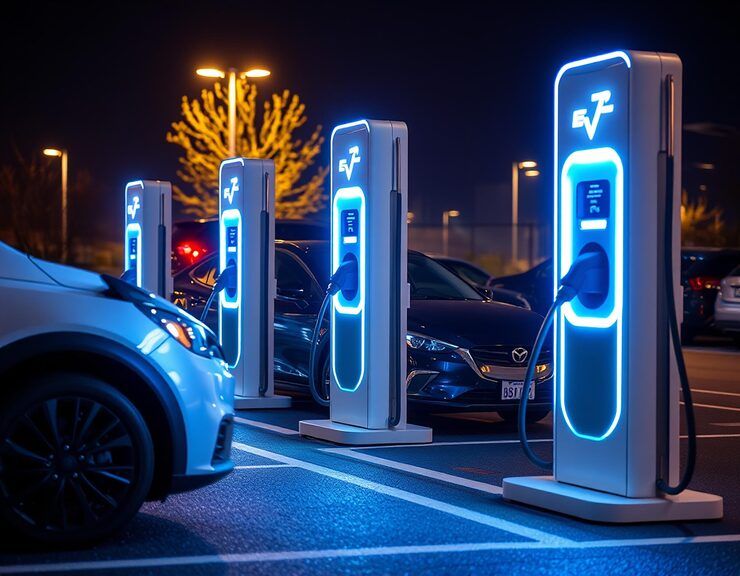
EV charging stations are electrical systems that transfer energy from the electricity grid or another power source into an electric vehicle's battery. They are an essential part of electric mobility because battery-powered vehicles need reliable access to electricity for everyday travel and longer journeys.
Charging infrastructure can be installed in homes, workplaces, apartment buildings, shopping areas, parking facilities, highways, fuel stations, fleet depots, and dedicated public charging locations.
Modern charging stations can include charging equipment, connectors, communication systems, payment interfaces, electrical protection, energy meters, software platforms, and network-management systems.
How EV Charging Works
When an electric vehicle is connected, the charging equipment communicates with the vehicle before electricity is transferred. The vehicle's onboard systems determine how much electrical power can be accepted.
There are two broad charging approaches:
AC charging: Alternating current reaches the vehicle and is converted to direct current by the vehicle's onboard charger.
DC fast charging: The charging station converts electricity before sending DC power directly to the vehicle battery, allowing higher charging power.
Actual charging time depends on battery capacity, battery state of charge, charger power, vehicle charging capability, temperature, and other technical conditions.
Main Types of EV Chargers
| Charger Type | Typical Application | General Characteristic |
|---|---|---|
| AC Level 1 | Residential | Lower-power charging |
| AC Level 2 | Homes, workplaces, public locations | Higher AC charging capability |
| DC Fast Charging | Public and highway locations | Much higher charging power |
| High-Power DC | Highway and fleet applications | Designed for rapid energy transfer |
| Depot Charging | Buses and commercial fleets | Supports scheduled fleet charging |
| Wireless Charging | Emerging applications | Transfers energy without a plug |
Terminology and power classifications can differ between countries, so charger specifications should always be checked against the applicable regional standards.
Why EV Charging Stations Matter Today
The growth of electric vehicles has created a corresponding need for charging infrastructure. A vehicle can only provide practical mobility when charging is available at appropriate locations and at suitable power levels.
Charging infrastructure therefore affects private EV owners, commercial fleets, public transport operators, property developers, utilities, parking operators, and governments.
Reducing Charging Gaps
Public charging infrastructure can support drivers who cannot charge conveniently at home. It is particularly important for apartment residents, long-distance travelers, commercial drivers, and people using electric vehicles across multiple locations.
Highway charging networks are also important because they can reduce the practical limitations associated with battery range.
Supporting Fleet Electrification
Commercial fleets can use centralized charging depots to coordinate vehicle charging around operating schedules.
Electric buses, delivery vehicles, taxis, vans, and other fleet vehicles can require different charging strategies from private passenger cars.
Fleet charging systems can include:
Scheduled charging
Load management
Multiple charging points
Energy monitoring
Vehicle identification
Remote diagnostics
Charging-session records
Grid Management
Large numbers of EVs can increase electricity demand, particularly when many vehicles charge simultaneously.
Smart charging systems can shift charging activity toward periods when electricity demand is lower or renewable generation is more available. This can help charging infrastructure interact more efficiently with the electricity grid.
Important EV Charging Factors
When evaluating an EV charging station, important factors include:
Charging power
Connector type
AC or DC architecture
Vehicle compatibility
Charging location
Electrical capacity
Communication protocol
Payment system
Network connectivity
Safety protection
Load-management capability
Installation requirements
Recent EV Charging Developments in 2025–2026
EV charging infrastructure expanded significantly in India during 2025 and 2026, alongside continued policy development and investment in public charging networks.
Expansion of Public Charging Infrastructure
On July 21, 2026, the Ministry of Heavy Industries reported 52,718 public charging stations in India, including 16,561 public charging stations equipped with fast chargers for cars. The same announcement highlighted continued government support for public charging infrastructure under FAME-II and PM E-DRIVE.
Earlier, on August 1, 2025, the government reported 29,277 public EV charging stations. The different reported totals reflect continued additions to the national charging network and differences in reporting dates.
PM E-DRIVE Charging Infrastructure
The PM E-DRIVE scheme includes an allocation of ₹2,000 crore for public EV charging infrastructure across India. Operational guidelines specifically for deployment of EV public charging stations were issued on September 26, 2025.
The framework includes participation by government ministries, central public-sector organizations, states, union territories, and their public-sector entities. Implementation can involve charging-point operators and other eligible participants.
2026 Charging Infrastructure Approvals
At a national conference held in Bengaluru on May 12, 2026, the Ministry of Heavy Industries announced approval of ₹123.26 crore for proposals involving 1,243 EV chargers in Karnataka. It also stated that proposals worth ₹503.86 crore had been approved for 4,874 chargers through states and central public-sector entities.
These developments indicate increasing attention to charging infrastructure beyond major metropolitan areas.
Fast Charging and Interoperability
Modern charging networks increasingly focus on interoperability, communication standards, connector compatibility, network management, and reliable operation.
The Ministry of Power's 2024 charging guidelines were designed to support a connected and interoperable national charging network.
Laws, Standards and Policies in India
India provides an important regulatory example because EV charging infrastructure is influenced by electricity regulations, technical standards, safety requirements, state-level permissions, and national EV programs.
EV Charging as an Unlicensed Activity
India has classified the setting up of EV charging stations as an unlicensed activity. Private entities can establish charging stations in accordance with the Ministry of Power's applicable guidelines.
This does not mean every installation is exempt from technical or local requirements. Electricity connections, electrical safety, land permissions, building requirements, fire protection, and other applicable rules can still apply depending on the location and installation.
Ministry of Power 2024 Guidelines
The Ministry of Power issued the Guidelines for Installation and Operation of Electric Vehicle Charging Infrastructure-2024 on September 17, 2024.
The guidelines apply to charging infrastructure in locations including:
Private parking areas
Office buildings
Educational institutions
Hospitals
Housing societies
E-bus depots
Commercial complexes
Railway stations
Airports
Metro stations
Parking facilities
Highways and expressways
The framework also addresses electricity connections, public land, tariffs, interoperability, and grid requirements.
Electricity Connections
The 2024 guidelines specify provisions intended to streamline electricity connections for charging infrastructure. EV charging station owners can opt for low-tension connections for loads up to 150 kW, subject to the applicable electricity-distribution framework.
The guidelines also include provisions concerning electricity tariffs and solar-hour charging.
Technical Standards
The Bureau of Indian Standards has published Indian Standards relevant to EV charging infrastructure. These cover areas such as connectors, communication protocols, EV supply equipment, and battery-swapping systems.
For a particular installation, the applicable standard depends on the charger type, electrical configuration, vehicle category, and intended application.
Tools and Resources for EV Charging Stations
EV charging infrastructure requires technical planning, location analysis, electrical calculations, software management, and ongoing monitoring.
Useful Tools
EV charging calculators: Estimate approximate charging duration from battery capacity and charger power.
Electrical load calculators: Help estimate the electrical demand created by charging equipment.
Route-planning applications: Help identify charging locations during longer journeys.
EV charging-network maps: Show charger locations, connector types, and availability information where supported.
Solar-generation calculators: Help evaluate potential integration between solar generation and EV charging.
Load-management software: Coordinates charging demand across multiple vehicles.
Energy-monitoring systems: Track electricity consumption and charging patterns.
CAD and electrical-design software: Helps design charging layouts and electrical infrastructure.
BIS standards resources: Useful for reviewing applicable Indian technical standards.
PM E-DRIVE guidelines: Provide information about the public charging infrastructure framework.
Key Specifications to Compare
When researching EV charging stations or commercial EV charging equipment, useful specifications include:
AC or DC configuration
Maximum charging power
Connector standards
Number of charging points
Vehicle compatibility
Input-voltage requirements
Communication protocols
Protection features
Network connectivity
Payment integration
Energy-metering capability
Remote monitoring
Load balancing
Environmental protection rating
Charging power should not be considered in isolation. A vehicle's maximum charging capability can limit the actual power received even when a station has a higher-rated charger.
Frequently Asked Questions
What is an EV charging station?
An EV charging station is electrical equipment that transfers energy to an electric vehicle's battery. It can be installed in residential, workplace, commercial, fleet, or public locations.
What is the difference between AC and DC charging?
AC charging supplies alternating current to the vehicle, where the onboard charger converts it to DC for the battery. DC fast charging performs the conversion within the charging equipment and can deliver substantially higher charging power.
How long does EV charging take?
Charging time depends on battery capacity, starting battery level, charger power, vehicle charging capability, temperature, and charging-system limitations. A simple estimate can be made by dividing the required energy by charging power, although actual charging can slow as the battery approaches a high state of charge.
Can an EV charging station be installed in India without a special license?
India treats setting up EV charging stations as an unlicensed activity, but installations still need to comply with applicable electricity, technical, safety, building, and local requirements. The Ministry of Power's 2024 guidelines provide the national framework.
What is fast EV charging?
Fast charging generally refers to higher-power charging, most commonly using DC charging equipment. The exact definition and power threshold can vary according to the market, vehicle category, and applicable technical standard.
Conclusion
EV charging stations are a fundamental part of the electric-mobility ecosystem. Their role extends beyond simply transferring electricity to a vehicle because modern charging infrastructure can incorporate communication, energy management, payment systems, monitoring, safety controls, and grid coordination.
The technology ranges from lower-power residential AC chargers to high-power DC systems designed for highway locations and commercial fleets. Choosing an appropriate configuration requires consideration of vehicle compatibility, electrical capacity, charging power, connector standards, installation conditions, and expected usage.
India's charging network has expanded considerably. Government data reported 29,277 public charging stations in August 2025 and 52,718 public charging stations by July 2026, while the PM E-DRIVE scheme allocated ₹2,000 crore toward public charging infrastructure.
The regulatory framework is also developing. India's 2024 Ministry of Power guidelines established a consolidated framework for charging infrastructure, while 2025 PM E-DRIVE operational guidelines provided a framework for deploying public EV charging stations.
For anyone researching EV charging stations, DC fast charging, commercial EV chargers, or electric vehicle charging infrastructure, the most important considerations are charger type, power rating, connector compatibility, electrical infrastructure, network connectivity, safety, location, and applicable standards.
As electric-vehicle adoption develops, charging infrastructure will increasingly become an integrated part of buildings, highways, parking facilities, fleets, renewable-energy systems, and electricity-grid management.