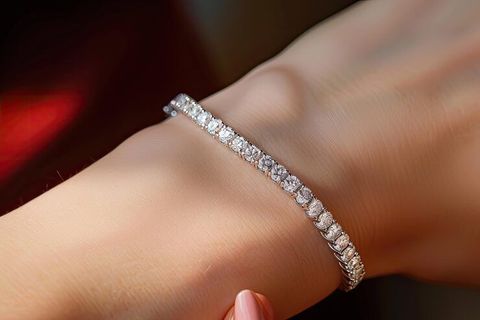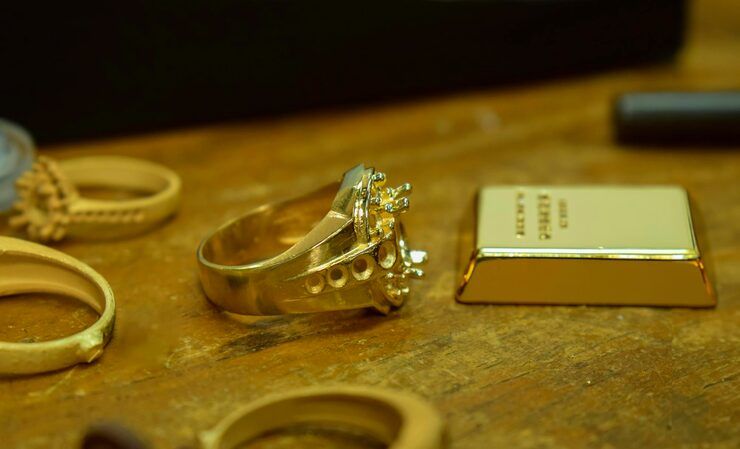
Matte finish gold pieces are jewellery articles with a deliberately subdued, non-reflective surface. Instead of the highly polished appearance associated with traditional high-shine gold jewellery, matte surfaces scatter light and create a softer visual effect.
The finish can be applied to rings, bracelets, necklaces, earrings, pendants, bangles, and other gold jewellery designs. It is a surface treatment rather than a different type of gold.
Several techniques can create a matte appearance. Brushing, sandblasting, satin finishing, texturing, bead blasting, and controlled abrasive finishing are among the methods used by jewellery manufacturers and artisans.
How a Matte Gold Surface Is Created
The final appearance depends on the texture produced on the metal surface. Fine abrasives can create a uniform satin effect, while directional brushing produces visible lines that create a contemporary appearance.
Some pieces combine matte and polished areas. Designers may leave selected edges or raised details highly reflective while keeping larger surfaces subdued.
This contrast is known as mixed-surface or two-texture jewellery and can make geometric patterns more visible.
Common Types of Matte Finishes
Satin finish: Smooth, soft, and lightly reflective.
Brushed finish: Contains fine directional lines.
Sandblasted finish: Produces a more granular appearance.
Bead-blasted finish: Creates a consistent textured surface.
Hammered finish: Uses deliberate surface impressions to create texture.
Mixed finish: Combines matte and polished sections.
The choice depends on the desired appearance, jewellery design, metal composition, and manufacturing process.
Why Matte Finish Gold Pieces Matter Today
Gold jewellery is increasingly being interpreted through texture, geometry, layering, and understated design rather than relying only on high reflectivity. Matte finishes can provide a different visual character while retaining the underlying properties of the gold alloy.
The distinction is especially relevant to consumers comparing gold jewellery designs, 18K gold jewellery, 22K gold jewellery, gold rings, gold bracelets, and designer gold jewellery.
Contemporary Design Applications
Matte gold surfaces can work particularly well with minimalist designs. Simple bands, geometric pendants, structured earrings, and modern bracelets can use texture to create visual depth without requiring elaborate decorative elements.
Matte surfaces are also frequently paired with gemstones or polished gold details. The contrast between reflective and subdued areas can make individual design elements easier to distinguish.
Practical Considerations
A matte surface is not permanently immune to changes. Regular contact with clothing, skin, other jewellery, household objects, and cleaning materials can gradually alter the texture.
Over time, frequently touched areas may become smoother or develop a more polished appearance.
| Finish Type | Visual Character | Common Applications | Maintenance Consideration |
|---|---|---|---|
| Matte | Soft and subdued | Rings, pendants, bracelets | Surface can gradually smooth |
| Satin | Fine, low-reflective texture | Earrings, bands | Avoid abrasive cleaning |
| Brushed | Directional lines | Bracelets, watches, rings | Lines may become less defined |
| Polished | High reflection | Traditional jewellery | Scratches can be more visible |
| Mixed | Matte + reflective | Contemporary designs | Different surfaces may age differently |
Recent Gold Jewellery and Matte-Finish Trends
The wider gold jewellery market experienced significant changes during 2025 and 2026. According to the World Gold Council's January 2026 full-year report, global jewellery demand volume declined 18% in 2025 to 1,542.3 tonnes, while the value of global jewellery demand increased 18% to a record US$172 billion.
This difference between volume and value is important when examining contemporary gold jewellery. Higher gold prices have encouraged many consumers to consider lighter-weight pieces while maintaining interest in gold jewellery.
Lightweight Designs in 2026
The World Gold Council reported in July 2026 that global gold jewellery demand fell to 278.2 tonnes in Q2 2026, down 17% year over year. At the same time, jewellery demand value increased 14% year over year to approximately US$40 billion.
The report also identified lightweight jewellery as an adaptation to the high-price environment across several markets. This can create opportunities for designers to explore thinner forms, smaller components, and texture-focused designs.
Texture and Minimalism
Matte surfaces fit naturally into minimalist jewellery because the texture itself becomes part of the design. Rather than depending entirely on gemstones or elaborate decoration, designers can use surface variation to create visual interest.
Popular approaches include:
Minimalist matte gold rings
Textured gold wedding bands
Satin-finish gold bracelets
Brushed gold earrings
Matte and polished gold combinations
Geometric gold pendants
Lightweight textured chains
Gold Market Conditions
The World Gold Council reported that Q1 2026 jewellery demand volume fell 23% year over year globally, while the value of jewellery demand reached a record US$47 billion. The organization attributed much of the volume pressure to elevated gold prices.
These conditions make design efficiency increasingly relevant. Lightweight construction and surface treatments can allow designers to create distinctive visual effects without relying exclusively on large quantities of metal.
Hallmarking and Gold Jewellery Policies in India
India provides an important regulatory example because gold jewellery is subject to BIS hallmarking requirements in covered districts and categories.
The Bureau of Indian Standards explains that hallmarking records the proportion of precious metal in an article and provides an official indication of fineness. Gold and silver are currently covered under India's hallmarking framework.
HUID Identification
Since the introduction of HUID in July 2021, the hallmark on covered gold jewellery consists of the BIS logo, purity/fineness information, and a six-digit alphanumeric Hallmark Unique Identification number.
The BIS states that consumers can verify the HUID through the BIS Care App.
A matte surface does not change the underlying gold purity requirements. The finish is a design characteristic, while hallmarking relates primarily to metal purity and identification.
Updates During 2025 and 2026
India's mandatory hallmarking framework continued to be updated during 2025 and 2026. BIS records amendments dated July 31, 2025, March 2, April 28, and August 3, 2026.
On March 2, 2026, BIS announced an additional seven districts covered under the sixth phase of mandatory hallmarking, including districts in Punjab, Uttar Pradesh, Maharashtra, Tripura, Bihar, Rajasthan, and Madhya Pradesh.
For jewellery businesses and consumers, the practical implication is that the applicable hallmarking requirements should be checked according to the current district coverage and article category.
Permitted Gold Fineness
BIS identifies six gold fineness grades permitted under IS 1417 for hallmarking:
14K — 585
18K — 750
20K — 833
22K — 916
23K — 958
24KS — 995
The exact grade used depends on the gold alloy and jewellery specification.
Tools and Resources for Matte Gold Jewellery
Understanding a matte gold piece involves both design evaluation and material verification. Several resources can help consumers, designers, manufacturers, and researchers.
Useful Resources
BIS Care App: Used in India to verify HUID information on applicable hallmarked gold jewellery.
BIS Hallmarking Portal: Provides information about hallmarking regulations, recognized centres, and registered jewellers.
Gold purity references: Useful for understanding differences between 14K, 18K, 20K, 22K, and 24K gold.
Jewellery design software: Helps create digital models and surface patterns.
3D modelling tools: Useful for developing rings, pendants, bracelets, and other detailed forms.
Gold weight calculators: Help estimate approximate metal weight based on dimensions and density.
Jewellery inspection tools: Magnification and measurement equipment can help examine surface texture and hallmark details.
World Gold Council research: Provides regularly updated information about global gold demand, jewellery trends, and market developments.
When evaluating a matte finish, useful questions include whether the texture is directional, granular, satin-like, hammered, or combined with polished sections.
Frequently Asked Questions
What are matte finish gold pieces?
Matte finish gold pieces are gold jewellery articles with a subdued, low-reflective surface. The appearance is produced through surface-finishing techniques such as brushing, blasting, satin finishing, or controlled texturing.
Is matte finish a different type of gold?
No. Matte describes the surface appearance rather than the gold purity. A matte ring may be made from 14K, 18K, 22K, or another recognized gold alloy depending on its specification.
Does a matte gold finish remain unchanged permanently?
Not necessarily. Repeated friction can gradually smooth the textured surface. Areas that receive frequent contact may develop a more polished appearance over time.
How can gold purity be checked in India?
For applicable hallmarked jewellery, consumers can examine the BIS hallmark and HUID and use the BIS Care App's HUID verification feature. BIS also provides information about recognized Assaying and Hallmarking Centres.
Can matte and polished gold be combined in one piece?
Yes. Designers frequently combine different surface textures. Matte sections can be paired with polished edges, lines, geometric details, or gemstone settings to create contrast.
Conclusion
Matte finish gold pieces represent a design approach in which surface texture becomes an important part of jewellery aesthetics. Satin, brushed, blasted, hammered, and mixed finishes can create visual depth while giving traditional gold forms a more contemporary character.
Recent gold-market data shows that high gold prices have reduced jewellery volumes while overall jewellery spending remains comparatively resilient. Lightweight and design-focused pieces are therefore becoming increasingly relevant to the changing jewellery environment.
For anyone researching matte gold jewellery, the key considerations include gold purity, surface-finishing technique, durability, maintenance, design construction, and applicable hallmarking requirements.
In India, BIS hallmarking and HUID verification provide an important framework for identifying the purity of covered gold jewellery. Because hallmarking rules and district coverage can change, current BIS information should be consulted when determining the requirements applicable to a particular article.
Matte finishing ultimately demonstrates how a relatively subtle surface treatment can significantly change the character of gold jewellery, creating designs that emphasize texture, proportion, craftsmanship, and understated visual appeal.