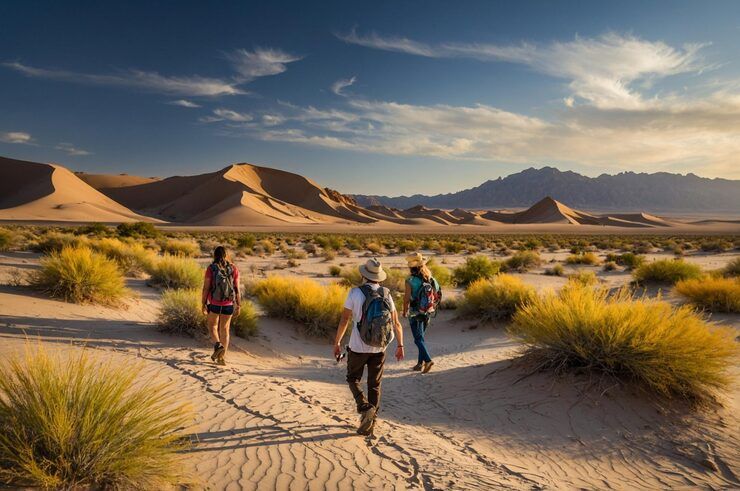
Desert exploration tours are organized journeys through arid landscapes where visitors can experience deserts, dunes, wildlife, local communities, geological features, and cultural traditions.
Desert tourism can include activities such as guided dune excursions, camel rides, wildlife observation, cultural visits, camping, photography, stargazing, and off-road exploration where permitted.
India has several desert landscapes, with the Thar Desert in Rajasthan being one of the country's most recognizable desert-tourism regions. Other arid areas across Gujarat, Ladakh, Haryana, and parts of the Deccan region also provide different forms of dry-land tourism.
Desert environments are distinct from conventional tourist destinations because temperatures can vary significantly between daytime and nighttime. Water availability, limited shade, difficult terrain, and distance from medical facilities can also affect travel planning.
A responsible desert exploration plan therefore considers both the visitor experience and the protection of the local environment.
Typical desert-tourism activities include:
- Guided desert walks
- Dune exploration
- Camel excursions
- Jeep or other permitted vehicle excursions
- Desert camping
- Stargazing
- Wildlife observation
- Landscape photography
- Local cultural experiences
- Visits to historic desert settlements
- Geological and ecological interpretation
The type of activity depends on local geography, regulations, weather conditions, conservation requirements, and community practices.
Why Desert Tourism Matters
Desert tourism can connect visitors with landscapes that have distinctive ecosystems, architecture, history, and cultural traditions.
In Rajasthan, desert tourism is closely associated with the Thar region and destinations such as Jaisalmer, Sam, Khuri, Bikaner, and Barmer.
Tourism can also contribute to local economies by creating demand for accommodation, transportation, food, handicrafts, cultural activities, and nature-based experiences. However, tourism in fragile environments needs careful management because excessive vehicle movement, waste, water consumption, and poorly planned construction can affect desert ecosystems.
The Thar Desert supports a variety of wildlife and plant species adapted to dry conditions. The Desert National Park near Jaisalmer and Barmer is an important protected area and habitat for species including the critically endangered Great Indian Bustard.
Desert travel also has educational value. Visitors can learn about:
- Desert ecology
- Water conservation
- Traditional architecture
- Local agriculture
- Nomadic and pastoral traditions
- Wildlife adaptation
- Astronomy and night skies
- Regional history
| Desert Activity | Main Considerations |
|---|---|
| Dune exploration | Terrain, weather, conservation |
| Camel excursion | Animal welfare and local rules |
| Wildlife observation | Distance and protected-area regulations |
| Camping | Waste management and designated areas |
| Photography | Privacy, wildlife, and local customs |
| Off-road driving | Permitted routes and environmental impact |
| Stargazing | Weather, light pollution, and visibility |
| Cultural visits | Local customs and community permissions |
Desert exploration therefore combines recreation, nature, culture, and environmental education.
Recent Developments in Desert Tourism
India's tourism sector has continued to place emphasis on sustainable, experiential, and destination-based travel during 2025 and 2026.
The Ministry of Tourism has continued implementing the Swadesh Darshan framework, which focuses on integrated development of thematic tourist destinations and infrastructure. The revised Swadesh Darshan 2.0 approach emphasizes sustainable and responsible tourism and destination development. (tourism.gov.in)
Rajasthan has also continued promoting tourism through its state tourism programs. The state's Tourism Unit Policy 2024 provides a framework intended to support tourism infrastructure and investment while incorporating sustainability and responsible tourism considerations. (tourism.rajasthan.gov.in)
In 2025, Rajasthan Tourism participated in international tourism events and promoted destinations across the state, including heritage, wildlife, culture, and desert experiences. (tourism.rajasthan.gov.in)
Sustainability has also become more important in desert destinations because fragile landscapes can be affected by uncontrolled vehicle movement, waste, water use, and construction.
Another continuing trend is the combination of desert travel with heritage tourism, wildlife tourism, cultural tourism, and astronomy experiences. This allows visitors to explore several aspects of a destination rather than focusing exclusively on dune activities.
The timing of desert travel also remains important. Seasonal weather, heat conditions, rainfall, and local tourism calendars can significantly affect the experience.
Laws, Regulations, and Policies in India
Desert exploration in India can be affected by tourism rules, protected-area regulations, wildlife laws, environmental requirements, vehicle restrictions, and local administrative rules.
The Wildlife (Protection) Act, 1972 provides the principal legal framework for wildlife protection in India. Activities within national parks, wildlife sanctuaries, and other protected areas can therefore be subject to specific entry, vehicle, photography, and behavioral requirements. (moef.gov.in)
The Desert National Park is a protected area in Rajasthan, and activities within or around protected habitats need to follow the applicable conservation and administrative requirements.
The Environment (Protection) Act, 1986 provides a broader legal framework for environmental protection. Depending on the project, location, and activity, environmental regulations can affect tourism infrastructure and development. (moef.gov.in)
Tourism development is also influenced by government programs. The Ministry of Tourism's Swadesh Darshan framework emphasizes sustainable and responsible destination development. (tourism.gov.in)
Rajasthan's Tourism Unit Policy 2024 also provides state-level guidance for tourism-related development and recognizes sustainability considerations. (tourism.rajasthan.gov.in)
Travelers should follow local instructions concerning protected areas, wildlife, designated routes, camping locations, waste disposal, fire use, and vehicle access.
Rules can differ between destinations, so information from the relevant tourism department, protected-area authority, or local administration should be checked before traveling.
Tools and Resources for Desert Exploration
Several resources can help travelers plan desert exploration responsibly.
- Ministry of Tourism: Provides information about national tourism programs, destination development, and travel initiatives.
- Rajasthan Tourism: Provides information about Rajasthan destinations, heritage sites, wildlife areas, and tourism activities. (tourism.rajasthan.gov.in)
- India's protected-area resources: Useful for checking national parks, wildlife sanctuaries, and conservation requirements.
- Weather applications: Help monitor temperature, rainfall, wind, and severe-weather conditions.
- Offline maps: Useful in areas where mobile connectivity can be inconsistent.
- Navigation tools: GPS-based navigation can help with permitted routes and location awareness.
- First-aid checklists: Useful for preparing for remote environments.
- Sun-exposure calculators and weather indexes: Can help travelers understand heat and ultraviolet exposure.
- Biodiversity resources: Useful for learning about local plants, birds, mammals, and reptiles.
- Travel checklists: Can help organize water, sun protection, navigation equipment, medicines, identification documents, and communication equipment.
Before entering a remote desert area, travelers should verify weather conditions, road conditions, local access restrictions, communication availability, and the location of the nearest medical facilities.
Frequently Asked Questions
What is the best time for desert exploration in India?
The most comfortable period depends on the destination, but Rajasthan's desert tourism generally has greater activity during the cooler months. Summer temperatures can become extremely high, so travelers should check current weather conditions before planning outdoor activities.
What should travelers carry for a desert trip?
Useful items can include adequate drinking water, sun protection, lightweight clothing, a hat, suitable footwear, personal medicines, identification documents, a charged phone, navigation tools, and appropriate emergency supplies.
Are desert areas safe for independent exploration?
Some desert environments are remote and have limited water, communication, roads, and medical facilities. Guided travel or clearly planned routes can reduce navigation and emergency risks, particularly in unfamiliar or protected areas.
Can visitors drive vehicles across desert dunes?
Vehicle access varies by location. Some areas have designated routes or restrictions intended to protect the landscape and wildlife. Travelers should use only permitted routes and follow local regulations.
Can visitors camp anywhere in the desert?
No. Camping permissions and restrictions vary by location. Protected areas and environmentally sensitive zones may prohibit camping or restrict it to designated locations.
Planning a Responsible Desert Journey
Good desert travel planning begins with understanding the destination rather than treating all deserts as the same environment.
The Thar Desert contains settlements, agricultural areas, wildlife habitats, roads, protected landscapes, and privately managed tourism areas. Conditions can therefore vary considerably between locations.
A practical preparation process can include:
Check the destination → Review weather → Confirm access rules → Plan transport → Prepare water and sun protection → Share the itinerary → Follow local guidance
Heat management is particularly important. Travelers should avoid assuming that cool nighttime temperatures mean daytime conditions are mild.
Water management is equally important because distances between settlements and facilities can be substantial in some desert areas.
Environmental responsibility should also be part of the plan. Visitors can reduce their impact by staying on permitted routes, avoiding littering, minimizing unnecessary plastic waste, respecting wildlife, and following restrictions on fires and camping.
Animal welfare should also be considered during activities involving camels or other working animals. Visitors can observe whether animals appear adequately rested, hydrated, and appropriately handled.
Cultural sensitivity is important as well. Desert regions are home to communities with distinct languages, traditions, crafts, clothing, food, and religious practices. Photography and visits to private spaces should follow local customs and permissions.
Desert Tourism and Environmental Sustainability
Desert ecosystems can appear empty at first glance, but they contain specialized plants and animals adapted to limited water and extreme temperature conditions.
Vehicle traffic can disturb wildlife and damage vegetation. Waste can remain in arid environments for long periods, while excessive water use can place pressure on local resources.
Responsible tourism therefore focuses on minimizing environmental disturbance.
Important practices include:
- Using designated vehicle routes
- Avoiding sensitive wildlife areas
- Carrying waste out of natural areas
- Using water carefully
- Avoiding unnecessary plastic
- Following protected-area instructions
- Respecting wildlife observation distances
- Avoiding removal of rocks, plants, fossils, or other natural materials
- Supporting locally appropriate cultural practices
Sustainable destination planning is also part of India's broader tourism policy approach through programs such as Swadesh Darshan 2.0. (tourism.gov.in)
The Future of Desert Exploration Tours
Desert tourism is increasingly connected with sustainable travel, wildlife conservation, cultural tourism, heritage tourism, adventure travel, and experiential tourism.
In Rajasthan, the Thar Desert provides a combination of natural landscapes, historic settlements, traditional architecture, wildlife habitats, and cultural experiences. Other Indian arid regions offer different landscapes and activities.
Future tourism development will need to balance visitor access with conservation. Better destination planning, responsible transportation, waste management, water management, and protection of sensitive habitats can help reduce environmental pressure.
Government programs such as Swadesh Darshan 2.0 emphasize sustainable and responsible tourism development, while protected-area legislation establishes additional conservation requirements for wildlife and sensitive environments. (tourism.gov.in)
For travelers, the essential principles remain straightforward: understand local conditions, prepare for heat and remoteness, follow applicable rules, respect communities and wildlife, and minimize environmental impact.
Desert exploration is therefore not only an outdoor travel activity. It can also provide an opportunity to understand arid ecosystems, regional culture, conservation, geography, and sustainable tourism.