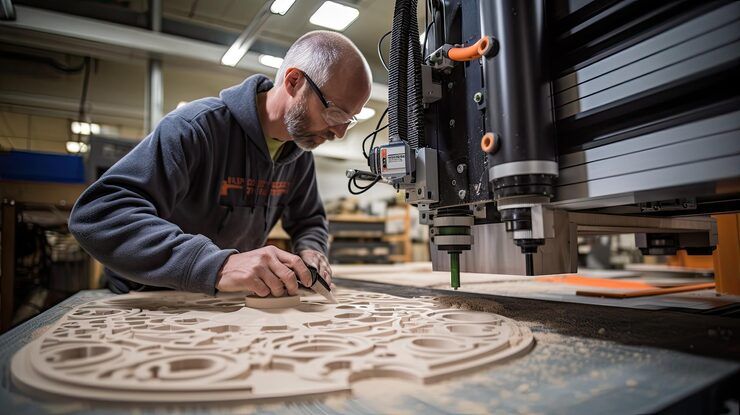
A computer numerical control (CNC) wood router is a machine that uses computer instructions to cut, carve, drill, engrave, and shape wood-based materials. Unlike a manually operated router, a CNC system follows programmed toolpaths to perform repeatable operations with limited direct intervention during machining.
CNC wood routers are used in furniture manufacturing, cabinetmaking, architectural woodworking, decorative panel production, signmaking, and custom wood fabrication. They can process solid wood, plywood, medium-density fibreboard (MDF), and certain composite materials when the machine and cutting tools are suitable for the material.
How CNC Wood Routing Works
The process generally begins with a digital design created in computer-aided design (CAD) software. Computer-aided manufacturing (CAM) software then converts the design into toolpaths and machine instructions, commonly expressed as G-code. The CNC controller interprets these instructions and coordinates the movement of the cutting tool along the required axes.
Most CNC wood routers use three primary axes: X for horizontal movement, Y for movement across the work area, and Z for vertical movement. Some advanced machines incorporate additional rotary axes for more complex shapes.
The typical workflow includes:
Creating or importing a digital design.
Selecting the material, cutter, and machining strategy.
Generating and checking toolpaths.
Securing the workpiece and setting the machine's reference position.
Running the machining program and monitoring operations.
Inspecting dimensions, surface finish, and overall quality.
The final result depends on machine rigidity, spindle performance, cutting-tool geometry, material properties, programming accuracy, and operator experience.
Why CNC Wood Routers Matter Today
Precision and Production Consistency
CNC woodworking supports repeatable manufacturing by following the same programmed toolpath across multiple workpieces. This is particularly useful when producing cabinet components, furniture panels, door designs, decorative screens, and interlocking parts.
Dimensional consistency can reduce manual rework and help manufacturers maintain established product specifications. However, actual accuracy depends on machine calibration, tool condition, material movement, and environmental factors such as humidity.
Automation and Manufacturing Efficiency
Automated routing can combine several operations within one programmed workflow, including drilling, pocketing, profiling, and engraving. This can reduce repeated manual positioning and make complex designs easier to reproduce.
CNC systems are also relevant to digital manufacturing, where design files, production instructions, and inspection records are connected through a coordinated workflow. Larger facilities may integrate routers with material-handling equipment, dust extraction systems, barcode tracking, and production-planning software.
Industries and Applications
CNC wood routers support several areas of manufacturing and design.
Furniture production: Cutting panels, creating joints, and shaping decorative components.
Cabinet manufacturing: Producing shelves, doors, drawer parts, and cabinet carcasses.
Architectural interiors: Machining wall panels, partitions, mouldings, and decorative screens.
Signmaking and engraving: Creating lettering, patterns, and carved graphics.
Prototyping: Producing scale models, design samples, and custom components.
Educational workshops: Teaching digital fabrication, CAD/CAM programming, and manufacturing principles.
These applications make CNC routing relevant to both small workshops and larger industrial facilities, although their machine requirements and production volumes differ considerably.
Factors That Influence Machining Performance
| Factor | Why It Matters |
|---|---|
| Spindle power and speed | Influence the suitable cutting tools and machining conditions |
| Work area | Determines the maximum practical workpiece dimensions |
| Machine rigidity | Affects vibration, cutting stability, and dimensional consistency |
| Controller and software | Determine programming compatibility and motion control |
| Dust extraction | Helps manage airborne wood dust and maintain a cleaner workspace |
| Tool selection | Influences cutting quality, edge condition, and machining time |
| Workholding | Prevents movement and supports consistent machining results |
Choosing appropriate operating parameters requires balancing cutting quality, machine capability, material characteristics, and tool life rather than relying on spindle speed alone.
Recent Developments and Industry Trends
Digital Manufacturing and Smarter Controls
During 2025 and 2026, digital manufacturing continued to emphasize connected equipment, production data, automation, and more integrated design-to-production workflows. These developments are relevant to CNC woodworking, although adoption varies by manufacturer, region, and facility size.
Modern CNC systems may include touchscreen controls, program simulation, automatic tool measurement, machine monitoring, and diagnostic features. Such capabilities can help operators identify programming errors and manage production more consistently.
It is important to distinguish broad manufacturing trends from specific product announcements. The availability of a particular feature depends on the machine model, software version, and installed equipment.
CAD/CAM Simulation and Digital Workflows
CAD/CAM software increasingly plays a central role in preparing complex woodworking projects. Toolpath simulation allows operators to review cutter movement and identify certain collisions, machining errors, or inefficient paths before starting a physical operation.
Digital design libraries also help teams standardize recurring components and maintain consistent dimensions across related projects. Nevertheless, simulation cannot replace correct machine setup, appropriate workholding, physical inspection, or safe operating procedures.
Dust Management and Energy Awareness
Wood dust management remains an important issue in automated woodworking. Effective extraction can improve workshop cleanliness, reduce airborne particulate exposure, and limit dust accumulation around electrical and mechanical equipment.
Manufacturers may also evaluate spindle efficiency, compressed-air use, standby power, cutting-tool life, and material utilization. These factors can affect the overall environmental and operational performance of a woodworking facility.
Artificial Intelligence and Automation
Artificial intelligence is being explored across manufacturing for tasks such as predictive maintenance, process monitoring, defect detection, and production scheduling. In CNC woodworking, these capabilities may support the identification of unusual machine behavior or variations in finished components.
However, advanced monitoring features are not standard across all CNC routers, and their usefulness depends on available sensor data, integration quality, and the reliability of the underlying system.
Regulations, Standards, and Government Policies
Workplace Safety Requirements
CNC wood routers combine high-speed rotating cutters, moving mechanical parts, electrical systems, and combustible wood dust. Appropriate safeguards are essential to reduce risks associated with entanglement, flying debris, noise, and airborne particles.
Applicable requirements depend on the country, workplace, machine configuration, and type of operation. Employers and workshop operators should identify the rules governing machinery guarding, emergency stops, operator training, personal protective equipment, and maintenance.
In the United States, relevant Occupational Safety and Health Administration (OSHA) requirements include machine guarding under 29 CFR 1910.212 and occupational wood-dust controls under applicable substance-specific and general industry provisions. The precise requirements depend on the circumstances.
Machinery Standards and Electrical Safety
Relevant technical standards may address woodworking machinery safety, electrical equipment, control systems, and risk assessment. For example, ISO 19085 is a series of standards covering the safety of woodworking machines, with different parts addressing different machine categories and configurations.
Compliance should be assessed against the specific machine type and the edition or legal adoption applicable in the relevant jurisdiction. A standards reference alone does not establish that a machine or workplace is compliant.
Environmental and Dust-Control Policies
Woodworking facilities may need to comply with occupational exposure limits, local air-quality rules, waste-management requirements, and fire-prevention provisions. Dust collectors, ducting, filters, and housekeeping procedures should be suitable for the materials and processes involved.
Wood dust can create both respiratory and fire or explosion hazards under certain conditions. Facilities should follow applicable engineering guidance and assess combustible-dust risks rather than assuming that a standard extraction unit eliminates every hazard.
Government Manufacturing Programs
Some governments support manufacturing modernization, technical education, digitalization, and industrial productivity through grants, training initiatives, or technology-development programs. Eligibility and availability vary by country and may change over time.
Organizations considering such programs should check current official guidance for the relevant region. They should also distinguish general manufacturing support from programs that specifically cover CNC machinery or woodworking equipment.
Tools and Resources for CNC Wood Routing
CAD and CAM Software
CAD/CAM applications help users create designs, generate cutting paths, and prepare machine instructions. The appropriate software depends on the complexity of the design, controller compatibility, and the operator's technical experience.
Common options include:
Autodesk Fusion: Combines computer-aided design with manufacturing tools and CNC toolpath planning.
VCarve: Supports woodworking layouts, decorative carving, lettering, and toolpath preparation.
Carbide Create: Provides design and toolpath features for compatible CNC machining workflows.
FreeCAD: Offers open-source CAD capabilities, with CAM functionality available through its Path workbench and related workflows.
Users should verify supported file formats, post-processors, controller compatibility, and licensing terms before integrating software into a production environment.
CNC Calculators and Planning Tools
Machining calculators help estimate suitable spindle speeds, feed rates, chip loads, and cutting conditions. These values depend on cutter diameter, flute count, material, machine rigidity, and the manufacturer's recommendations.
Useful planning resources include:
Feed-rate calculators: Estimate tool movement based on spindle speed and chip load.
Material utilization spreadsheets: Estimate sheet layouts, offcuts, and material requirements.
Toolpath simulators: Review programmed movements before machining.
Maintenance logs: Track spindle hours, cutter changes, lubrication, and inspection dates.
Production time estimators: Calculate expected machining time from toolpaths and operating conditions.
Calculators provide starting estimates rather than guaranteed operating settings. Test cuts and manufacturer guidance remain important, especially when working with unfamiliar materials or tools.
Training and Technical References
Technical documentation is an important resource for safe and consistent CNC operation. Machine manuals explain startup procedures, controller functions, maintenance intervals, and emergency-stop arrangements.
Additional learning resources include CAD/CAM training courses, technical colleges, woodworking engineering publications, machine-tool manuals, and recognized occupational-safety guidance. Practical instruction should cover workholding, tool selection, dust extraction, program verification, and emergency procedures.
Maintenance and Quality-Control Records
Routine inspection helps identify developing mechanical or electrical problems before they affect production. A maintenance checklist can include spindle condition, axis movement, belts or ball screws, electrical connections, dust extraction, and cutting-tool wear.
Quality-control records may document workpiece dimensions, tolerances, surface defects, and corrective actions. These records are particularly useful when the same components must be reproduced over time.
Frequently Asked Questions
What materials can a CNC wood router process?
Many CNC wood routers can process solid wood, plywood, MDF, and selected composite boards. Some machines can also work with plastics or other compatible materials, provided the spindle, cutter, workholding, and operating conditions are appropriate. Always verify the machine and tool manufacturers' specifications.
What is the difference between a CNC wood router and a CNC milling machine?
A CNC wood router is generally designed for sheet materials, woodworking operations, and relatively large workpieces. CNC milling machines are commonly configured for rigid machining tasks involving metals and other engineering materials. These are general distinctions; machine capabilities overlap, and the suitable equipment depends on the material and application.
Which software is needed to operate a CNC wood router?
A typical workflow uses CAD software to create or edit a design and CAM software to generate toolpaths. A post-processor converts those paths into instructions compatible with the machine controller. Some applications combine design and manufacturing features, while others require separate programs.
How can CNC routing accuracy be improved?
Accuracy can be improved through proper machine calibration, secure workholding, sharp and appropriate cutters, suitable feed rates, and verified toolpaths. Operators should also account for material thickness variations, wood movement, machine vibration, and tool deflection. Measurement and inspection help confirm that the finished part meets its intended dimensions.
What safety precautions are important when operating a CNC wood router?
Operators should use functioning machine guards, effective dust extraction, appropriate eye and hearing protection, and safe workholding methods. Loose clothing and unsecured hair should be kept away from moving components. Operators must understand emergency stops and avoid reaching into the machine while hazardous motion continues. Maintenance and adjustments should follow the manufacturer's safe isolation procedures.
Conclusion
CNC wood routers connect digital design with automated woodworking, enabling repeatable cutting, carving, drilling, and engraving across a wide range of applications. Their role in furniture manufacturing, cabinetry, architectural interiors, prototyping, and digital fabrication makes them an important part of modern production workflows.
Performance depends on more than the machine itself. CAD/CAM preparation, cutting-tool selection, material characteristics, machine calibration, maintenance, and operator training all contribute to finished quality and operational consistency.
As manufacturing continues to adopt connected equipment, simulation, and data-driven monitoring, CNC woodworking workflows may become increasingly integrated. At the same time, workplace safety, dust control, applicable machinery standards, and environmental requirements remain essential considerations.
A clear understanding of CNC technology, technical resources, and regulatory responsibilities helps workshops and manufacturers evaluate their processes, maintain consistent results, and make informed decisions about woodworking automation.