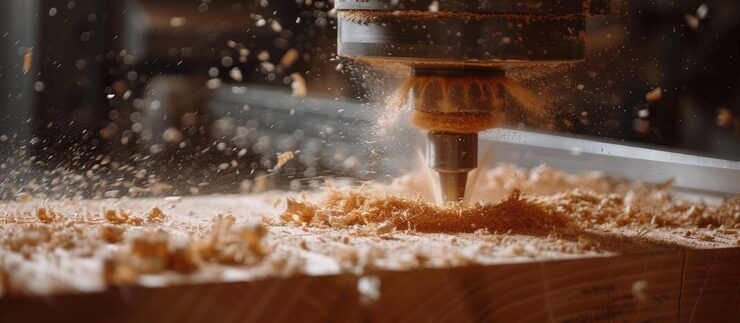
CNC milling machines are computer-controlled manufacturing systems that use rotating cutting tools to remove material from a workpiece. CNC stands for Computer Numerical Control, meaning machine movements are directed by programmed instructions rather than controlled entirely by manual operation.
These machines developed from conventional milling equipment as manufacturers needed greater repeatability, precision, and automation. Modern systems can produce components with complex pockets, slots, contours, holes, threads, and three-dimensional surfaces.
CNC milling is widely used for metals, engineering plastics, composites, and other machinable materials. It forms an important part of precision CNC machining, advanced manufacturing, aerospace machining, and industrial automation.
How CNC Milling Works
The process normally begins with a digital component model. Computer-aided manufacturing software converts the design into toolpaths that describe how the cutting tool should move.
The CNC controller interprets these instructions and coordinates the machine axes, spindle speed, cutting tools, and related functions.
A typical workflow includes:
Creating a CAD model
Preparing CAM toolpaths
Selecting cutting tools
Securing the workpiece
Establishing machine coordinates
Loading the CNC program
Running machining operations
Inspecting the finished component
Modern machining centers can also include automatic tool changers, probing systems, coolant management, chip evacuation, and automated workpiece handling.
Main CNC Milling Configurations
CNC machines are commonly described by the number of controlled axes.
| Configuration | Typical Movement | Common Application |
|---|---|---|
| 3-axis | X, Y and Z | General component machining |
| 3+2 axis | Indexed rotary positioning | Multi-face components |
| 4-axis | Linear axes plus rotation | Cylindrical and complex parts |
| 5-axis | Simultaneous multi-direction movement | Aerospace and complex geometry |
| Vertical machining center | Vertical spindle | General precision manufacturing |
| Horizontal machining center | Horizontal spindle | Multi-face and production machining |
Five-axis systems can position the cutting tool relative to a workpiece from several directions, reducing the need to repeatedly reposition complex components.
Why CNC Milling Matters Today
Manufacturing increasingly requires components with precise dimensions, complex geometry, consistent quality, and shorter development cycles. CNC milling addresses many of these requirements by connecting digital engineering data directly with machining equipment.
The technology affects aerospace, automotive, medical-device, electronics, energy, tooling, robotics, defense, and general engineering industries.
Precision and Repeatability
Computer control allows machine movements to be programmed with high accuracy. Once a machining process has been properly developed, the same programmed operations can be repeated across multiple components.
Actual accuracy depends on factors including:
Machine rigidity
Cutting-tool condition
Workholding
Thermal stability
Material characteristics
Spindle condition
Toolpath strategy
Machine calibration
A CNC machine's stated positioning specification should therefore not be interpreted as a guarantee that every finished component will automatically achieve the same tolerance.
Complex Component Manufacturing
Modern 5-axis CNC milling machines can produce complex surfaces used in turbine components, aerospace structures, molds, medical components, and precision engineering.
Multi-axis machining can reduce the number of separate setups required for some components. Fewer setups can also reduce errors caused by repeated repositioning.
Materials Commonly Machined
CNC milling can process materials including:
Aluminum alloys
Stainless steel
Tool steel
Titanium
Copper
Brass
Engineering plastics
Composite materials
Nickel-based alloys
Tool material, spindle speed, feed rate, cutting depth, cooling method, and toolpath strategy must be selected according to the workpiece material and desired result.
Recent CNC Milling Developments
CNC machining continued to evolve during 2025 and 2026 around automation, connected manufacturing, digital simulation, machine monitoring, and multi-axis technology.
Advanced Manufacturing in India
On February 23, 2026, India's Office of the Principal Scientific Adviser and Ministry of Heavy Industries conducted a stakeholder consultation at the Central Manufacturing Technology Institute in Bengaluru focused on advanced manufacturing systems.
The consultation brought together manufacturing enterprises, MSMEs, technology developers, research institutions, startups, and academic participants to discuss India's advanced manufacturing ecosystem.
This broader advanced-manufacturing direction is relevant to CNC machining because machine tools, robotics, digital manufacturing, automation, and production monitoring increasingly operate as interconnected systems.
Digital Twins and Simulation
One significant trend is greater use of virtual machining and digital twins.
CAM simulation can help engineers evaluate:
Tool movements
Machine-axis limits
Potential collisions
Workholding interference
Tool reach
Material removal
Cycle characteristics
Advanced simulation can reduce the likelihood of discovering programming problems only after a component reaches the physical machine.
Machine Monitoring
Connected CNC equipment can collect information from controllers, sensors, spindle systems, and production processes.
Monitoring platforms can help track machine utilization, spindle behavior, tool conditions, production interruptions, and machining parameters.
These technologies form part of the broader Industry 4.0 manufacturing environment.
Five-Axis Machining
Five-axis technology continues to expand beyond highly specialized aerospace environments. Improved CAM systems and CNC controls have made complex multi-axis machining more accessible across precision engineering applications.
Five-axis machining can be particularly useful when a component contains multiple angled surfaces or complex three-dimensional geometry.
Automation Around CNC Equipment
Robotic loading, pallet systems, automated workholding, probing, and tool measurement are increasingly being integrated with machining centers.
Automation does not eliminate the need for skilled engineering. Process planning, fixture design, programming, tool selection, inspection, and machine maintenance remain important.
Laws, Standards and Policies in India
India provides an important regulatory example because CNC milling equipment can be affected by machinery-safety, electrical, workplace, and conformity requirements.
Machinery Safety Framework
India introduced the Machinery and Electrical Equipment Safety (Omnibus Technical Regulation) Order, 2024, covering specified machinery and electrical equipment. BIS maintains Scheme-X information covering machinery categories subject to technical regulation requirements.
Metal-cutting machine tools appear within the machinery categories listed under the Scheme-X framework.
The precise requirements for a particular CNC milling machine depend on classification, specifications, and applicable standards.
BIS Machine-Tool Guidance
During 2025, BIS published machine-category guidance covering metal-cutting machine tools under the Machinery and Electrical Equipment Safety framework.
The guidance addresses technical documentation, product grouping, marking, certification, and applicable Indian Standards.
Manufacturers and importers should determine which current requirements apply to their particular machine rather than relying solely on a general description such as "CNC milling machine."
Important Safety Considerations
CNC milling involves high-speed rotating tools, moving axes, electrical equipment, sharp chips, workholding forces, and cutting fluids.
Relevant safety measures can include:
Machine guarding
Interlocked access doors
Emergency stopping controls
Electrical protection
Secure workholding
Chip containment
Tool inspection
Safe maintenance procedures
Operator instructions
Appropriate personal protective equipment
Safety systems should be considered part of machine operation rather than separate accessories.
Tools and Resources for CNC Milling
Modern CNC machining depends on a combination of mechanical equipment, digital software, measurement technology, and process data.
CAD and CAM Tools
CAD software is used to create component geometry, while CAM software generates machining strategies and CNC toolpaths.
CAM platforms can support:
2D milling
3D contouring
Pocket machining
Drilling
High-speed machining
Multi-axis milling
Toolpath simulation
Useful Manufacturing Resources
Cutting-speed calculators: Help determine appropriate machining parameters.
Feed-rate calculators: Assist with programmed tool movement.
Tool-life tracking: Helps monitor cutting-tool usage.
CNC simulation software: Identifies possible programming or collision issues.
Machine probing systems: Measure workpiece position and selected dimensions.
Coordinate measuring machines: Provide detailed dimensional inspection.
Surface roughness equipment: Evaluates machined surface characteristics.
Tool presetters: Measure cutting tools before machining.
Digital maintenance records: Track inspections and machine condition.
BIS Know Your Standard: Helps users locate relevant Indian Standards and amendments.
Specifications Worth Comparing
When researching industrial CNC milling machines, important technical parameters include:
Axis configuration
X, Y and Z travel
Spindle speed
Spindle power
Tool capacity
Table dimensions
Maximum workpiece weight
Positioning accuracy
Repeatability
Rapid traverse rate
CNC controller
Probing capability
Automation compatibility
Chip-management system
Coolant configuration
Machine selection should be based on the intended components and manufacturing requirements rather than one specification alone.
Frequently Asked Questions
What is a CNC milling machine?
A CNC milling machine is a computer-controlled machine tool that removes material using rotating cutting tools. Programmed instructions control the machine axes and machining operations.
What is the difference between 3-axis and 5-axis CNC milling?
A 3-axis machine primarily moves along the X, Y and Z axes. A 5-axis machine adds rotational movement, allowing the cutting tool to approach the workpiece from additional directions.
What materials can CNC milling machines process?
Common materials include aluminum, steel, stainless steel, titanium, brass, copper, engineering plastics, and selected composites. Appropriate tooling and machining parameters depend on the material.
What software is used with CNC milling machines?
CAD software creates component geometry, while CAM software develops machining toolpaths. CNC controllers then interpret machine instructions, commonly represented through G-code and related commands.
How accurate is CNC milling?
Accuracy depends on machine design, calibration, tooling, workholding, thermal conditions, programming, material, and inspection methods. Different machines and applications therefore have different achievable tolerances.
Conclusion
CNC milling machines are fundamental tools within modern precision manufacturing. By combining computer control with rotating cutting tools, they can transform digital component designs into accurately machined physical parts.
Three-axis machines remain important for general manufacturing, while four-axis, 3+2-axis, and five-axis configurations expand the ability to produce complex components. Automation, probing, simulation, and connected manufacturing systems are further extending these capabilities.
India's advanced-manufacturing initiatives and evolving machinery-safety framework also demonstrate increasing attention to modern production equipment and machine-tool compliance. Metal-cutting machinery appears within the BIS Scheme-X technical framework, making current standards and classification important considerations.
For anyone researching CNC milling machines, 5-axis CNC machining, precision CNC machining, industrial machining centers, or advanced manufacturing equipment, important considerations include machine configuration, spindle characteristics, accuracy, tooling, automation, software, workholding, inspection, and safety.
As manufacturing becomes more digitally connected, CNC milling is increasingly integrated with CAD/CAM systems, simulation, automated inspection, robotics, and production monitoring. These developments position CNC machining as an important bridge between digital engineering and physical manufacturing.