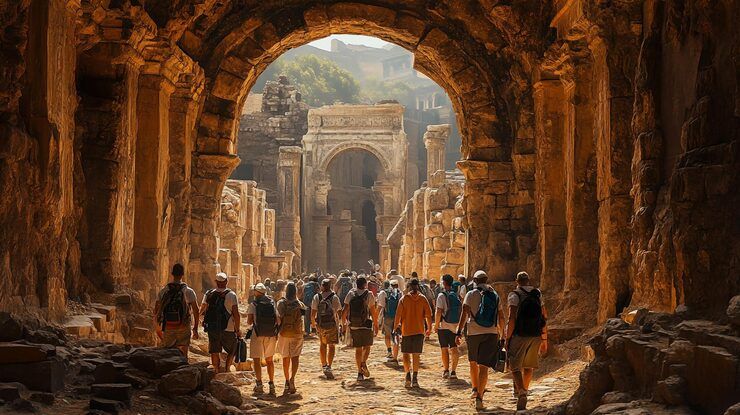
Ancient civilization tours provide a way to explore archaeological sites, historic cities, monuments, temples, burial grounds, museums, and landscapes connected with early human societies. These journeys can cover civilizations that developed thousands of years ago, including those in Egypt, Mesopotamia, Greece, Rome, South Asia, China, Mesoamerica, and other regions.
The purpose of an ancient civilization tour is not simply to see old buildings. Archaeological landscapes can provide evidence about architecture, religion, government, trade, technology, agriculture, warfare, art, and everyday life.
Modern heritage tourism combines these physical locations with museums, archaeological research, digital interpretation, conservation programs, and educational resources.
What Counts as an Ancient Civilization Site?
Ancient sites can vary greatly in appearance and purpose. Some are large cities with roads, houses, temples, and public buildings. Others are individual monuments or archaeological landscapes.
Examples include:
- Pyramids and monumental tombs
- Ancient temples
- Archaeological cities
- Fortifications
- Roman roads and settlements
- Ancient theaters
- Burial complexes
- Palaces
- Archaeological museums
- Religious sanctuaries
- Ancient agricultural landscapes
A site does not need to contain a completely preserved city to be historically significant. Archaeological remains, inscriptions, artifacts, and landscape features can all provide evidence about earlier societies.
Major Ancient Civilization Regions
| Region | Examples of Civilizations | Typical Archaeological Evidence |
|---|---|---|
| North Africa | Ancient Egypt, Carthage | Pyramids, temples, tombs |
| Mediterranean | Greek and Roman civilizations | Theaters, temples, forums |
| Middle East | Mesopotamian civilizations | Cities, ziggurats, tablets |
| South Asia | Indus Valley civilization | Planned cities, drainage systems |
| East Asia | Ancient Chinese civilizations | Tombs, walls, palaces |
| Central America | Maya and other civilizations | Pyramids, cities, inscriptions |
| South America | Andean civilizations | Roads, settlements, ceremonial structures |
The archaeological evidence differs from one region to another because civilizations developed under different environmental, political, technological, and cultural conditions.
Why Ancient Civilization Tours Matter
Ancient archaeological sites connect modern societies with evidence from earlier periods. They are important to researchers, educators, museums, local communities, and visitors interested in history.
Understanding Early Societies
Archaeological remains can reveal how ancient societies organized themselves.
Researchers can examine:
- Building techniques
- Food production
- Water management
- Trade networks
- Religious practices
- Burial traditions
- Writing systems
- Artistic styles
- Social organization
- Technological development
For example, ancient urban drainage systems can provide evidence about public infrastructure, while inscriptions can reveal political structures, religious beliefs, and languages.
Connecting Museums With Archaeological Sites
Museums and archaeological locations provide complementary information.
An archaeological site shows buildings and landscapes in their original geographical context. A museum can preserve objects discovered at sites and provide controlled environments for conservation and research.
A visit that combines both can therefore provide a broader understanding of an ancient civilization.
Cultural Heritage and Education
Ancient sites are important educational resources for schools, universities, researchers, and the general public.
They can help explain complex subjects through physical evidence rather than relying exclusively on written descriptions.
Heritage and Local Communities
Archaeological sites can also be connected with local identity and community history.
UNESCO's heritage framework increasingly recognizes that conservation involves not only monuments but also communities, landscapes, cultural practices, and contemporary urban development.
This is particularly relevant where ancient sites exist close to modern towns and cities.
Recent Developments and Trends
Ancient civilization tourism continues to change as governments, museums, universities, and heritage organizations adopt digital tools and new approaches to conservation.
Digital Archaeology
Digital mapping, 3D documentation, remote sensing, geographic information systems, and photogrammetry are increasingly used to document archaeological sites.
These technologies can help researchers record structures before deterioration, analyze landscapes, and create digital representations for education.
The UNESCO Urban Heritage Atlas, expanded with additional case studies in 2025, demonstrates how geographic information systems and cultural mapping can be used to understand historic urban environments. (whc.unesco.org)
Climate and Heritage Risks
Climate change has become an increasingly important issue for archaeological preservation.
Extreme heat, drought, flooding, erosion, changing humidity, storms, and rising sea levels can affect archaeological remains.
UNESCO's recent work on historic urban heritage has highlighted climate-related risks alongside uncontrolled development and other pressures affecting heritage areas. (unesco.org)
Digital Visitor Experiences
Museums and heritage authorities are increasingly using:
- Virtual tours
- Augmented reality
- Interactive maps
- Digital archives
- 3D models
- Multimedia interpretation
- Mobile guides
These tools can provide additional context without requiring visitors to physically interact with fragile archaeological remains.
Conservation Before Expansion
Modern heritage management increasingly emphasizes preservation and documentation rather than simply increasing visitor access.
This can result in controlled visitor routes, protective structures, restricted areas, timed entry, and digital alternatives for particularly fragile locations.
Laws, Policies, and Heritage Protection
Ancient archaeological sites are generally protected through national heritage laws, international conventions, site-specific regulations, and local management systems.
UNESCO World Heritage Framework
The 1972 UNESCO World Heritage Convention established an international framework for identifying and protecting cultural and natural heritage considered to have outstanding universal value.
Many ancient archaeological sites are included on the World Heritage List.
World Heritage status does not replace national law. Instead, countries remain responsible for protecting and managing their heritage properties under their own legal systems.
National Antiquities Laws
Countries generally maintain legislation governing archaeological excavation, conservation, ownership, export of antiquities, research permits, and access to protected sites.
The exact rules differ substantially.
Visitors may encounter restrictions covering:
- Photography
- Drones
- Tripods
- Touching monuments
- Climbing
- Archaeological excavation
- Artifact collection
- Metal detecting
- Commercial filming
- Access to restricted areas
Visitors should follow site-specific instructions rather than assuming that rules are identical across countries.
Protection Against Illicit Trafficking
International heritage policy also addresses the illegal movement of archaeological objects.
The 1970 UNESCO Convention provides an international framework concerning illicit import, export, and transfer of ownership of cultural property.
This is important because archaeological objects can lose significant historical information when removed from their original context.
Responsible Visitor Behavior
Visitors can support preservation by:
- Remaining on marked paths
- Not touching fragile surfaces
- Avoiding climbing on monuments
- Following photography restrictions
- Not removing archaeological material
- Respecting local communities
- Following staff instructions
- Avoiding unauthorized drone activity
These actions reduce physical and environmental pressure on heritage sites.
Tools and Resources for Ancient Civilization Tours
Modern technology provides several useful resources for researching archaeological destinations.
UNESCO World Heritage Centre
The UNESCO World Heritage Centre provides information about listed archaeological properties, their historical significance, boundaries, conservation status, and management frameworks.
It is useful for researching a destination before visiting and understanding why a site has international heritage recognition.
National Heritage Authorities
Government archaeology and heritage departments often provide the most current information about:
- Opening arrangements
- Archaeological research
- Visitor rules
- Conservation projects
- Photography regulations
- Temporary closures
- Site maps
Official national sources should be checked when planning a visit.
Digital Mapping
Mapping applications can help visitors understand the geography of archaeological landscapes.
Useful functions include:
- Walking routes
- Site locations
- Distances
- Elevation information
- Nearby museums
- Transportation
- Offline maps
For large archaeological complexes, examining the site's scale before arriving can help visitors estimate the time required.
Museum Databases
Many major museums provide searchable online collections. These databases can help visitors understand artifacts before seeing them in person.
Useful information may include:
- Object dates
- Archaeological locations
- Materials
- Dimensions
- Historical context
- Collection history
Digital Archaeology Resources
Researchers and interested visitors can also explore digital archives, satellite imagery, academic databases, 3D models, and archaeological publications.
These resources can provide additional context when physical access to a site is restricted.
Simple Research Checklist
Before visiting an ancient civilization site, check:
- Historical period
- Site map
- Current opening arrangements
- Weather conditions
- Accessibility
- Photography rules
- Archaeological restrictions
- Nearby museums
- Transportation
- Current conservation work
Frequently Asked Questions
What are ancient civilization tours?
Ancient civilization tours focus on archaeological sites, monuments, museums, historic cities, and landscapes connected with societies from earlier historical periods. They can combine cultural tourism with archaeology and heritage education.
Which civilizations can visitors explore?
Depending on the destination, visitors can explore evidence from ancient Egyptian, Greek, Roman, Mesopotamian, Persian, Indus Valley, Chinese, Maya, Aztec, Inca, and many other civilizations.
The archaeological evidence and preservation conditions vary considerably between regions.
Are ancient archaeological sites protected?
Most significant archaeological sites are protected through national heritage laws or regulations. Some also have UNESCO World Heritage status or other international recognition.
Specific protections depend on the country, archaeological designation, and individual site.
Can visitors take photographs at ancient sites?
Photography rules vary. Personal photography may be permitted in many areas, while flash photography, tripods, drones, commercial photography, or photography of specific objects may be restricted.
Visitors should check the current rules for each archaeological site or museum.
How can visitors learn more than what is visible at the ruins?
Museums, official archaeological websites, site interpretation panels, digital maps, academic publications, and virtual collections can provide additional context.
Combining an archaeological site with a nearby museum can help connect buildings and landscapes with artifacts and historical evidence.
Conclusion
Ancient civilization tours provide a direct way to explore the physical evidence left by societies that developed thousands of years ago. Archaeological sites reveal buildings, landscapes, infrastructure, inscriptions, and objects, while museums preserve artifacts and provide additional historical context.
Modern heritage tourism is increasingly influenced by digital archaeology, geographic information systems, 3D documentation, virtual interpretation, and climate-conscious conservation. These developments allow researchers and visitors to understand archaeological sites while reducing unnecessary pressure on fragile remains.
Heritage protection depends on national laws, international agreements, site-specific regulations, and responsible visitor behavior. Checking official archaeological authorities, UNESCO resources, museum databases, maps, and current site rules can help visitors prepare for a more informed experience.
The value of an ancient civilization tour ultimately extends beyond viewing old monuments. It provides an opportunity to examine how earlier societies organized cities, developed technologies, practiced religions, managed resources, created art, and interacted with their environments—and how those traces continue to shape the modern understanding of human history.