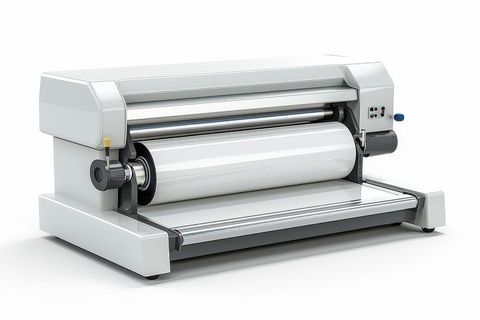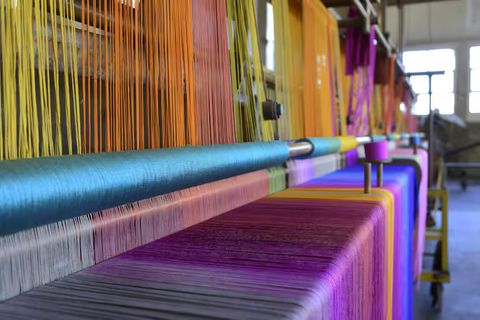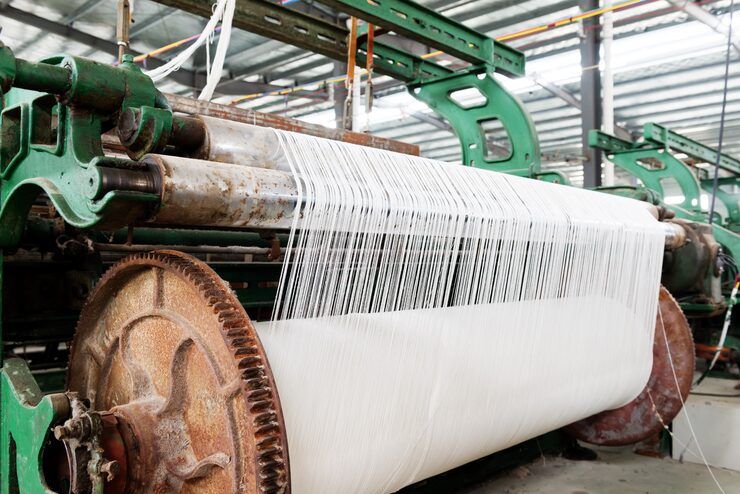
Air jet looms are shuttleless weaving machines that use compressed air to insert the weft yarn across the width of the fabric. Instead of carrying the yarn with a traditional shuttle, the machine uses a controlled stream of air to move the weft through the open warp shed.
This technology is widely used for high-speed production of woven fabrics. It can process many synthetic and natural yarn types and is commonly associated with applications such as apparel fabrics, home textiles, industrial fabrics, and technical textiles.
A modern air jet loom combines mechanical components, pneumatic systems, electronic controls, sensors, and digital monitoring. The coordination of these systems allows the loom to maintain controlled yarn insertion while the warp and weft form the fabric structure.
How Air Jet Weaving Works
The weaving cycle consists of several coordinated operations:
Warp yarns are held under controlled tension.
The shedding mechanism separates warp yarns to create an opening.
A main nozzle introduces the weft yarn into the shed.
Relay nozzles maintain the movement of the yarn across the weaving width.
A reed beats the inserted weft into position.
The fabric take-up system advances the completed fabric.
Sensors monitor yarn movement and detect selected faults.
Compressed air is therefore a central part of the weft-insertion process. Air pressure, nozzle timing, yarn characteristics, loom width, and weaving speed all influence performance.
Major Air Jet Loom Components
A typical industrial air jet loom contains:
Warp beam
Shedding mechanism
Main nozzle
Relay nozzles
Reed and reed holder
Weft accumulator
Weft detector
Warp stop motion
Weft stop motion
Take-up mechanism
Let-off mechanism
Electronic control system
Compressor and air-treatment equipment
The interaction between these components determines fabric quality, machine stability, energy use, and production continuity.
Why Air Jet Looms Matter Today
Air jet looms are important because modern textile production requires increasingly consistent fabric construction, high production speeds, accurate yarn insertion, and digital process control.
They are particularly relevant to industrial weaving machines, high-speed air jet looms, textile manufacturing machinery, shuttleless looms, and advanced weaving technology.
Fabric Applications
Air jet weaving can be used for a broad range of woven materials, including:
Apparel fabrics
Shirting fabrics
Home textiles
Bed linen
Curtain fabrics
Technical textiles
Industrial fabrics
Automotive textiles
Synthetic fabrics
Cotton fabrics
Blended fabrics
The appropriate loom configuration depends on yarn characteristics, fabric construction, width, density, and production requirements.
Advantages of Air Jet Technology
Air jet looms can provide several technical benefits:
High-speed weft insertion
Shuttleless operation
Automated electronic controls
Flexible fabric-width configurations
Compatibility with many yarn types
Automated fault detection
Digital production monitoring
Potential for optimized compressed-air use
However, performance depends strongly on correct machine configuration and yarn preparation. A high-speed loom does not automatically produce higher-quality fabric if yarn tension, air pressure, shedding, reed configuration, or other parameters are unsuitable.
Air Consumption as a Key Factor
Compressed air is one of the most important operating considerations for an air jet loom. Main and relay nozzles need precisely controlled air streams to move the weft.
Modern machine designs increasingly focus on optimizing nozzle geometry, timing, pressure, and airflow. For example, Itema's current A9500EVO platform incorporates systems intended to optimize weft insertion and reduce air consumption.
Recent Air Jet Loom Developments
Air jet weaving technology continued to develop during 2025 and 2026, particularly around energy efficiency, digital controls, automation, and production monitoring.
New Air Jet Technology in 2025
On September 24, 2025, Itema announced the launch of its Galileo-AX air jet weaving machine at ITMA Asia + CITME 2025 in Singapore. The machine incorporated a newer electronic platform, touch-based controls, connectivity features, and technology designed to manage weft insertion and compressed-air consumption.
This reflects a wider industry direction toward integrating mechanical weaving systems with software, data analysis, and connected production environments.
Digital Monitoring
Modern air jet looms increasingly incorporate digital interfaces that can collect and display information about production parameters.
For example, current machine platforms can provide production monitoring, machine-status information, energy data, and other operating parameters through connected systems.
Digital monitoring can help textile mills identify production interruptions, compare machine performance, and investigate process variations.
Energy and Air-Efficiency Improvements
Compressed-air generation can represent a significant part of an air jet weaving system's energy demand. Manufacturers are therefore working on nozzle designs, airflow management, pressure control, and automated adjustment.
The A9500EVO platform, for example, uses an electronic control system to monitor weft insertion and automatically adjust relay-nozzle operation. Itema states that its iREED configuration can reduce air consumption by up to 23% under specified conditions.
Actual savings depend on machine configuration, fabric construction, operating parameters, compressor efficiency, and production conditions.
Indian Textile Manufacturing
India continues to strengthen its textile-manufacturing ecosystem. The Ministry of Textiles' PLI scheme currently lists 170 approved companies across MMF apparel, MMF fabrics, and technical textiles, with projected investment of ₹41,533 crore. The ministry's current dashboard reports projected turnover of ₹2,75,053 crore and export turnover of ₹53,798 crore.
Such developments can support wider demand for advanced textile machinery and modern weaving infrastructure.
Laws, Standards and Policies in India
India provides an important regulatory example for air jet loom operators because textile machinery is covered by specific safety standards and industrial requirements.
Textile Machinery Safety
The Bureau of Indian Standards identifies IS 17361 (Part 6): 2020 / ISO 11111-6:2005 as the safety standard for fabric-manufacturing machinery. The standard is relevant to machinery used for fabric production, including weaving equipment.
BIS's machinery certification information also specifically lists guidelines for all types of weaving machines (looms) under Scheme-X certification. The BIS page was updated April 1, 2026.
Safety considerations can include:
Moving-part guarding
Emergency stopping systems
Electrical protection
Pneumatic-system safety
Operator access controls
Noise exposure
Maintenance procedures
Risk assessment
Noise Considerations
Air jet looms can produce substantial noise because of high-speed mechanical movement and compressed-air release. BIS lists IS 17362 standards covering noise test methods for textile machinery, including weaving and knitting preparatory machinery.
Factories should also consider applicable occupational health, workplace safety, and local environmental requirements.
Textile Industry Policy
India's Production Linked Incentive scheme for textiles was established to strengthen MMF apparel, MMF fabrics, and technical textiles. The scheme has received multiple amendments, including changes during 2025 and 2026.
The Ministry of Textiles also identifies PM MITRA Parks as part of India's effort to create integrated textile manufacturing infrastructure, including weaving and textile machinery-related activities.
Tools and Resources for Air Jet Looms
Air jet weaving requires careful coordination of mechanical, pneumatic, yarn, and digital parameters.
Useful Tools
Loom production calculators: Estimate theoretical and practical fabric output.
Air-consumption calculators: Help evaluate compressed-air requirements.
Weaving-setting calculators: Assist with warp density, weft density, and fabric construction.
Yarn-count calculators: Convert between common yarn-count systems.
Fabric construction calculators: Help evaluate ends per inch and picks per inch.
Tension measurement tools: Monitor warp and yarn tension.
Compressed-air flow meters: Measure pneumatic consumption.
Power-quality meters: Evaluate electrical characteristics of the weaving system.
Vibration monitoring tools: Help identify mechanical abnormalities.
Digital production-monitoring systems: Track loom status and production data.
BIS standards resources: Help identify applicable Indian machinery-safety standards.
Specifications Worth Comparing
When researching air jet weaving machines, useful parameters include:
Maximum weaving width
Maximum insertion rate
Yarn compatibility
Fabric density range
Reed width
Number of relay nozzles
Main-nozzle configuration
Air-pressure requirements
Compressor capacity
Energy consumption
Electronic controls
Production monitoring
Fault detection
Automatic adjustment capabilities
Maintenance requirements
Machine speed should always be evaluated alongside fabric quality, yarn characteristics, air consumption, and actual operating conditions.
Frequently Asked Questions
What is an air jet loom?
An air jet loom is a shuttleless weaving machine that uses controlled compressed air to carry the weft yarn across the warp shed. It combines pneumatic, mechanical, and electronic systems to produce woven fabric.
What fabrics can be produced on an air jet loom?
Air jet looms can produce many woven fabrics, including cotton, polyester, blended, apparel, home-textile, and selected technical fabrics. The suitable machine configuration depends on yarn properties and fabric construction.
Why does an air jet loom require compressed air?
Compressed air provides the force needed to transport the weft yarn across the open warp shed. Main and relay nozzles work together to maintain controlled yarn movement across the weaving width.
Are air jet looms energy efficient?
Efficiency varies according to machine design, fabric construction, compressor performance, operating parameters, and maintenance. Newer systems increasingly focus on optimizing airflow and reducing unnecessary compressed-air consumption.
What safety standards apply to air jet looms in India?
BIS identifies textile-machinery safety standards including IS 17361 Part 6 for fabric-manufacturing machinery, and its Scheme-X information specifically includes all types of weaving machines under machinery-safety certification guidelines.
Conclusion
Air jet looms are an important part of modern textile manufacturing because they combine high-speed weft insertion with electronic control, pneumatic technology, and automated weaving processes.
Their importance extends across apparel, home textiles, synthetic fabrics, industrial materials, and technical textiles. Modern systems increasingly combine the traditional mechanics of weaving with digital monitoring, automatic adjustment, connectivity, and energy-management technologies.
Developments during 2025 and 2026 demonstrate this transition. New air jet platforms introduced during ITMA Asia + CITME 2025 incorporated updated controls, connectivity, and technologies intended to improve weft insertion and compressed-air management.
India is also strengthening its broader textile-manufacturing ecosystem through initiatives such as the PLI scheme for MMF and technical textiles and PM MITRA Parks. The PLI program currently lists 170 approved companies across its target segments.
For anyone researching industrial air jet looms, the most important considerations include weaving width, insertion rate, yarn compatibility, fabric construction, compressed-air requirements, energy use, automation, machine safety, and production-monitoring capabilities.
As textile manufacturing becomes increasingly connected and data-driven, air jet looms are evolving from high-speed mechanical weaving machines into integrated manufacturing systems where pneumatic efficiency, digital controls, machine intelligence, and fabric quality work together.