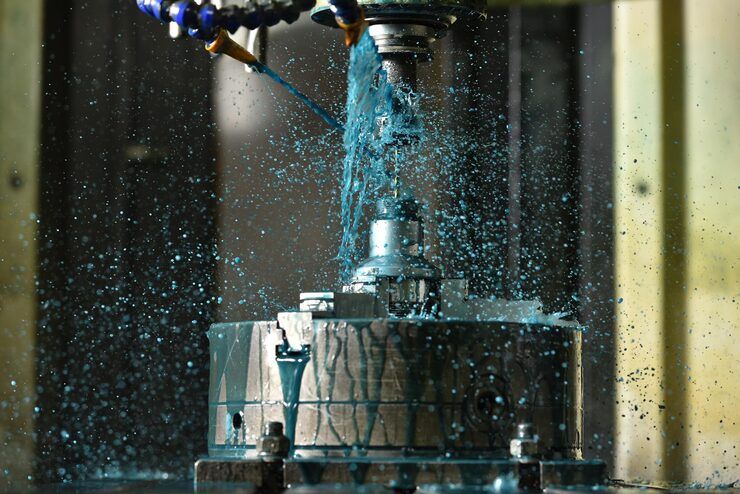
Water jet cutting machines use a high-pressure stream of water to cut, shape, or profile materials. Depending on the application, abrasive particles such as garnet can be introduced into the water stream to increase cutting capability for harder materials.
Unlike many conventional cutting methods, water jet technology does not depend on a heat-affected cutting zone. This makes it useful for materials where thermal distortion, discoloration, or metallurgical changes need to be minimized.
Modern systems generally combine a high-pressure pump, cutting head, CNC controller, worktable, abrasive delivery system, and water-management equipment. Advanced configurations can also include multi-axis motion and automated material handling.
How Water Jet Cutting Works
The basic cutting process follows several stages:
Water is pressurized through a high-pressure pumping system.
The pressurized water travels toward a precision cutting head.
A small orifice converts the pressure into a high-velocity jet.
Abrasive particles may be introduced for hard materials.
CNC controls guide the cutting head along a programmed path.
The workpiece is supported above a water-filled cutting table.
Pure water jets are commonly associated with softer materials such as rubber, foam, textiles, and some plastics. Abrasive water jets are more appropriate for metals, stone, ceramics, composites, glass, and other hard materials.
Common Water Jet Cutting Applications
Water jet cutting machines are used across several industrial fields:
Aerospace component manufacturing
Automotive component production
Metal fabrication
Architectural stone processing
Glass and ceramic processing
Industrial machinery manufacturing
Electronics and precision components
Composite material processing
Energy equipment manufacturing
Prototype and custom-part production
High-value search areas such as CNC water jet cutting, industrial water jet cutting machines, precision metal cutting, and abrasive water jet technology reflect the broad industrial relevance of this technology.
Why Water Jet Cutting Matters Today
Manufacturers increasingly need accurate cutting while working with different material types and complex geometries. Water jet technology can address these requirements by combining CNC movement with a highly concentrated cutting stream.
It can also reduce some limitations associated with thermal cutting. Since the process does not rely on a conventional heat source at the cutting interface, it can be useful for materials that are sensitive to heat.
Industries That Use the Technology
Aerospace and defense manufacturers use precision cutting for complex components and advanced materials. Automotive manufacturers can use water jets for prototypes, interior materials, metal components, and composite structures.
Stone and architectural industries use large-format systems for intricate patterns and detailed profiles. Electronics and engineering manufacturers can also use smaller precision systems when dimensional accuracy is important.
Key Advantages
Important characteristics include:
Low thermal influence on the workpiece
Ability to process many material categories
CNC-controlled cutting paths
Capability for complex shapes
Suitable for thick material applications
Reduced need for mechanical cutting pressure
Potential for high dimensional accuracy
Compatibility with automated production environments
| Feature | Pure Water Jet | Abrasive Water Jet |
|---|---|---|
| Main cutting medium | Water | Water + abrasive |
| Typical materials | Foam, rubber, textiles | Metal, stone, glass, ceramics |
| Heat generation | Very low | Very low |
| CNC compatibility | Yes | Yes |
| Typical industrial use | Soft-material cutting | Hard-material precision cutting |
Recent Water Jet Cutting Machine Developments
The water jet cutting market continues to develop around automation, precision, digital controls, and broader industrial applications. A 2026 market analysis estimated the global waterjet cutting machine market at about USD 1.17 billion in 2026, with projected expansion through 2034. The same analysis identified aerospace, automotive, electronics, energy, metal fabrication, and other industrial segments as important application areas.
Automation and CNC Integration
One major direction is greater integration between CNC controls, automated material handling, CAD/CAM software, and production monitoring. These capabilities can reduce manual intervention and make repeat production easier to manage.
Robotic waterjet cutting is also receiving attention for applications where cutting paths require multiple movement axes or where complex three-dimensional components are involved.
Higher-Precision Cutting
Modern systems increasingly focus on improved cutting-head control, taper compensation, positioning accuracy, and software-based path optimization.
These developments are particularly relevant to precision CNC cutting, aerospace manufacturing equipment, and advanced metal fabrication, where dimensional consistency can have a major effect on downstream assembly.
Abrasive Management
Abrasive consumption and recovery remain important considerations for abrasive water jet systems. Improved abrasive delivery and recycling approaches are being developed to improve material utilization and reduce waste handling requirements.
Growing Industrial Applications
Water jet systems continue to find applications in advanced materials, including composites and difficult-to-machine alloys. This is particularly relevant to aerospace, energy, automotive, and specialized engineering production.
The broader machine-tool sector is also receiving increased attention in India. BIS published updated machine-tool resources and technical guidance during 2025–2026, reflecting continuing emphasis on machine safety, conformity, and standardized manufacturing practices.
Laws, Standards and Policies in India
India provides a useful regulatory example because industrial cutting equipment can fall under machinery safety, electrical safety, environmental, and workplace requirements depending on its configuration and application.
Machinery Safety Requirements
The Bureau of Indian Standards (BIS) maintains standards and conformity-assessment frameworks relevant to machinery. In 2025, BIS issued machine-category-specific guidelines for metal-cutting machines under the Machinery and Electrical Equipment Safety framework. These guidelines address areas such as technical documentation, machine grouping, labeling, marking, and certification procedures.
The BIS Scheme-X framework lists metal-cutting machine tools under the machinery categories covered by its technical regulation framework. It also identifies machinery for working stone, ceramics, concrete, and similar materials.
For a particular water jet system, the applicable classification should therefore be checked against its machine category, configuration, intended material, and applicable Indian Standards rather than assumed from the machine name alone.
Electrical and Workplace Considerations
Water jet systems combine high-pressure equipment, electrical controls, moving mechanical components, pumps, and CNC systems. Appropriate guarding, emergency controls, electrical protection, operating instructions, and risk assessment are therefore important.
BIS also maintains standards related to machinery safety, including general principles for risk assessment and electrical equipment of machines.
Environmental Considerations
Abrasive cutting can generate spent abrasive, removed material, and wastewater containing suspended particles. Industrial facilities should therefore review applicable wastewater, waste-management, and local environmental requirements before installing or operating a system.
The precise requirements can vary according to the material being processed, abrasive type, wastewater characteristics, facility location, and applicable consent conditions.
Tools and Resources for Water Jet Cutting
Selecting and operating a water jet system requires more than choosing pump pressure. Material thickness, cutting speed, abrasive flow, nozzle condition, accuracy requirements, and production volume all influence system configuration.
Useful Technical Tools
Helpful resources include:
CAD/CAM software: Used to create and prepare cutting paths.
Cutting parameter calculators: Help estimate feed rates and cutting conditions.
Material databases: Provide information about different metals, stone, glass, composites, and plastics.
CNC simulation tools: Help identify path errors before production.
Abrasive consumption calculators: Help estimate abrasive requirements for production planning.
Dimensional inspection equipment: Used to verify finished component accuracy.
BIS Know Your Standard: Allows users to search Indian Standards by number or keyword. BIS describes it as a centralized resource for standards, amendments, testing information, and related documentation.
Parameters Worth Comparing
When evaluating industrial water jet cutting equipment, consider:
Maximum cutting thickness
Worktable dimensions
Pump pressure
Cutting-head configuration
CNC positioning accuracy
Number of cutting axes
Abrasive delivery arrangement
Water recycling capability
Software compatibility
Maintenance requirements
Electrical specifications
Safety features
Frequently Asked Questions
What is a water jet cutting machine?
A water jet cutting machine is a CNC-controlled system that uses a high-pressure water stream to cut materials. Abrasive particles can be added when cutting harder materials such as steel, stone, glass, and ceramics.
Can water jet machines cut metal?
Yes. Abrasive water jet systems can cut many metals, including steel, stainless steel, aluminum, copper, titanium, and specialized alloys. The appropriate machine configuration depends on thickness, material properties, required accuracy, and production requirements.
Does water jet cutting create a heat-affected zone?
Water jet cutting is generally considered a cold-cutting process because it does not depend on a conventional thermal cutting source. Consequently, it can be useful when avoiding significant heat-related changes to the workpiece is important.
What is the difference between pure and abrasive water jet cutting?
Pure water jet cutting uses pressurized water alone and is generally associated with softer materials. Abrasive water jet cutting adds abrasive particles to increase cutting capability for harder materials.
What factors determine water jet cutting performance?
Performance depends on factors including pump pressure, nozzle condition, abrasive characteristics, material type, material thickness, cutting speed, CNC accuracy, and cutting-head configuration. Proper parameter selection is important for achieving the desired dimensional quality.
Conclusion
Water jet cutting machines have become an important part of modern precision manufacturing because they can process a broad range of materials while minimizing the thermal effects associated with conventional heat-based cutting.
The technology is evolving toward greater CNC integration, automation, precision control, abrasive management, and compatibility with advanced materials. These developments are increasing its relevance across aerospace, automotive, stone processing, electronics, energy, and industrial manufacturing.
For organizations evaluating CNC water jet cutting machines, the most important considerations are material requirements, thickness, dimensional accuracy, production volume, machine configuration, safety, environmental controls, and applicable standards.
In India, BIS machinery-safety frameworks and technical requirements are particularly relevant when determining conformity obligations for applicable machine categories.
Overall, water jet cutting represents a flexible approach to precision material processing, particularly where complex shapes, diverse materials, and limited thermal influence are important production considerations.