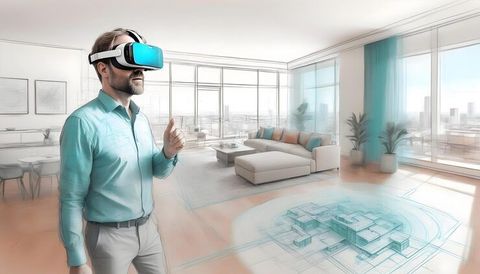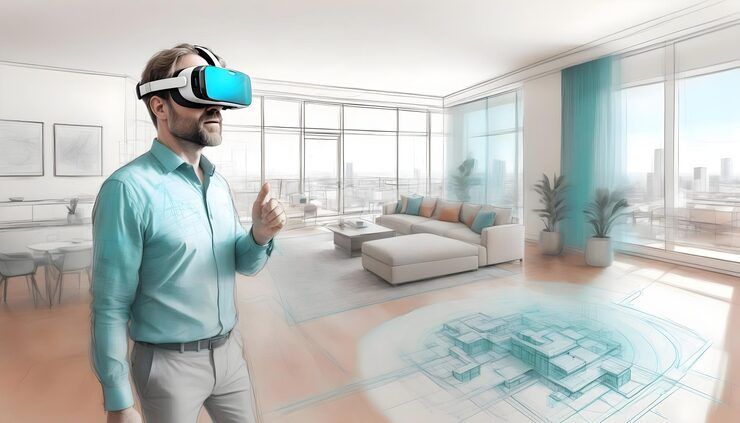
Virtual reality (VR) virtual real estate tours use digital technology to help people explore properties through an interactive, three-dimensional environment. Instead of relying only on photographs, floor plans, or recorded videos, viewers can examine rooms, move between spaces, and understand a property's layout from a computer, smartphone, or compatible VR headset.
This technology has become increasingly relevant to residential real estate, commercial property, architecture, interior design, property development, and international property research. It can help people understand spaces before arranging an in-person visit, while giving architects and property professionals another way to communicate design concepts.
Understanding VR Property Tours
A virtual property tour may be created using 360-degree photography, a three-dimensional digital model, or a computer-generated environment. Each approach provides a different level of interaction and visual detail.
A 360-degree tour lets viewers look around from fixed positions. A 3D walkthrough may allow movement between rooms, while a fully immersive VR experience can provide a stronger sense of spatial depth when viewed through a compatible headset.
Some tours represent completed buildings, while others show proposed properties that have not yet been constructed. In the latter case, the experience is based on architectural plans and digital models rather than a finished physical space.
How Virtual Reality Tours Work
The process usually begins with capturing an existing property or creating a digital representation from architectural information.
Common stages include:
Capturing photographs or scanning rooms.
Creating a 3D model or panoramic environment.
Connecting rooms and viewpoints into a navigable tour.
Adding labels, measurements, floor plans, or explanatory information.
Optimizing the experience for computers, mobile devices, or VR headsets.
Publishing the tour through a suitable digital platform.
Depending on the technology, viewers may be able to change viewpoints, examine finishes, compare layouts, or explore different interior configurations.
The accuracy of the experience depends on the source data, modeling process, software, and quality-control procedures. A visually realistic tour does not automatically guarantee that every dimension or building feature is accurate.
Main Types of Virtual Property Tours
360-degree photography tours use panoramic images to show the surroundings from selected locations. They are commonly used for existing homes, apartments, offices, and hospitality properties.
Interactive 3D walkthroughs connect multiple rooms in a navigable environment. They can include floor plans, informational labels, and clickable features.
Immersive VR environments are designed for headsets that provide stereoscopic views and head-tracked movement. These experiences can help viewers understand room proportions and spatial relationships.
Computer-generated property visualization uses architectural models to represent planned buildings, interior layouts, lighting, and materials before construction is complete.
Virtual staging adds digitally represented furniture and decorative elements to photographs or three-dimensional spaces. Such changes should be clearly identified so that viewers can distinguish existing features from simulated designs.
Benefits for Buyers, Tenants, and Property Professionals
Virtual reality property tours can help people evaluate properties before arranging a physical visit. They are particularly relevant when the viewer is located in another city or country.
For prospective buyers and tenants, virtual tours can help them understand room connections, approximate spatial proportions, window placement, and the relationship between different areas of a property.
For real estate professionals, interactive tours provide another way to present property layouts and explain features to prospective clients.
For architects and property developers, VR can help communicate proposed designs before construction is complete. Teams can review room arrangements, interior finishes, circulation paths, and alternative layouts within a simulated environment.
Problems Virtual Tours Can Help Address
Traditional property photographs often show only selected angles. They may not communicate how rooms connect or how a space feels when moving through it.
Virtual tours can help address several limitations:
Limited visibility of rooms in conventional photographs
Difficulty evaluating properties from a distant location
Challenges understanding architectural floor plans
Limited opportunities to review proposed building designs
Difficulty comparing alternative interior layouts
Time spent arranging preliminary property viewings
However, virtual tours do not replace every form of physical inspection. They may not reveal hidden structural defects, plumbing problems, noise levels, odors, or other conditions that require an in-person assessment.
Recent Updates and Industry Trends
Developments during 2025 and 2026 demonstrate how virtual property tours are becoming more closely connected with artificial intelligence, digital twins, architectural modeling, and property data.
Artificial Intelligence and Digital Twins
On February 25, 2025, Matterport announced its Winter Release, which included AI-assisted content creation, workflow improvements, and collaboration features for property marketing and building management.
On February 28, 2025, CoStar Group completed its acquisition of Matterport, bringing digital twin technology into a broader property information and real estate technology business.
A digital twin is a digital representation of a physical space. Depending on how it is created, it can contain visual information, spatial measurements, and other building data. Not every virtual tour is a digital twin, and the level of detail varies by project.
Virtual and Augmented Reality in 2025
On September 15, 2025, the National Association of Realtors' technology publication discussed emerging extended reality trends in real estate. The discussion covered immersive visualization, virtual staging, mixed reality, and the use of AI with property experiences.
These technologies can help viewers examine proposed interior designs and understand how different furnishings or configurations might appear within a room.
Trends to Watch in 2026
Current development priorities include:
AI-assisted 3D modeling and content preparation
More detailed digital representations of buildings
Browser-based immersive experiences
Integration with building information modeling
Improved mobile and headset compatibility
Interactive floor plans and spatial measurements
Virtual staging with clearer distinctions between existing and proposed features
The practical value of these developments depends on the accuracy of the underlying property information and how clearly the experience communicates its limitations.
Laws, Policies, and Consumer Protection
Virtual real estate tours are affected by several areas of law, including advertising, consumer protection, privacy, accessibility, and intellectual property. The applicable requirements depend on the country and the purpose of the tour.
Truthful Property Representation
In the United States, the Federal Trade Commission Act prohibits deceptive advertising practices. Property-related digital content should not create a materially misleading impression about the features or condition of a property.
For example, digitally removing permanent structural features, presenting proposed construction as completed, or using virtual staging without appropriate clarification may mislead viewers.
Property professionals should distinguish between existing conditions, digitally enhanced photographs, proposed designs, and computer-generated representations.
Data Privacy and Security
Virtual tours may capture personal belongings, family photographs, security devices, access points, or other information that occupants would prefer to keep private.
Organizations creating tours should consider consent, image handling, access controls, retention periods, and secure storage.
In the European Union, the General Data Protection Regulation can apply when a virtual tour platform processes personal data. The ePrivacy framework may also apply to relevant electronic communications and tracking technologies.
Accessibility and Digital Inclusion
Accessible design can help people navigate virtual property tours using different devices and input methods.
Useful considerations include keyboard navigation, readable labels, clear instructions, alternative text, captions where relevant, and compatibility with assistive technologies.
Accessibility requirements vary by jurisdiction and application, so developers should assess the standards applicable to their particular platform.
Intellectual Property
Architectural plans, photographs, 3D models, textures, and other visual materials may be protected by intellectual property law.
Permission to photograph a property does not necessarily establish permission to reproduce every architectural drawing, artwork, or other protected element within a digital tour.
Tools and Resources for Virtual Property Tours
Different tools support different stages of creating and evaluating immersive property experiences.
3D Capture and Modeling
Property capture systems use cameras, depth sensors, or other scanning technology to record a physical environment.
Modeling applications can then organize spatial information into a navigable representation. The appropriate approach depends on the required visual quality, measurement accuracy, and level of interaction.
Architectural Visualization Software
Building information modeling and 3D visualization applications help architects and designers create digital representations of buildings.
These applications can support:
Interior layout planning
Material and lighting visualization
Floor plan review
Design comparisons
Construction coordination
Virtual walkthrough preparation
VR Hardware and Compatibility
VR headsets provide immersive viewing through stereoscopic displays and motion tracking. However, many virtual property tours can also run on standard computers and smartphones.
When evaluating a platform, consider device compatibility, internet requirements, ease of navigation, visual clarity, and accessibility.
Property Tour Evaluation Checklist
Evaluation Factor | What to Check |
|---|---|
Visual accuracy | Does the tour represent the actual or proposed property clearly? |
Navigation | Can viewers move between rooms easily? |
Measurements | Are dimensions provided and appropriately verified? |
Device support | Does the tour work on common devices? |
Privacy | Are personal belongings and sensitive details protected? |
Accessibility | Can users navigate with different abilities? |
Disclosure | Are staged or computer-generated elements identified? |
Performance | Does the tour load and operate reliably? |
Frequently Asked Questions
What is a VR virtual real estate tour?
It is an interactive digital representation of a property that allows viewers to explore rooms and spatial layouts remotely. Depending on the platform, it may use 360-degree photography, 3D models, or an immersive VR headset.
Do virtual property tours require a VR headset?
No. Many tours operate through a web browser on a computer, tablet, or smartphone. A compatible headset is needed only for experiences specifically designed for immersive VR viewing.
Are virtual real estate tours accurate?
Accuracy depends on the capture method, source measurements, modeling process, and subsequent editing. A tour can provide a useful visual overview, but it does not automatically verify a property's structural condition or every physical measurement.
How is virtual staging different from a VR tour?
Virtual staging digitally adds furniture, decorations, or other design elements to a property representation. A VR tour is an interactive way to navigate a digital space. Virtual staging can be included within a VR tour, but the two technologies serve different purposes.
Can virtual tours replace an in-person property inspection?
Not completely. Virtual tours can help people evaluate layouts and identify properties for further consideration, but they may not reveal hidden defects, environmental conditions, or other issues that require physical inspection and professional assessment.
Conclusion
VR virtual real estate tours are changing how people explore residential and commercial properties, review architectural designs, and understand building layouts. By combining panoramic photography, 3D modeling, digital twins, and immersive interfaces, these tools provide additional ways to evaluate spaces remotely.
Recent developments in AI-assisted modeling and property visualization are expanding the possibilities for interactive tours. At the same time, accuracy, privacy, accessibility, intellectual property, and truthful representation remain important considerations.
The most useful virtual property experiences combine clear visuals with reliable measurements, understandable navigation, and transparent information about what is real, digitally enhanced, or still proposed. Used alongside physical inspections and verified property documentation, virtual tours can support more informed property research and design decisions.