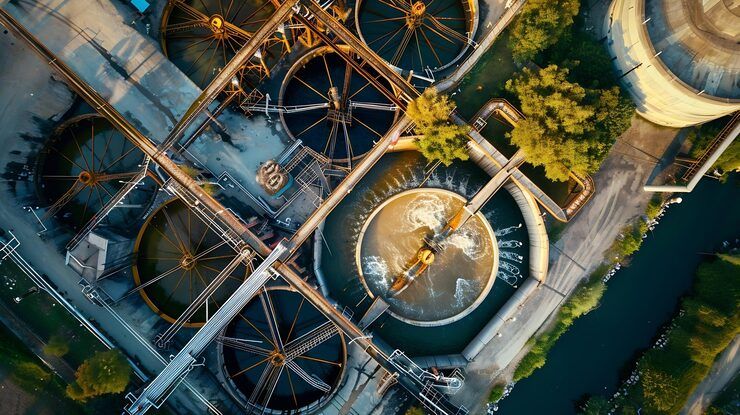
Waste water recycling plants are treatment facilities designed to process used water so that it can be reused for appropriate applications. Depending on the treatment level, recycled water can support industrial processes, cooling systems, irrigation, landscaping, toilet flushing, groundwater recharge, or other approved uses.
The term wastewater generally includes water discharged from households, commercial buildings, manufacturing facilities, institutions, and other activities. This water can contain suspended solids, organic matter, nutrients, oils, chemicals, microorganisms, salts, and other contaminants.
A recycling plant combines physical, biological, chemical, and membrane-based treatment processes to reduce these contaminants to a level appropriate for the intended reuse.
How a Wastewater Recycling Plant Works
A typical plant uses several treatment stages rather than relying on one technology.
The exact configuration depends on the wastewater characteristics and the quality required for reuse.
Common stages include:
Screening and preliminary treatment
Grit and solids removal
Primary clarification
Biological treatment
Secondary clarification
Filtration
Membrane treatment
Disinfection
Sludge processing
Storage and distribution
A plant designed for industrial reuse may require additional treatment for dissolved salts, heavy metals, oils, solvents, or other industry-specific contaminants.
Major Treatment Technologies
Activated sludge systems use microorganisms to break down biodegradable organic matter.
Membrane bioreactors (MBR) combine biological treatment with membrane filtration and can produce relatively high-quality treated water in a compact footprint.
Ultrafiltration (UF) removes suspended particles, colloids, and many microorganisms.
Reverse osmosis (RO) uses a semi-permeable membrane to reduce dissolved salts and many dissolved contaminants.
Ultraviolet (UV) disinfection uses ultraviolet radiation to inactivate microorganisms without adding a chemical disinfectant.
Ozonation uses ozone as an oxidation and disinfection process for selected treatment applications.
| Treatment Stage | Main Purpose | Typical Technologies |
|---|---|---|
| Preliminary | Remove large solids | Screens, grit removal |
| Primary | Remove settleable solids | Clarifiers |
| Biological | Reduce organic matter | Activated sludge, MBR |
| Tertiary | Improve water quality | Sand filters, UF |
| Advanced | Reduce dissolved contaminants | RO, advanced oxidation |
| Disinfection | Control microorganisms | UV, ozone, chlorine |
| Sludge treatment | Manage residual solids | Digesters, dewatering |
Why Wastewater Recycling Matters Today
Freshwater availability is under increasing pressure from population growth, urbanization, agriculture, industrial activity, and climate variability.
Wastewater recycling can reduce dependence on freshwater sources by allowing treated water to be used again for suitable applications.
This makes industrial wastewater treatment, water recycling systems, wastewater treatment plants, reverse osmosis water treatment, and water reuse technology important areas within modern water management.
Industrial Applications
Industries can generate significant wastewater volumes. Depending on the production process, wastewater may contain organic compounds, suspended solids, oils, metals, salts, or other contaminants.
Recycling systems can allow suitably treated water to return to applications such as:
Cooling towers
Boiler systems
Equipment washing
Process water
Landscaping
Dust suppression
Utility operations
Toilet flushing
The required treatment level depends on the intended reuse.
Municipal and Building Applications
Urban wastewater recycling can support non-potable applications such as landscape irrigation, toilet flushing, road cleaning, and certain municipal uses.
Large buildings, campuses, hotels, hospitals, and residential developments can incorporate on-site wastewater treatment systems where appropriate.
Water Security
Recycling does not eliminate the need for freshwater sources, but it can create an additional water resource. A well-designed reuse system can reduce freshwater withdrawals and wastewater discharge simultaneously.
However, recycled water must be matched carefully to its intended application. Water intended for potable use requires substantially more stringent treatment and monitoring than water intended for irrigation or industrial cooling.
Recent Wastewater Recycling Developments
Water reuse continued to receive significant attention during 2025 and 2026 as governments and industries addressed water scarcity, pollution control, climate resilience, and resource efficiency.
India's Water-Reuse Focus
India's National Water Mission identifies water conservation and efficient water use as important components of national water management. The government's Jal Shakti initiatives have also emphasized water conservation, reuse, recharge, and wastewater management.
The Ministry of Jal Shakti's annual reporting during 2025–26 continued to highlight water conservation and wastewater-management activities under India's broader water-management programs.
Urban Water Recycling
Indian cities are increasingly examining treated wastewater as an additional water resource. The approach is particularly relevant where urban water demand is increasing while freshwater sources face pressure.
Applications can include:
Industrial reuse
Horticulture
Urban landscaping
Construction activities
Non-potable building applications
Environmental discharge management
Advanced Membrane Technology
Membrane filtration continues to play a major role in advanced wastewater recycling.
MBR, UF, nanofiltration, and RO can be combined in different configurations depending on the required water quality.
Digital monitoring is also becoming more important. Sensors can track parameters such as pH, conductivity, turbidity, dissolved oxygen, pressure, flow, and total dissolved solids.
Resource Recovery
Modern wastewater treatment is increasingly viewed as more than contaminant removal. Plants can potentially recover water, energy, nutrients, biogas, and other resources.
This approach supports the concept of a circular water economy, where wastewater is treated as a resource rather than simply a waste stream.
Laws, Regulations and Policies in India
India's wastewater-recycling framework involves central environmental regulations, state pollution-control requirements, water-quality standards, municipal rules, and sector-specific requirements.
Environment Protection Framework
The Environment (Protection) Act, 1986 provides an important legal foundation for environmental regulation in India.
The Central Pollution Control Board (CPCB) establishes and publishes environmental standards and guidance relevant to wastewater discharges and treatment systems.
Industries can also be subject to consent requirements administered by State Pollution Control Boards.
Effluent Standards
Industrial facilities generally need to meet applicable effluent standards before treated wastewater is discharged. Requirements can vary according to industry category, receiving environment, location, and applicable regulatory notifications.
The CPCB maintains industry-specific standards and environmental guidance covering numerous industrial sectors.
This means a wastewater recycling plant should be designed around the actual wastewater characteristics and the applicable regulatory limits rather than using a generic treatment configuration.
National Green Tribunal and Water Protection
Indian environmental regulation has also been influenced by judicial decisions concerning wastewater discharge, water pollution, sewage treatment, and environmental compliance.
Local authorities and industries may therefore face requirements concerning treatment capacity, monitoring, discharge quality, and reuse.
Water Reuse and Zero Liquid Discharge
Some industrial applications use Zero Liquid Discharge (ZLD) systems. These systems are designed to minimize or eliminate liquid wastewater discharge by combining treatment, concentration, evaporation, crystallization, and water recovery.
ZLD can be particularly relevant to industries with high-salinity wastewater or strict discharge requirements.
However, ZLD is not automatically appropriate for every facility. The technical configuration depends on wastewater chemistry, recovery objectives, energy requirements, residual solids, and regulatory conditions.
Tools and Resources for Wastewater Recycling
Designing or operating a recycling plant requires accurate water-quality information and continuous process monitoring.
Useful Tools
Flow meters: Measure incoming, treated, and recycled-water flows.
pH meters: Monitor acidity and alkalinity.
Turbidity meters: Measure suspended particles affecting water clarity.
Conductivity meters: Help track dissolved ionic content.
TDS meters: Provide an indication of total dissolved solids.
Dissolved oxygen sensors: Monitor biological treatment conditions.
COD and BOD testing: Help evaluate organic pollution.
Membrane monitoring systems: Track pressure, flow, and membrane performance.
Water-quality dashboards: Combine sensor information for operational monitoring.
Treatment-capacity calculators: Help estimate daily hydraulic loading.
RO recovery calculators: Estimate permeate and reject-water flows.
CPCB resources: Provide environmental standards and regulatory information.
Laboratory testing: Provides detailed chemical and microbiological analysis.
Important Design Parameters
When researching an industrial wastewater treatment plant, important parameters include:
Daily wastewater flow
Peak flow
pH
BOD
COD
TSS
TDS
Oil and grease
Heavy metals
Nitrogen and phosphorus
Microbiological characteristics
Required recycled-water quality
Sludge generation
Energy requirements
Space availability
A treatment plant should be designed from actual wastewater testing rather than assumptions based only on industry type.
Frequently Asked Questions
What is a wastewater recycling plant?
A wastewater recycling plant treats used water so that it can be reused for suitable applications. Depending on the treatment level, recycled water can support industrial processes, irrigation, cooling, flushing, landscaping, or other approved uses.
What is the difference between wastewater treatment and wastewater recycling?
Wastewater treatment focuses on reducing contaminants to meet a required discharge or quality standard. Recycling adds a reuse objective, meaning the treated water is recovered and directed toward another appropriate application.
Can wastewater be converted into drinking water?
Yes, technically, highly treated wastewater can be used as a source for potable water when a regulatory framework permits it. Potable reuse requires advanced treatment, multiple barriers, extensive monitoring, and strict microbiological and chemical controls.
What is reverse osmosis used for in wastewater recycling?
Reverse osmosis is an advanced membrane process used to reduce dissolved salts and many dissolved contaminants. It is commonly used when recycled water requires a significantly lower dissolved-solids concentration.
What is Zero Liquid Discharge?
Zero Liquid Discharge is a treatment approach designed to minimize or eliminate liquid wastewater discharge. It commonly combines membrane treatment with concentration and evaporation processes to recover water while producing concentrated residual materials.
Conclusion
Wastewater recycling plants are becoming increasingly important as communities and industries seek more efficient approaches to water management. By treating used water and directing it toward suitable reuse applications, these systems can reduce freshwater demand while supporting pollution-control objectives.
Modern plants can combine biological treatment, filtration, membrane processes, disinfection, and advanced monitoring. The appropriate combination depends on wastewater composition and the required quality of the recycled water.
Developments during 2025 and 2026 continue to emphasize water conservation, urban wastewater management, advanced membrane technologies, digital monitoring, and resource recovery. India's wider water-management programs also demonstrate the increasing importance of efficient water use and wastewater reuse.
For organizations researching industrial wastewater treatment plants, water recycling systems, RO wastewater treatment, membrane bioreactors, or Zero Liquid Discharge systems, the most important considerations are wastewater characteristics, flow rate, treatment objectives, regulatory requirements, energy use, residual management, and the intended reuse application.
In India, compliance with applicable CPCB and State Pollution Control Board requirements is an important part of wastewater-treatment planning. Current standards should always be checked against the specific industry and discharge or reuse situation.
Ultimately, wastewater recycling represents a shift from viewing used water solely as a disposal challenge toward treating it as a potential resource within a more circular and resilient water-management system.