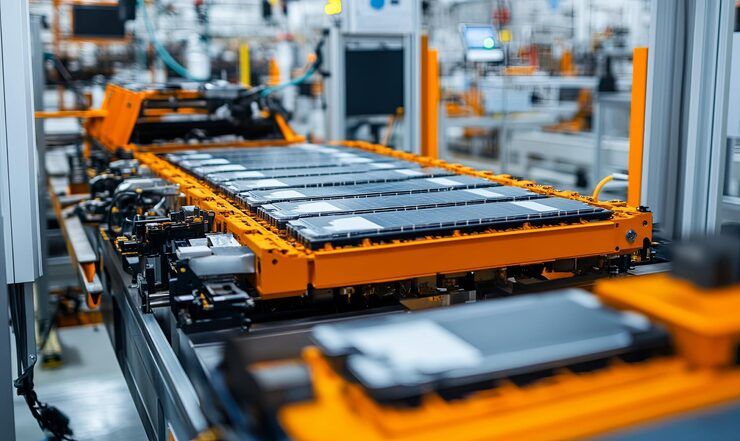
Battery pack assembly lines are integrated manufacturing systems used to transform individual battery cells or modules into complete battery packs. These systems are particularly important for electric vehicles, energy-storage systems, industrial equipment, consumer electronics, and other applications that require rechargeable electrical energy.
A battery pack normally contains multiple cells connected electrically and mechanically. Depending on its design, it can also contain modules, busbars, cooling components, insulation materials, sensors, wiring, a battery management system, enclosure structures, and protective components.
The assembly line brings these elements together through a sequence of controlled manufacturing operations.
How a Battery Pack Assembly Line Works
The exact process depends on the battery chemistry, cell format, pack architecture, and application. A typical automated line can include:
Cell inspection and sorting
Cell loading
Cell orientation
Module assembly
Welding or joining
Busbar installation
Insulation placement
Cooling-system integration
Battery management system installation
Pack enclosure assembly
Electrical testing
Leak or pressure testing where applicable
End-of-line inspection
Automation can connect these operations through conveyors, robotic systems, machine-vision equipment, programmable controls, and manufacturing execution systems.
Battery Cell Formats
Three common cell formats are used in modern battery manufacturing:
| Cell Format | General Characteristics | Typical Application |
|---|---|---|
| Cylindrical | Round metal casing | EVs, power tools, energy storage |
| Prismatic | Rigid rectangular casing | EVs and stationary storage |
| Pouch | Flexible layered enclosure | EVs, electronics, energy systems |
Each format creates different assembly requirements. Cylindrical cells may require precise orientation and high-volume joining, while prismatic and pouch cells require different handling and structural integration methods.
Why Battery Pack Assembly Matters Today
The expansion of electric mobility and stationary energy storage has increased the importance of efficient battery manufacturing. Battery pack assembly is the stage where individual cells become a functional energy system capable of interacting with a vehicle, storage installation, or industrial device.
The technology is especially relevant to EV battery manufacturing, lithium-ion battery assembly, battery manufacturing equipment, automated battery assembly, and energy storage systems.
Supporting Electric Mobility
Electric vehicles require battery packs with controlled electrical connections, thermal management, mechanical protection, and accurate monitoring.
An assembly line helps coordinate these requirements through repeatable processes. Automated inspection can also identify defects before the completed pack moves into vehicle integration.
Battery Energy Storage
Grid-scale and commercial energy-storage systems increasingly use modular battery architectures. Assembly lines can produce standardized modules and packs that can later be integrated into larger storage installations.
Quality and Traceability
Battery packs contain many interconnected components. A small assembly defect can potentially affect electrical performance, thermal behavior, or long-term reliability.
Modern production therefore emphasizes:
Cell traceability
Weld inspection
Electrical testing
Insulation verification
Dimensional inspection
Thermal monitoring
Software-controlled process records
End-of-line testing
Recent Battery Pack Assembly Developments
Battery manufacturing continued to expand and evolve during 2025 and 2026, with major developments in EV production, energy storage, advanced cell chemistries, automation, and recycling.
India's Advanced Battery Manufacturing Expansion
India's Production Linked Incentive program for Advanced Chemistry Cell battery storage is an important part of the country's domestic battery-manufacturing strategy. The Ministry of Heavy Industries has stated that the ACC scheme targets domestic manufacturing capacity and strengthening the battery ecosystem in India.
In September 2025, the Ministry of Heavy Industries announced that JSW Energy had received approval under the ACC PLI scheme for an additional 30 GWh capacity, bringing its total allocated capacity under the scheme to 40 GWh.
These developments are relevant to battery pack assembly because cell manufacturing capacity can support the expansion of downstream module and pack manufacturing.
EV Battery Manufacturing Ecosystems
India's National Programme on Advanced Chemistry Cell Battery Storage aims to develop domestic manufacturing capabilities and reduce dependence on imported battery technologies and components.
As local battery manufacturing expands, assembly lines increasingly need to support automated cell handling, traceability, testing, thermal systems, and integration with battery-management electronics.
Automation and Digital Manufacturing
Modern battery assembly lines increasingly combine robotics, machine vision, data acquisition, automated inspection, and manufacturing software.
Digital production systems can record information such as:
Cell identification
Welding parameters
Assembly sequence
Torque values
Electrical test results
Temperature measurements
Quality-control outcomes
This creates a production history for each battery pack or module.
Battery Recycling and Circular Manufacturing
Battery recycling is also becoming more important as the installed base of electric vehicles and energy-storage systems grows.
The ability to identify battery chemistry, cell format, manufacturing history, and pack configuration can help support later dismantling, recovery, reuse, and recycling activities.
Laws, Standards and Policies in India
India's battery manufacturing sector is affected by industrial safety requirements, environmental rules, battery-waste regulations, electrical standards, and government programs.
Battery Waste Management Rules
The Ministry of Environment, Forest and Climate Change introduced the Battery Waste Management Rules, 2022, establishing an Extended Producer Responsibility framework for batteries.
The rules cover various battery categories and establish responsibilities associated with collection, recycling, refurbishment, and environmentally sound management.
The Central Pollution Control Board maintains registration and regulatory resources related to battery producers, recyclers, and refurbishers.
For battery-pack manufacturers, understanding whether their activities fall within producer, manufacturer, assembler, importer, or another defined category is important.
Extended Producer Responsibility
Under India's battery-waste framework, producers have obligations connected with end-of-life battery management. Digital records and registration mechanisms support monitoring of these responsibilities.
The regulatory framework applies to batteries based on defined categories and responsibilities rather than simply the physical appearance of a battery pack.
Advanced Chemistry Cell Policy
The ACC battery program is also an important industrial policy. The Ministry of Heavy Industries describes the program as a way to establish domestic manufacturing capacity for advanced battery cells and strengthen the broader electric-mobility and energy-storage ecosystem.
Workplace and Electrical Safety
Battery pack assembly involves high-current electrical connections, automated machinery, welding systems, thermal systems, chemicals, and potentially hazardous energy sources.
Manufacturing facilities should therefore establish appropriate:
Electrical protection
Emergency controls
Fire protection
Battery handling procedures
Personal protective equipment
Machine guarding
Ventilation
Thermal monitoring
Chemical-handling procedures
Emergency response plans
Applicable Indian Standards and local industrial requirements should be reviewed according to the particular facility and battery technology.
Tools and Resources for Battery Pack Assembly
Battery assembly requires engineering software, production equipment, testing instruments, traceability systems, and safety resources.
Useful Tools
Battery pack design software: Helps model cell arrangements, electrical connections, thermal systems, and enclosure structures.
CAD software: Used for mechanical pack and module design.
Battery sizing calculators: Estimate required cell count and pack capacity.
BMS configuration software: Used to configure battery-management parameters.
Weld monitoring systems: Record and evaluate joining parameters.
Machine-vision systems: Inspect cells, welds, labels, connectors, and assembly positions.
Insulation-resistance testers: Check electrical isolation.
Battery cyclers: Evaluate charging, discharging, capacity, and performance.
Thermal imaging cameras: Identify abnormal temperature patterns.
Leak-testing equipment: Used for cooling systems and sealed enclosures where applicable.
MES platforms: Record production data and traceability.
CPCB battery-waste resources: Useful for reviewing applicable Indian battery-waste obligations.
Key Assembly-Line Parameters
When evaluating an automated battery pack assembly line, important specifications include:
Cell format compatibility
Production throughput
Automation level
Welding technology
Machine-vision capability
Torque control
BMS integration
Electrical testing
Insulation testing
Thermal-management integration
Traceability
Data connectivity
Safety systems
Changeover capability
Throughput should not be evaluated independently. Actual production depends on inspection requirements, process cycle time, material handling, testing, downtime, and the number of operations performed automatically.
Frequently Asked Questions
What is a battery pack assembly line?
A battery pack assembly line is a manufacturing system that combines battery cells or modules with electrical, mechanical, thermal, monitoring, and protective components to create a complete battery pack.
What equipment is used in battery pack assembly?
Typical equipment includes cell-handling systems, conveyors, robotic stations, welding equipment, machine-vision systems, insulation testers, torque tools, BMS integration equipment, thermal-system assembly equipment, and end-of-line testing systems.
What is the role of a battery management system?
A battery management system monitors and controls important battery parameters such as voltage, temperature, current, state of charge, and other safety-related conditions. It can also support cell balancing and communication with external vehicle or energy-management systems.
Why is cell traceability important?
Traceability links individual cells, modules, components, process parameters, and test results to a specific production record. This can help manufacturers investigate quality issues and maintain controlled manufacturing processes.
What battery regulations apply in India?
India's Battery Waste Management Rules, 2022 establish requirements related to battery waste management and Extended Producer Responsibility. The applicable obligations depend on the organization's role and the type of battery involved. The CPCB maintains resources for battery-waste registration and compliance.
Conclusion
Battery pack assembly lines are a critical part of modern battery manufacturing because they transform individual cells and modules into complete energy-storage systems.
The process combines mechanical assembly, electrical joining, thermal management, battery-management electronics, inspection, and end-of-line testing. Increasing automation allows these activities to be coordinated with greater data collection and process traceability.
Developments during 2025 and 2026 show continued investment in battery manufacturing capacity, particularly in India. The ACC PLI program and new capacity allocations demonstrate the country's broader effort to establish domestic advanced-cell manufacturing capabilities.
At the same time, battery-waste regulations are increasing the importance of lifecycle management. Manufacturing organizations need to consider not only how battery packs are assembled but also how batteries are tracked, handled, recovered, and managed at the end of their useful life.
For organizations researching EV battery assembly lines, lithium-ion battery manufacturing equipment, or automated battery pack production, the most important considerations include cell format, production architecture, joining technology, automation, testing, traceability, thermal management, safety, and regulatory requirements.
As electric mobility and stationary energy storage continue developing, battery pack assembly is likely to become increasingly connected with robotics, machine vision, digital manufacturing, advanced testing, and circular battery-management systems.