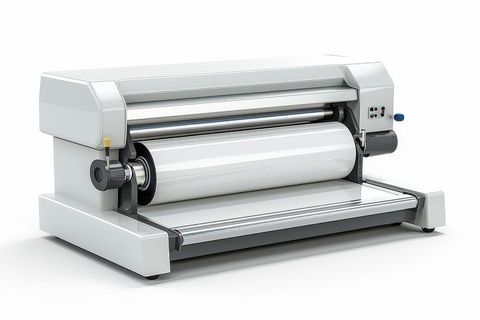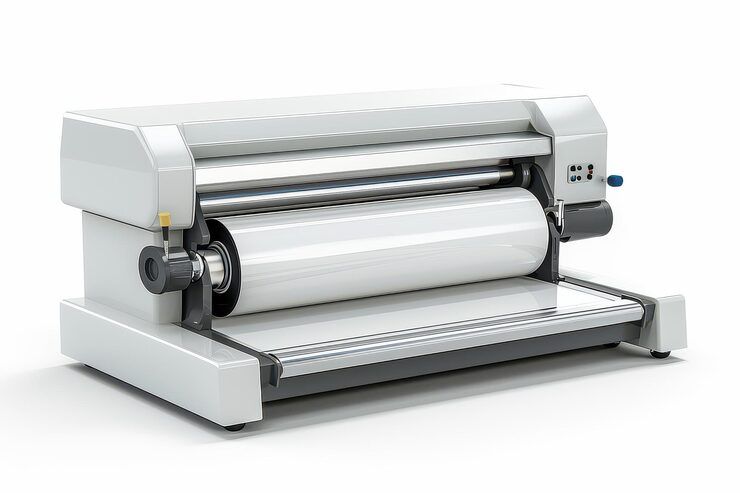
Lamination machines are industrial or commercial systems used to bond two or more layers of material into a combined structure. The process can improve strength, barrier performance, appearance, dimensional stability, insulation, or protection of the underlying material.
Lamination is used across packaging, printing, textiles, electronics, construction materials, labels, furniture components, and technical films.
Depending on the application, a lamination machine may use heat, pressure, adhesives, ultraviolet curing, or other bonding techniques. Some systems operate continuously from large rolls of material, while others process individual sheets.
How Lamination Works
A typical roll-to-roll laminating process involves feeding two or more substrates into the machine. The layers pass through a coating, adhesive, heating, or bonding stage and are then brought together under controlled pressure.
The finished laminated web may subsequently pass through cooling, curing, slitting, rewinding, or inspection stages.
Common process variables include:
Web tension
Lamination pressure
Temperature
Line speed
Adhesive quantity
Coating thickness
Curing time
Material thickness
Surface energy
Alignment accuracy
Maintaining consistent conditions is important because variations can produce bubbles, wrinkles, delamination, uneven coating, or dimensional changes.
Main Types of Lamination Machines
Different machines are designed around different materials and bonding methods.
| Machine Type | Typical Application | Main Process |
|---|---|---|
| Thermal laminator | Documents, films, sheets | Heat + pressure |
| Adhesive laminator | Flexible packaging | Adhesive bonding |
| Solventless laminator | Food and industrial packaging | Reactive adhesive |
| Dry laminator | Films and foil structures | Adhesive + heat |
| Wet laminator | Paper and board | Liquid adhesive |
| Hot-melt laminator | Textiles, films, technical materials | Heated adhesive |
| Roll-to-roll laminator | Flexible webs | Continuous bonding |
| Sheet laminator | Printed sheets and boards | Sheet-based bonding |
Why Lamination Machines Matter Today
Lamination allows manufacturers to combine the properties of different materials into one engineered structure.
For example, a packaging structure may combine a printable outer layer, a barrier layer, and a heat-sealable inner layer. Each layer performs a different function.
This makes lamination particularly relevant to industrial lamination machines, flexible packaging machinery, film laminating machines, roll-to-roll laminators, and packaging production equipment.
Packaging Applications
Flexible packaging is one of the major applications for industrial lamination. Different films, papers, foils, and coatings can be combined to create structures with specific barrier and mechanical characteristics.
Applications include:
Food packaging
Pharmaceutical packaging
Personal-care packaging
Industrial packaging
Labels
Pouches
Sachets
Wrapping films
Paper-based packaging
The exact material combination depends on the required moisture barrier, oxygen barrier, light protection, sealability, mechanical strength, and printing characteristics.
Printing and Commercial Applications
Lamination is also used to protect printed materials. A transparent film can be applied over printed sheets to improve resistance to moisture, handling, abrasion, and surface damage.
Applications can include:
Packaging labels
Printed cards
Menus
Catalogues
Educational materials
Product identification sheets
Commercial graphics
Industrial and Technical Uses
Beyond packaging and printing, lamination technology is used in technical materials.
Examples include:
Composite structures
Insulation materials
Automotive interiors
Textile composites
Electronics
Solar-related materials
Building products
Protective films
The machine configuration changes substantially according to the substrate and required bonding method.
Recent Lamination Machine Developments
The lamination industry has continued moving toward automation, lower-emission processes, digital monitoring, material efficiency, and packaging structures designed around changing environmental requirements.
Growth of Solventless Technology
Solventless adhesive lamination has gained attention within flexible packaging because the process avoids conventional organic solvents in the adhesive application stage.
Modern solventless systems use precise adhesive metering and controlled mixing to maintain consistent coating weights. Automation can also monitor adhesive ratios, web tension, temperature, and machine speed.
This technology is particularly relevant where manufacturers are seeking to reduce solvent handling within production environments.
Digital Process Monitoring
Modern industrial laminators increasingly incorporate sensors, PLC controls, touchscreen interfaces, automatic tension controls, and production monitoring.
Important monitored parameters can include:
Adhesive ratio
Coating weight
Web tension
Temperature
Line speed
Registration
Pressure
Material alignment
Data monitoring can help identify process variation earlier and support more consistent production.
Packaging Sustainability
Packaging regulation continues to influence lamination technology because multilayer structures can present different recycling challenges from single-material structures.
In India, the Ministry of Environment, Forest and Climate Change reported that the Plastic Waste Management Amendment Rules, 2024 were notified on March 14, 2024. The amendment strengthened reporting and monitoring arrangements and expanded obligations related to plastic packaging and Extended Producer Responsibility.
This wider regulatory direction encourages packaging manufacturers to consider material composition, recycling pathways, and waste management when designing laminated structures.
Paper-Based and Fiber-Based Structures
Packaging manufacturers are also investigating laminated paper and fiber-based structures with barrier coatings. These approaches aim to combine paper's structural characteristics with improved resistance to moisture, grease, oxygen, or other external conditions.
However, a paper-based appearance does not automatically mean that a laminated package is recyclable. The complete material structure and available recycling infrastructure need to be evaluated.
Laws, Standards and Policies in India
India provides an important regulatory example because lamination machines can be connected to packaging production, plastic materials, electrical equipment, workplace safety, and environmental requirements.
The exact rules depend on the machine configuration and the materials being processed.
Plastic Waste Management Rules
India's Plastic Waste Management framework is particularly relevant to laminated packaging containing plastic films or layers.
The Ministry of Environment, Forest and Climate Change lists the Plastic Waste Management Rules and their amendments, including the 2024 amendment.
The 2024 amendment includes changes involving plastic packaging, definitions, reporting, and Extended Producer Responsibility mechanisms.
CPCB guidance also establishes recycling-related obligations for different plastic-packaging categories. For example, the framework contains category-specific recycling targets and recycled-plastic-content requirements for certain packaging categories.
For a lamination operation, the important question is therefore not simply whether a laminator is used. The material structure produced by the machine and its intended packaging application can determine which environmental requirements apply.
Extended Producer Responsibility
Extended Producer Responsibility, or EPR, places defined waste-management responsibilities on specified producers, importers, and brand owners of plastic packaging.
CPCB's guidance describes online reporting and recycling-related obligations for covered plastic packaging.
Manufacturers working with laminated packaging should therefore maintain accurate information about material composition, production quantities, packaging categories, and applicable compliance documentation.
Machinery and Electrical Safety
Lamination machines contain moving rollers, heated surfaces, motors, electrical controls, pneumatic equipment, and sometimes high-temperature adhesive systems.
Appropriate machine guarding, emergency stopping mechanisms, electrical protection, operator instructions, ventilation where applicable, and preventive inspection are important workplace considerations.
The applicable Indian Standards should be identified according to the machine type and installation environment rather than assuming one standard covers every laminator.
Tools and Resources for Lamination Machines
Lamination quality depends on machine settings, material characteristics, adhesive behavior, and environmental conditions. Several technical tools can help manufacturers monitor these variables.
Useful Tools
Web-tension calculators: Help estimate appropriate tension ranges for different substrates.
Coating-weight calculators: Help determine adhesive or coating quantities.
Line-speed calculators: Help estimate production throughput.
GSM calculators: Useful for paper and flexible substrates.
Adhesive-ratio calculators: Help maintain appropriate component ratios for two-part adhesives.
Temperature monitoring equipment: Measures heated roller and adhesive-system conditions.
Peel-strength testing equipment: Evaluates bond strength between laminated layers.
Thickness gauges: Measure finished laminate thickness.
Surface-energy testing tools: Help evaluate substrate suitability for bonding.
Optical inspection systems: Identify wrinkles, bubbles, streaks, misalignment, and other defects.
CPCB resources: Useful for understanding applicable plastic-packaging and EPR requirements.
BIS standards database: Helps identify relevant Indian Standards for machinery and materials.
Specifications Worth Comparing
When researching industrial lamination machines, useful technical specifications include:
Maximum web width
Maximum line speed
Compatible substrates
Adhesive technology
Coating-weight range
Temperature range
Web-tension control
Roller configuration
Drying or curing system
Slitting capability
Rewinding system
Automatic controls
Defect monitoring
Energy consumption
Machine speed should not be considered independently. Actual production performance depends on substrate characteristics, adhesive curing, line stability, changeover requirements, inspection, and acceptable defect rates.
Frequently Asked Questions
What is a lamination machine?
A lamination machine bonds two or more layers of material into a combined structure. Depending on the application, it can use heat, pressure, adhesives, or other bonding technologies.
What industries use lamination machines?
Lamination equipment is used in flexible packaging, printing, textiles, electronics, construction materials, automotive components, labels, insulation, and various industrial applications.
What is solventless lamination?
Solventless lamination uses a reactive adhesive system without conventional solvent carriers. The adhesive components are accurately mixed and applied before the substrates are combined and cured.
What causes bubbles or wrinkles during lamination?
Common causes include incorrect web tension, unsuitable temperature, excessive line speed, uneven adhesive application, substrate moisture, poor alignment, trapped air, or insufficient curing. The specific cause depends on the machine and material combination.
Are laminated packaging materials recyclable?
Recyclability depends on the complete structure, including the films, paper, foil, adhesives, coatings, and available recycling infrastructure. A laminated package cannot be classified as recyclable solely because one of its layers is paper or another recyclable material.
Conclusion
Lamination machines are important manufacturing systems because they allow different materials to be combined into engineered structures with specific mechanical, barrier, protective, and visual characteristics.
The technology is widely used in flexible packaging, printing, textiles, electronics, construction materials, and other industrial fields. Modern equipment is increasingly incorporating automation, precision adhesive metering, web-tension control, digital monitoring, and automated inspection.
Environmental requirements are also influencing the development of laminated packaging. India's Plastic Waste Management framework and EPR mechanisms demonstrate why manufacturers increasingly need to understand the complete material structure produced by a lamination process.
For organizations researching industrial lamination machines, the most important factors include substrate compatibility, adhesive technology, web width, line speed, tension control, temperature management, curing requirements, inspection systems, energy use, and applicable environmental and machinery requirements.
The future of lamination is likely to involve greater process automation alongside material innovation. Solventless adhesives, recyclable-oriented structures, digital monitoring, and improved quality control can help manufacturers respond to changing technical and environmental requirements.
Understanding both the machine and the material structure it produces is therefore essential when evaluating modern lamination technology.