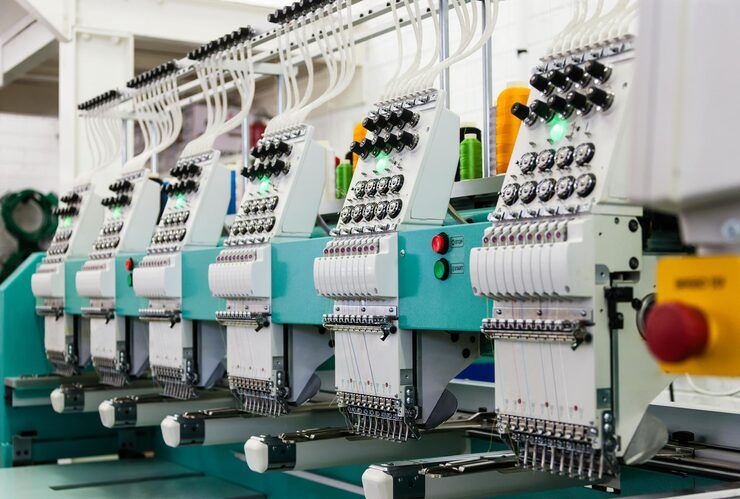
Embroidery machines are specialized textile machines designed to create decorative patterns, lettering, logos, motifs, and other stitched designs on fabric. Modern equipment ranges from compact computerized machines to multi-head industrial systems capable of producing multiple embroidered pieces within the same production cycle.
| production | One embroidery area at a time | |
| Multi-head | Larger production environments | Several heads work simultaneously |
| Computerized | Digital embroidery | Programmable designs |
| Specialty | Decorative applications | Supports specific techniques |
Why Embroidery Machines Matter Today
Embroidery remains an important textile-decoration technique because it can add visual detail, texture, lettering, and decorative patterns to fabric.
Computerized embroidery has expanded the range of designs that can be produced consistently. Digital workflows also make it easier to reproduce the same pattern across different textile products.
Applications Across Industries
Embroidery machines are used in:
Apparel manufacturing
Fashion and textile production
Sportswear
Uniform decoration
Home textiles
Caps and headwear
Bags and accessories
Traditional textile production
Decorative patches
Promotional merchandise
Interior textiles
The technology is particularly relevant to commercial embroidery machines, industrial embroidery machines, computerized embroidery machines, and multi-head embroidery machines.
Digital Design and Automation
One of the most important developments in embroidery has been the connection between design software and machine controls.
A designer can create artwork digitally and convert it into an embroidery-ready file. The digitizing process determines stitch types, density, direction, underlay, sequencing, and thread changes.
Automation can reduce repetitive manual steps and improve consistency when the same design needs to be reproduced.
Factors Affecting Embroidery Quality
Several variables influence the final result:
Fabric type
Thread composition
Needle size
Stitch density
Stitch direction
Underlay selection
Hoop tension
Design complexity
Machine speed
Stabilizer selection
A design that works well on woven fabric may require different settings when applied to stretch fabric, denim, knitwear, leather, or technical textiles.
Recent Embroidery Machine Developments
The textile industry continued to emphasize automation, digital production, sustainability, and advanced manufacturing during 2025 and 2026.
Growth of Digital Textile Production
The broader textile industry is increasingly integrating digital design systems, automated machinery, and data-driven production methods. This trend is relevant to embroidery because modern embroidery workflows can connect artwork, digitization, machine programming, production monitoring, and quality inspection.
Computerized embroidery machines are increasingly designed around touch-screen controls, automatic thread management, design-memory functions, network connectivity, and production monitoring.
Smart Manufacturing
Industry 4.0 concepts are becoming increasingly relevant to textile machinery. Connected machines can provide information about operating conditions, production progress, machine errors, and maintenance requirements.
For larger embroidery operations, digital monitoring can help operators identify production interruptions and maintain more consistent workflows.
Sustainability and Textile Efficiency
Sustainability continues to influence textile manufacturing. The European Commission's Ecodesign for Sustainable Products Regulation entered into force in July 2024 and provides a framework for improving the environmental performance and circularity of products placed on the European market. Its Digital Product Passport framework is also relevant to future textile traceability.
Although the regulation is not specifically an embroidery-machine rule, broader textile traceability and sustainability requirements can influence how decorated textile products are designed, documented, and manufactured.
Textile Technology in India
India continues to support textile modernization through national textile programs. The Ministry of Textiles' PM Mega Integrated Textile Regions and Apparel Parks initiative is designed to develop integrated textile ecosystems with modern infrastructure and production capabilities.
Such developments are relevant to embroidery because garment and textile production increasingly takes place within digitally integrated manufacturing environments.
Laws, Standards and Policies in India
India provides an important example of how embroidery-machine operations can be affected by machinery safety, electrical requirements, workplace rules, textile regulations, and environmental considerations.
There is not one universal regulation covering every embroidery machine. Requirements can depend on the machine's electrical configuration, workplace environment, textile application, and location.
Machinery and Electrical Safety
The Bureau of Indian Standards maintains standards covering machinery safety and electrical equipment. For industrial embroidery equipment, manufacturers and operators should identify the relevant standards applicable to the particular machine configuration.
BIS provides a Know Your Standard platform that allows users to search Indian Standards by keyword or standard number and review related information.
Important safety considerations for computerized embroidery equipment can include:
Electrical protection
Needle and moving-part guarding
Emergency stopping controls
Operator instructions
Machine grounding
Safe thread and material handling
Routine inspection
Textile and Product Regulations
Textile products may also be subject to labeling, fiber-content, quality, and other requirements depending on the destination market.
For organizations producing embroidered garments for international markets, the requirements of the destination country should be reviewed separately. European, North American, and other markets can have different rules for textile composition, labeling, product safety, and environmental information.
Government Support for Textile Manufacturing
India's PM MITRA initiative is intended to create integrated textile and apparel manufacturing ecosystems with modern infrastructure and facilities. The scheme is part of India's broader textile-sector development approach.
Embroidery machinery can form part of downstream garment-decoration and textile-production activities within these wider manufacturing ecosystems.
Tools and Resources for Embroidery Machines
A modern embroidery workflow normally combines machine hardware with digital design, digitizing software, thread-management tools, and quality-control resources.
Useful Tools
Embroidery digitizing software: Converts artwork into stitch-based embroidery designs.
CAD and vector-design software: Helps prepare artwork before digitization.
Embroidery file converters: Convert designs into machine-compatible formats.
Thread-color charts: Help coordinate thread colors with digital designs.
Stitch-density calculators: Assist with planning suitable stitch density.
Design libraries: Provide references for embroidery patterns and motifs.
Stabilizer guides: Help determine suitable backing materials for different fabrics.
Machine-maintenance schedules: Track cleaning, lubrication, needle replacement, and inspection.
BIS Know Your Standard: Helps identify relevant Indian Standards.
Textile testing laboratories: Can assess fabric characteristics and selected textile-performance properties.
Choosing Technical Specifications
When comparing industrial embroidery machines, useful specifications include:
Number of embroidery heads
Number of needles
Maximum embroidery area
Maximum operating speed
Hoop dimensions
Supported file formats
Thread-management capabilities
Automatic thread trimming
Design-memory capacity
Touch-screen controls
Network connectivity
Cap embroidery capability
Sequin or specialty attachments
Maintenance requirements
Machine speed alone does not determine embroidery quality. Fabric characteristics, design complexity, stitch density, stabilization, thread selection, and machine calibration all influence the finished result.
Frequently Asked Questions
What is an embroidery machine?
An embroidery machine is a mechanical or computerized textile machine that creates decorative stitched patterns on fabric. Modern systems can follow digital designs to control needle movement, stitch placement, and thread changes.
What is the difference between single-head and multi-head embroidery machines?
A single-head machine has one embroidery head, while a multi-head machine has several heads operating within the same production system. Multi-head configurations can process several pieces during a production cycle, depending on the machine design.
What file formats are used for machine embroidery?
Common embroidery formats include DST, PES, EXP, JEF, VP3, and several manufacturer-specific formats. The appropriate format depends on the machine's control system.
Can embroidery machines work on different fabrics?
Yes, but settings may need to change according to fabric characteristics. Woven cotton, denim, knitwear, leather, synthetic fabrics, and stretch materials can require different needles, stabilizers, thread settings, stitch densities, and hooping techniques.
How does embroidery digitizing work?
Digitizing converts artwork into instructions that an embroidery machine can interpret. The process determines stitch types, stitch direction, density, sequencing, underlay, thread changes, and other machine instructions.
Conclusion
Embroidery machines combine traditional textile decoration with digital manufacturing technology. Modern computerized systems can create detailed patterns, lettering, logos, motifs, and decorative surfaces with programmable control and repeatability.
The technology is increasingly connected to broader textile-manufacturing trends involving automation, digital design, production monitoring, and improved resource management.
Recent developments in textile manufacturing, including India's PM MITRA initiative and international sustainability frameworks, demonstrate how textile production is moving toward more integrated and digitally managed ecosystems.
For anyone researching industrial embroidery machines or computerized embroidery technology, important factors include machine configuration, embroidery area, needle count, head count, fabric compatibility, software integration, production requirements, safety features, and applicable standards.
As textile manufacturing becomes increasingly digital, embroidery machines are likely to remain an important link between creative textile design and automated production.