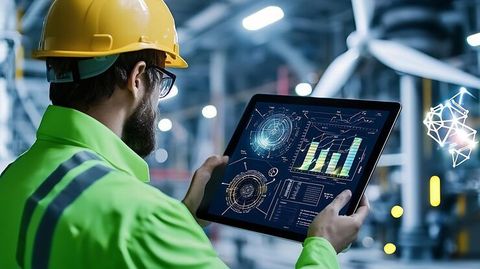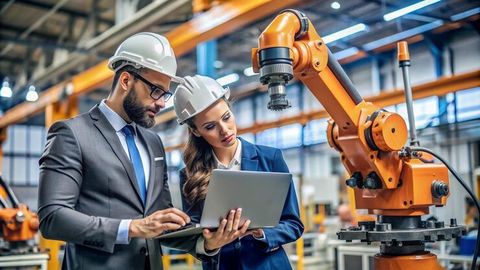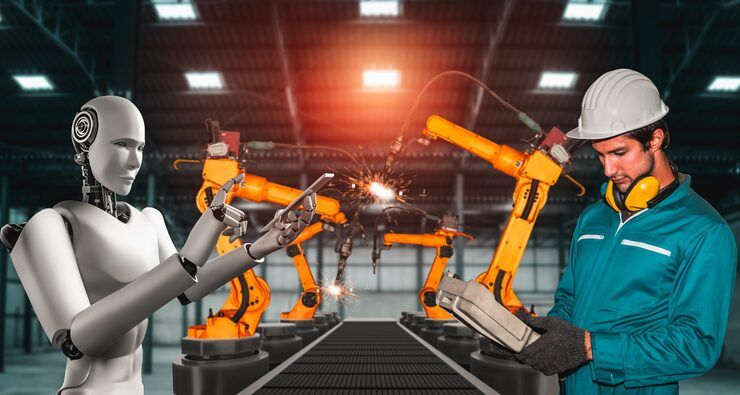
Physical AI is an emerging field that combines artificial intelligence (AI) with machines capable of interacting with the physical world. Unlike traditional AI systems that mainly process text, images, or digital information, Physical AI enables robots to observe their surroundings, understand situations, make decisions, and perform physical actions.
Autonomous robots use technologies such as machine learning, computer vision, advanced sensors, and robotics software to complete tasks with limited human intervention. These systems can operate in factories, warehouses, laboratories, agricultural environments, and other industrial settings.
The development of Physical AI is connected to several technological advancements, including:
Artificial intelligence and machine learning.
Industrial robotics and autonomous navigation.
Computer vision and object recognition.
Sensor fusion and real-time data processing.
Digital twins and simulation technology.
Edge computing and intelligent control systems.
Traditional industrial robots generally follow programmed instructions and operate within predefined environments. Physical AI introduces greater adaptability, allowing robots to respond to changing conditions and unfamiliar objects.
For example, an autonomous warehouse robot can identify obstacles, calculate a suitable route, and transport materials without following one fixed movement path. This combination of intelligence and physical movement represents an important development in industrial automation.
Why Physical AI Matters Today
Physical AI is becoming important because industries increasingly need flexible production systems, accurate operations, and better coordination between humans and machines.
Manufacturing facilities face challenges involving complex production requirements, equipment monitoring, material handling, and operational efficiency. Autonomous robotics can help address some of these challenges by performing repetitive, physically demanding, or precision-based activities.
Major industries affected include:
Manufacturing: Intelligent robots can support assembly, inspection, welding, packaging, and material handling.
Warehousing: Autonomous mobile robots can transport materials and coordinate inventory movement.
Healthcare: Robotic systems can assist with laboratory processes, medical logistics, and selected surgical applications.
Agriculture: Autonomous machines can support crop monitoring, harvesting, and precision farming.
Automotive: AI-powered robotics can improve inspection, component assembly, and production coordination.
Logistics: Intelligent machines can support sorting, transportation, and warehouse operations.
Key advantages of Physical AI
Improved adaptability in changing environments.
Greater consistency in repetitive industrial activities.
Better coordination between connected machines.
More detailed equipment monitoring.
Reduced exposure of workers to certain hazardous activities.
Improved visibility into production processes.
Physical AI does not mean that every industrial task can operate without human involvement. Human supervision, technical expertise, safety assessments, and maintenance remain important parts of autonomous industrial systems.
How Physical AI Differs from Traditional Industrial Automation
Feature | Traditional Robotics | Physical AI Robotics |
|---|---|---|
Decision-making | Predefined instructions | AI-supported decisions |
Environment | Structured environments | More adaptable environments |
Object recognition | Programmed identification | AI-based recognition |
Navigation | Fixed or programmed routes | Dynamic route planning |
Learning | Manual reprogramming | Machine learning and training |
Human interaction | Usually predefined | Can support adaptive collaboration |
The main difference is adaptability. Traditional robots are effective when tasks remain consistent, while Physical AI aims to help machines handle variations in objects, surroundings, and operating conditions.
However, autonomous robots still have limitations. Their performance depends on training data, sensor accuracy, computing capacity, software reliability, and the physical environment.
Recent Developments in Physical AI and Robotics
Growing Interest in Humanoid Robots
Humanoid robotics has become an important area of industrial research. These robots are designed with human-like body structures, allowing them to interact with equipment, tools, and workspaces originally designed for people.
During 2026, several technology companies and industrial manufacturers announced developments involving humanoid robots, robotic foundation models, and autonomous machine platforms.
On January 5, 2026, NVIDIA announced new Physical AI models and robotics technologies, including developments involving its Cosmos and GR00T platforms. The announcements also included simulation and evaluation technologies intended to support robot training and development.
Industrial Testing of Autonomous Humanoids
On April 16, 2026, Siemens and Humanoid announced testing of the HMND 01 Alpha humanoid robot at Siemens' electronics factory in Erlangen, Germany.
The robot performed autonomous logistics activities in an industrial environment. This development demonstrated how humanoid robotics could be evaluated for practical factory operations rather than remaining limited to laboratory experiments.
Advanced Robotics Simulation and Training
On March 16, 2026, NVIDIA announced additional developments involving Isaac simulation frameworks, Cosmos world models, and GR00T models.
These technologies are designed to help developers train and evaluate autonomous robots through simulated environments. Simulation is particularly important because it allows engineers to examine robot movements, environmental interactions, and possible failures before physical deployment.
Greater Attention to Robotics Safety
On June 22, 2026, NVIDIA announced Halos for Robotics, a safety architecture intended to support Physical AI systems.
The development reflects growing attention to safety across the computing, sensing, and software components of autonomous machines. However, individual manufacturers and industrial operators must still evaluate their systems against applicable safety requirements.
Important Technology Trends
Technology trend | Industrial application |
|---|---|
Humanoid robotics | Material handling and factory operations |
Robot foundation models | Learning and adapting physical tasks |
Digital twin technology | Virtual factory testing |
Autonomous mobile robots | Warehouse transportation |
Edge AI computing | Real-time machine decisions |
Computer vision | Quality inspection and object detection |
Collaborative robotics | Human-machine coordination |
These developments indicate that industrial robotics is moving toward more flexible systems that combine physical movement, environmental understanding, and artificial intelligence.
Laws, Regulations, and Government Policies
Physical AI and autonomous robotics are influenced by industrial safety regulations, machinery requirements, workplace protection rules, and artificial intelligence governance. The exact requirements depend on the country, the robot's intended application, and the level of autonomy.
European Union Regulations
The European Union has introduced several regulatory frameworks relevant to industrial robotics.
EU Machinery Regulation (EU) 2023/1230
This regulation establishes requirements concerning machinery safety, risk assessment, technical documentation, and conformity assessment.
Its general application date is January 20, 2027. Manufacturers and industrial operators should prepare for the transition from the previous machinery framework.
EU Artificial Intelligence Act
The AI Act introduces risk-based requirements for artificial intelligence systems. Certain AI applications connected with machinery and regulated industrial products may fall under high-risk provisions.
Organizations developing or deploying autonomous robotics should examine applicable risk classifications, documentation requirements, human oversight, and compliance timelines.
United States Regulations
In the United States, workplace robotics activities are influenced by Occupational Safety and Health Administration (OSHA) requirements.
Relevant areas include:
Machine guarding.
Electrical safety.
Hazardous energy control.
Workplace risk assessment.
Employee training and protective equipment.
OSHA's robotics guidance references relevant industrial safety standards, including ISO 10218. It also explains that there is no single OSHA standard specifically covering the entire robotics industry.
International Robotics Safety Standards
The International Organization for Standardization (ISO) published updated industrial robot safety standards in February 2025.
ISO 10218-1:2025: Covers safety requirements for industrial robots.
ISO 10218-2:2025: Covers safety requirements for industrial robot systems and their integration.
These standards address robot design, risk reduction, protective measures, and safe integration into industrial environments.
India and Industrial Robotics Development
India's manufacturing and automation ecosystem is supported by national initiatives such as Make in India and the Production Linked Incentive (PLI) schemes across selected sectors.
These initiatives support manufacturing development, industrial investment, and domestic production capabilities. Businesses exploring AI-powered robotics should also consider applicable factory safety requirements, machinery regulations, electrical standards, and data protection obligations.
Regulatory requirements can change, so organizations should review the latest national and regional rules before introducing autonomous systems.
Tools and Resources for Physical AI Development
Physical AI development involves several technical platforms, robotics frameworks, simulation environments, and industrial automation technologies. The following resources help engineers, researchers, and manufacturers understand and develop autonomous robotic systems.
Artificial Intelligence and Robotics Platforms
NVIDIA Isaac
A robotics development platform used for simulation, robot learning, perception, and autonomous machine development.
ROS 2 (Robot Operating System 2)
An open-source robotics framework that supports communication between sensors, controllers, software components, and robotic hardware.
NVIDIA Omniverse
A platform for developing industrial digital twins and simulating complex physical environments.
Gazebo Robotics Simulator
A simulation environment that allows developers to test robot movement, sensors, physical interactions, and navigation.
Hugging Face LeRobot
An open-source robotics initiative that supports robot learning, datasets, models, and experimentation.
MATLAB and Simulink
Engineering environments used for robotics modelling, control system development, simulation, and autonomous system testing.
Essential Resources for Industrial Automation
Resource | Main purpose |
|---|---|
NVIDIA Isaac Sim | Robotics simulation and testing |
ROS 2 | Robot software development |
Gazebo | Physical environment simulation |
MATLAB | Robotics modelling and control |
NVIDIA Omniverse | Industrial digital twins |
Hugging Face LeRobot | Robot learning and datasets |
ISO Robotics Standards | Industrial safety guidance |
Important Factors Before Implementing Physical AI
Organizations considering autonomous robotics should evaluate several technical and operational factors:
Infrastructure readiness: Assess factory layouts, network connectivity, computing hardware, and sensor requirements.
Data quality: Ensure that training datasets represent real operating environments.
Cybersecurity: Protect robot controllers, industrial networks, and connected equipment.
System compatibility: Examine whether autonomous robots can communicate with existing manufacturing systems.
Workforce preparation: Provide technical training for employees responsible for monitoring and maintaining robotic equipment.
Performance evaluation: Measure accuracy, reliability, production consistency, and safety before expanding deployment.
A structured implementation approach helps organizations understand the practical limitations of autonomous robotics and identify suitable industrial applications.
Frequently Asked Questions
What is Physical AI in robotics?
Physical AI refers to artificial intelligence integrated into machines that interact with the physical environment. It combines machine learning, computer vision, sensors, and robotics to help machines understand surroundings, make decisions, and perform physical activities.
How are autonomous robots different from traditional industrial robots?
Traditional industrial robots generally follow predefined instructions and operate within controlled environments. Autonomous robots use artificial intelligence, sensors, and environmental perception to respond to changing conditions and adjust their actions when necessary.
Which industries can benefit from Physical AI?
Manufacturing, automotive production, warehousing, agriculture, healthcare, construction, and logistics are among the industries exploring Physical AI. Its applications include material transportation, quality inspection, automated assembly, inventory management, and equipment monitoring.
What technologies are required to develop autonomous robots?
Common technologies include:
Artificial intelligence and machine learning.
Computer vision and image recognition.
LiDAR and advanced sensor systems.
Robot operating systems.
Edge computing hardware.
Motion planning and control algorithms.
Simulation and digital twin platforms.
These technologies work together to support perception, decision-making, navigation, and physical movement.
Will Physical AI completely replace human workers?
Physical AI is not expected to eliminate the need for human involvement across all industrial activities. Autonomous robots can perform selected repetitive or hazardous tasks, while people continue to manage planning, supervision, engineering, maintenance, quality control, and complex decisions. The overall impact will depend on technological progress and how individual industries adopt automation.
Conclusion
Physical AI and autonomous robots represent an important development in industrial automation. By combining artificial intelligence, machine learning, computer vision, sensor technology, and robotics engineering, these systems are expanding the capabilities of machines beyond traditional programmed operations.
Manufacturing facilities, warehouses, automotive companies, agricultural organizations, and other industrial sectors are exploring intelligent robotics to improve operational flexibility, production accuracy, and workplace safety.
Recent developments in humanoid robotics, robot foundation models, simulation platforms, and industrial digital twins demonstrate the growing interest in connecting artificial intelligence with physical machines.
However, successful adoption requires more than advanced technology. Organizations must consider equipment compatibility, cybersecurity, regulatory compliance, workforce preparation, and operational reliability.
As research and industrial applications continue to develop, Physical AI could become an important part of the next industrial revolution, creating new possibilities for human-machine collaboration and intelligent manufacturing.