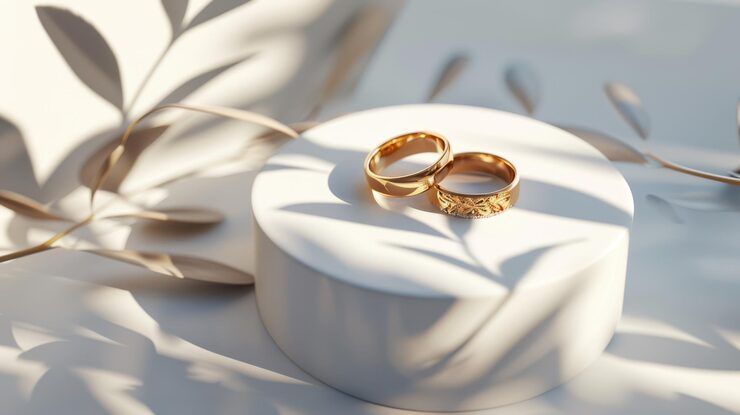
Minimalist engagement rings are characterized by simple designs, restrained detailing, and an emphasis on the central stone or clean metalwork. Instead of elaborate settings with many decorative elements, these rings generally use uncomplicated bands, smaller accents, or a single prominent gemstone.
Common minimalist designs include:
- Solitaire rings with one central stone
- Slim gold or platinum bands
- Bezel-set gemstones
- Low-profile settings
- Plain bands with small diamond accents
- Delicate halo designs
- Three-stone rings with restrained proportions
- Geometric or contemporary settings
Minimalism does not necessarily mean that a ring has no gemstones. The style is primarily about visual simplicity and balanced proportions.
The concept has become relevant as jewelry preferences have expanded beyond highly decorative designs. Minimalist rings can be designed around different metals and gemstones, allowing the overall appearance to range from traditional to contemporary.
The main components of a minimalist engagement ring include the setting, band, gemstone, metal, proportions, and finishing. Each affects appearance, durability, comfort, and maintenance.
Why Minimalist Engagement Rings Matter Today
Minimalist engagement rings appeal to people who prefer jewelry that is visually understated and can fit with different types of clothing and occasions.
A simple design can also make the central gemstone more visually prominent. For example, a solitaire setting places most of the visual attention on one stone rather than distributing it across multiple decorative elements.
Minimalist designs are also relevant to everyday wear. Lower-profile settings can reduce the likelihood of catching on clothing or other objects, although durability depends on the specific design and construction.
The choice of gemstone is another important consideration. Natural diamonds, laboratory-grown diamonds, sapphires, and other gemstones can all be used in engagement rings. Their physical properties, grading systems, appearance, and long-term characteristics differ.
For gold jewelry in India, purity is expressed using caratage and fineness. BIS identifies several permitted grades, including 14K (585), 18K (750), 20K (833), 22K (916), 23K (958), and 24KS (995).
| Feature | Common Minimalist Choice | What to Consider |
|---|---|---|
| Setting | Solitaire or bezel | Protection and visibility of the stone |
| Band | Slim or medium-width | Comfort and durability |
| Metal | Gold or platinum | Color, hardness, and maintenance |
| Center Stone | Diamond or gemstone | Cut, clarity, color, and durability |
| Accent Stones | Few or none | Simplicity and maintenance |
| Profile | Low or moderate | Comfort and snag resistance |
| Finish | Polished or brushed | Appearance and upkeep |
Minimalist jewelry also fits into a broader movement toward contemporary and everyday jewelry. Recent reporting from India's jewelry sector has highlighted growing interest in contemporary designs, diamond jewelry, and pieces intended for regular wear.
Recent Trends in Minimalist Engagement Rings
Jewelry preferences continued to evolve during 2025 and 2026, with understated jewelry receiving attention alongside larger and more elaborate styles.
In September 2026, coverage of the MTV VMAs highlighted minimalist jewelry and delicate diamond pieces as part of contemporary red-carpet styling. Although celebrity fashion does not necessarily represent the broader engagement-ring market, it illustrates the continued visibility of understated jewelry aesthetics.
Another important development has been the continuing discussion around laboratory-grown diamonds. These diamonds are created through technological processes rather than geological formation. They have the same basic chemical composition and crystal structure as natural diamonds, but their origin and production methods differ.
Recent 2026 coverage has also emphasized the importance of examining diamond grading information rather than judging a stone solely by its size or appearance. Factors such as cut, clarity, color, carat weight, fluorescence, and certification can affect how a diamond is evaluated.
The distinction between natural and laboratory-grown diamonds is increasingly relevant to engagement-ring design because both can be incorporated into minimalist settings.
Other visible design trends include:
- Thin and refined bands
- Oval and elongated center stones
- Yellow-gold settings
- Bezel and half-bezel designs
- Mixed-metal details
- Low-profile settings
- Small accent diamonds
- Geometric shapes
- Stackable wedding and engagement rings
These trends can change quickly, so they should be viewed as current design observations rather than permanent preferences.
Laws, Hallmarking, and Policies in India
Engagement rings made from precious metals can be affected by India's BIS hallmarking framework.
The Bureau of Indian Standards states that hallmarking provides an official indication of the proportion of precious metal in an article. Gold and silver are currently covered by India's hallmarking system.
For hallmarked gold jewelry, the hallmark introduced with the HUID system consists of three components:
- BIS Standard Mark
- Purity in caratage and fineness
- Six-digit alphanumeric Hallmark Unique Identification (HUID) number
The BIS states that consumers can use the BIS Care App to verify a HUID.
India's mandatory hallmarking framework has also been expanded through successive amendments. The BIS mandatory-hallmarking page lists amendments through April and August 2026, with the page updated on September 1, 2026.
There are exemptions within the mandatory hallmarking framework. BIS lists, among other categories, certain articles weighing less than two grams and specific traditional jewelry categories such as Kundan, Polki, and Jadau among the exemptions. The exact applicability depends on the relevant order and circumstances.
BIS also states that registered jewellers selling hallmarked precious-metal articles are subject to the applicable registration and hallmarking requirements.
For consumers, the BIS Care App's Verify HUID function is a useful verification resource. BIS also states that consumers can have jewelry tested through a BIS-recognized Assaying and Hallmarking Centre.
These rules concern the precious-metal article and its purity; they do not establish that a particular ring design or gemstone is inherently better than another.
Tools and Resources for Choosing a Minimalist Ring
Several resources can help people understand ring specifications and verify jewelry information.
- BIS Care App: Allows verification of HUID numbers on eligible hallmarked gold jewelry.
- BIS Hallmarking Resources: Provides information about purity, hallmarking standards, registered jewellers, and applicable requirements.
- Ring-size guides: Help estimate finger size, although professional measurement can be more reliable.
- Diamond grading reports: Provide information about characteristics such as carat weight, color, clarity, and cut for graded diamonds.
- Gemological references: Explain the physical and optical characteristics of diamonds and colored gemstones.
- Metal-purity references: Help explain differences between 14K, 18K, 22K, and other gold grades.
- Jewelry CAD tools: Allow designers to visualize ring proportions and settings before fabrication.
- Ring-sizing calculators: Can convert measurements between common sizing systems.
When comparing designs, it can be useful to record the metal type, purity, center-stone specifications, setting style, ring dimensions, hallmark information, and grading documentation in one checklist.
Frequently Asked Questions
What makes an engagement ring minimalist?
A minimalist engagement ring generally uses a simple structure, limited decoration, clean lines, and restrained proportions. A solitaire, plain band, or low-profile bezel setting can all have a minimalist appearance.
Are minimalist engagement rings durable?
Durability depends on the metal, setting, gemstone, band thickness, and construction. A simple appearance does not automatically mean that a ring is more durable. Settings should be evaluated based on how securely they hold the center stone and how the ring is intended to be worn.
What is the difference between 18K and 22K gold?
The difference is the proportion of gold in the alloy. BIS identifies 18K gold as 750 fineness and 22K gold as 916 fineness. Higher gold content generally changes the metal's characteristics, including hardness and color.
What is HUID on a gold engagement ring?
HUID stands for Hallmark Unique Identification. It is a six-digit alphanumeric identifier associated with a hallmarked gold article under India's current hallmarking system. The BIS Care App provides a Verify HUID function.
Are laboratory-grown diamonds the same as natural diamonds?
Laboratory-grown diamonds and natural diamonds have the same fundamental carbon crystal structure, but they have different origins. A natural diamond forms through geological processes, while a laboratory-grown diamond is produced using technological processes. Grading documentation can identify relevant characteristics and origin information.
Understanding Proportions and Design
Minimalist engagement rings depend heavily on proportion. A narrow band paired with a large center stone can create a different visual balance from a medium-width band with a smaller stone.
The setting also affects both appearance and practicality.
Solitaire settings emphasize a single center stone.
Bezel settings surround the stone with metal and can provide additional protection around its edges.
Prong settings hold the stone with small metal claws and allow more of the gemstone to remain visually exposed.
Low-profile settings position the center stone closer to the finger and can provide a more restrained silhouette.
The appropriate design depends on personal preferences, finger proportions, lifestyle, and how the ring will be worn.
For a minimalist design, fewer decorative elements do not necessarily mean fewer decisions. The choice of metal purity, gemstone, setting, band thickness, proportions, finish, and hallmark information can all influence the final ring.
The Role of Certification and Verification
For diamond engagement rings, a grading report from a recognized gemological laboratory can document important characteristics of the stone.
For gold jewelry in India, BIS hallmarking provides information about the precious-metal purity of eligible articles. The BIS states that a hallmark provides third-party assurance regarding the stated purity or fineness.
Consumers can also verify eligible HUID numbers through the BIS Care App.
These verification mechanisms are useful because the appearance of a ring alone cannot establish its metal purity or the detailed characteristics of its gemstone.
The Future of Minimalist Engagement Rings
Minimalist engagement rings reflect a broader interest in simple forms, everyday wearability, and contemporary jewelry design. Their appearance can remain understated while still incorporating diamonds, colored gemstones, different gold purities, platinum, or mixed-metal elements.
Current jewelry trends also show continued interest in contemporary and everyday designs, while laboratory-grown diamonds remain an important part of the wider diamond market discussion.
In India, understanding BIS hallmarking, HUID verification, gold purity, gemstone grading, and applicable jewelry regulations can help people interpret product information more accurately.
Ultimately, minimalist design is less about a particular gemstone size or metal and more about simplicity, proportion, functionality, and restrained visual detail. A well-informed choice considers both the aesthetic characteristics of the ring and the documented information about its materials and construction.