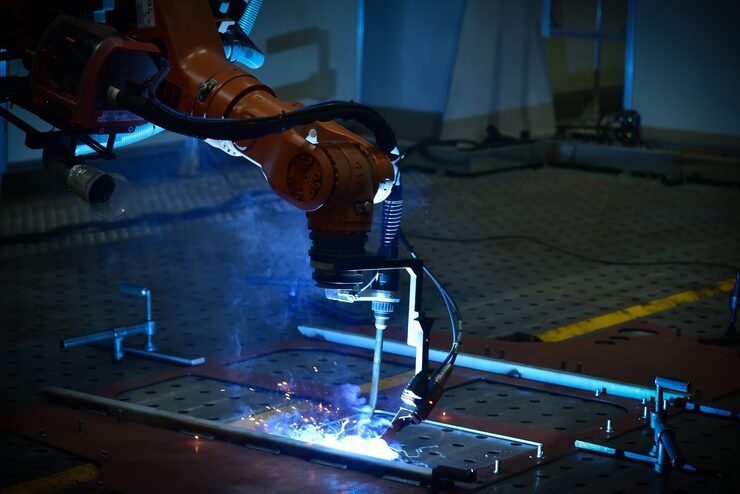
MIG/MAG welding machines are electric arc welding systems that use a continuously fed wire electrode to create a weld between metal components. MIG stands for Metal Inert Gas, while MAG means Metal Active Gas. The primary distinction is the shielding gas used around the welding arc.
MIG generally uses an inert gas such as argon or helium, particularly for materials such as aluminum and some non-ferrous metals. MAG uses active gas mixtures, commonly based on carbon dioxide or argon with carbon dioxide or oxygen, and is widely used for steel fabrication.
The basic process combines an electrical power source, wire feeder, welding torch, consumable wire, shielding gas, and control system. When the wire reaches the workpiece, an arc forms and generates heat that melts the wire and base metal to create a joint.
How MIG/MAG Welding Works
A typical MIG/MAG welding machine coordinates several parameters during welding:
Welding current
Arc voltage
Wire-feed speed
Shielding-gas flow
Travel speed
Polarity
Arc characteristics
Inductance or dynamic arc control
Digital welding machines can monitor these parameters continuously and adjust the arc according to programmed settings.
MIG and MAG Comparison
| Feature | MIG Welding | MAG Welding |
|---|---|---|
| Shielding gas | Mainly inert gas | Active gas or gas mixture |
| Common materials | Aluminum, copper alloys, some stainless applications | Carbon steel, low-alloy steel |
| Typical environment | Fabrication and precision applications | General industrial fabrication |
| Wire electrode | Continuous | Continuous |
| Automation potential | High | High |
| Common advantage | Controlled arc for non-ferrous materials | Efficient steel welding |
The exact gas mixture, wire type, current, voltage, and technique depend on the material thickness, joint design, welding position, and applicable welding procedure.
Why MIG/MAG Welding Matters Today
MIG/MAG welding is important because it can combine relatively high deposition rates with continuous wire feeding and adaptable digital controls. These characteristics make the process suitable for many manufacturing and fabrication environments.
Applications include:
Automotive manufacturing
Heavy equipment
Structural fabrication
Shipbuilding
Rail manufacturing
Agricultural machinery
Pressure equipment
Metal furniture
Energy infrastructure
General metal fabrication
Supporting Modern Manufacturing
Manufacturers increasingly need welding systems that can maintain repeatable parameters across many components. Digital MIG/MAG systems can store welding programs and monitor process data, helping production teams maintain greater consistency.
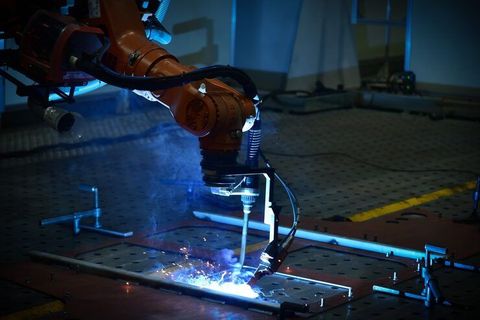
The technology also fits automated production cells. Robotic arms can control torch movement while the welding power source manages the electrical characteristics of the arc.
Improving Process Control
Modern industrial welding machines can include programmable operating modes, digital displays, waveform controls, wire-feed monitoring, and data interfaces.
These functions can help technicians investigate issues such as:
Excessive spatter
Inconsistent penetration
Porosity
Wire feeding problems
Arc instability
Excessive heat input
Poor shielding-gas coverage
Correct parameter selection remains essential. A sophisticated machine cannot compensate for unsuitable material preparation, incorrect wire selection, poor joint fit-up, or inadequate shielding.
Supporting Automated Welding
Robotic MIG/MAG welding is widely used where components have repeatable geometry and production sequences.
Automation can improve repeatability by maintaining programmed torch angles, travel paths, speeds, and welding parameters. Recent industry developments also show greater use of synchronized robots, machine vision, digital monitoring, and adaptive controls.
Recent MIG/MAG Welding Developments
The welding industry has continued moving toward digital control, automation, advanced sensing, and more efficient use of materials and energy during 2025 and 2026.
Digital MIG/MAG Systems
In April 2025, Fronius announced that its September 2025 SCHWEISSEN & SCHNEIDEN presentation would include a new manual MIG/MAG system alongside robotic, collaborative-robot, and customized automation technologies. The company also highlighted resource efficiency involving filler metal, shielding gas, and energy.
This reflects a wider industry direction toward welding equipment that combines process control with easier parameter management.
Synchronized Robotic Welding
In February 2026, the American Welding Society highlighted synchronized automation in which multiple robots coordinate welding and material-handling operations. Such systems can allow several robotic units to work around the same component while coordinating their movements.
This development is particularly relevant to automotive, heavy equipment, and other high-volume manufacturing environments.
AI and Adaptive Welding
AI-assisted welding is moving from experimental research toward practical inspection and process-monitoring applications. In August 2026, the American Welding Society reported on AI-integrated welding inspection using 3D robot vision and machine-learning approaches for joint recognition, path correction, and quality analysis.
In September 2026, AWS also examined physical AI for adaptive welding automation, including systems that use vision, force, position, and other sensor information to respond to variations in real production environments.
Greater Attention to Resource Efficiency
Modern welding development increasingly considers energy consumption, shielding-gas usage, wire utilization, spatter, and post-weld processing. These factors can influence overall production efficiency and environmental performance.
The direction is therefore shifting from simply producing an arc toward controlling the entire welding process through connected equipment, data collection, sensing, and automated inspection.
Laws, Regulations and International Standards
MIG/MAG welding is affected by workplace safety rules, electrical requirements, exposure controls, equipment standards, fire-prevention rules, and welding-quality standards. Requirements differ between countries, so organizations should verify the rules applicable to their facility and industry.
United States
In the United States, OSHA's welding, cutting, and brazing requirements include rules for general industry, construction, and maritime environments. OSHA's regulations cover arc-welding equipment, fire prevention, ventilation, personal protective equipment, and hazardous exposure controls.
OSHA's arc-welding requirements state that equipment should be selected and installed appropriately and that designated operators must receive suitable instruction and qualification.
Ventilation is particularly important because welding can generate fumes and gases. OSHA requirements address mechanical ventilation and additional controls for certain metals and confined environments.
European Union
The European Union has established occupational exposure rules covering several hazardous substances associated with welding fumes. In July 2025, the European Commission proposed amendments to the Carcinogens, Mutagens and Reprotoxic substances Directive that specifically addressed exposure to welding fumes containing relevant carcinogenic, mutagenic, or reprotoxic substances.
The proposal illustrates the increasing regulatory attention given to welding-fume exposure and workplace risk management.
United Kingdom
The UK's Health and Safety Executive recommends controlling welding-fume exposure through measures such as reducing exposure, local exhaust ventilation, and suitable respiratory protective equipment where required. Its guidance specifically discusses on-torch extraction for MIG welding.
International Welding Standards
ISO 4063:2023 provides internationally recognized reference numbers and terminology for welding, brazing, soldering, and cutting processes. A standardized process nomenclature helps technical documentation and welding procedure specifications use consistent process references.
Manufacturers and fabrication organizations may also need to consider national electrical standards, machinery requirements, welding-quality standards, worker-protection rules, and industry-specific codes.
Tools and Resources for MIG/MAG Welding
A well-planned welding operation normally combines equipment documentation, parameter references, measurement tools, inspection methods, and safety resources.
Useful Technical Tools
Welding parameter calculators: Help estimate starting current, voltage, wire-feed speed, and gas-flow settings.
Welding procedure specifications: Define controlled parameters for particular materials and joint configurations.
Digital welding power sources: Store programs and provide controlled arc characteristics.
Wire-feed monitoring: Helps identify feeding interruptions and inconsistent wire movement.
Gas-flow meters: Help verify shielding-gas delivery.
Thermal monitoring tools: Help evaluate heat distribution and thermal behavior.
Weld inspection equipment: Supports visual and non-destructive examination.
Machine-vision systems: Can monitor joint position, weld appearance, and production consistency.
Robotic programming software: Used to create and modify automated welding paths.
Welding data-logging platforms: Record process parameters for quality analysis and traceability.
Fume extraction systems: Capture welding fumes near their source.
PPE selection guides: Help determine appropriate eye, face, hand, body, and respiratory protection.
For international reference, ISO standards provide process terminology, while organizations such as OSHA, HSE, and the European Commission provide regulatory and workplace-safety information.
Important Machine Specifications
When evaluating an industrial MIG welding machine or MIG/MAG welding system, important technical factors include:
| Parameter | Why It Matters |
|---|---|
| Output current | Determines suitable welding range |
| Duty cycle | Indicates continuous operating capability |
| Wire diameter range | Determines compatible filler-wire sizes |
| Welding modes | Supports different materials and joint conditions |
| Gas compatibility | Determines shielding-gas options |
| Digital controls | Improve parameter repeatability |
| Data connectivity | Supports monitoring and traceability |
| Automation compatibility | Enables robotic integration |
| Cooling system | Helps manage thermal load |
| Protection features | Supports safer operation |
The correct specification depends on material, thickness, production volume, welding position, joint design, and applicable standards.
Frequently Asked Questions
What is a MIG/MAG welding machine?
A MIG/MAG welding machine is an arc-welding system that uses a continuously fed wire electrode and shielding gas to create a welded joint. MIG normally uses inert shielding gas, while MAG uses active gas mixtures.
What is the difference between MIG and MAG welding?
The main difference is the shielding gas. MIG generally uses inert gases such as argon or helium, while MAG uses active gas mixtures. Material selection and welding requirements determine which process is appropriate.
Can MIG/MAG welding be automated?
Yes. MIG/MAG processes are widely compatible with robotic arms, collaborative robots, machine vision, positioners, and digital welding controls. Automated systems can maintain programmed welding paths and process parameters.
What materials can MIG/MAG machines weld?
Depending on the machine, wire, shielding gas, and welding procedure, MIG/MAG technology can be used with carbon steel, stainless steel, aluminum, and various alloys. The correct combination of consumables and parameters is essential.
Is welding-fume control important?
Yes. Welding fumes can contain hazardous substances, and workplace rules in many regions require appropriate exposure controls. Ventilation, local exhaust systems, suitable respiratory protection, shielding, and appropriate work practices can help reduce exposure.
Conclusion
MIG/MAG welding machines remain an important technology for joining metals across automotive, transportation, construction, heavy equipment, energy, and general manufacturing.
Their combination of continuous wire feeding, programmable electrical control, adaptable shielding gases, and automation compatibility makes them suitable for both manual and highly automated production environments.
The technology is also becoming increasingly digital. Developments during 2025 and 2026 show greater integration of robotic coordination, machine vision, process monitoring, digital controls, and emerging AI-based inspection and adaptive-welding technologies.
At the same time, welding-fume management and workplace protection remain major considerations. Regulations in the United States, United Kingdom, European Union, and other regions continue to emphasize ventilation, exposure control, equipment safety, and worker protection.
For organizations researching MIG welding machines, MAG welding equipment, industrial welding machines, robotic MIG welding, or automated welding systems, the most important considerations include material compatibility, current range, duty cycle, wire system, shielding gas, process control, automation capability, inspection methods, ventilation, and applicable international standards.
The future of MIG/MAG welding is therefore not limited to higher welding speeds. It is increasingly focused on connected equipment, adaptive process control, automated inspection, better resource management, and safer production environments.