London is a city shaped by more than two thousand years of settlement, political change, architecture, trade, religion, engineering, and cultural development. Its historical landmarks range from Roman archaeological remains and medieval fortresses to royal palaces, Victorian structures, churches, bridges, monuments, and internationally recognized World Heritage Sites.
Among the best-known landmarks are the Tower of London, Westminster Abbey, St Paul's Cathedral, Tower Bridge, the Palace of Westminster, Greenwich, and the Royal Botanic Gardens, Kew. London also contains thousands of less prominent historic buildings that contribute to the character of individual neighborhoods.
The city's heritage is therefore not limited to famous attractions. It includes streets, archaeological remains, historic houses, parks, churches, bridges, monuments, and buildings that continue to form part of everyday urban life.
Major Historical Landmarks in London
| Landmark | Historical Significance | Main Historical Period |
|---|---|---|
| Tower of London | Royal fortress, palace and historic prison | Medieval |
| Westminster Abbey | Coronations and major religious history | Medieval–Modern |
| Palace of Westminster | Centre of Britain's parliamentary history | Medieval–Modern |
| St Paul's Cathedral | Major religious and architectural landmark | Medieval–Modern |
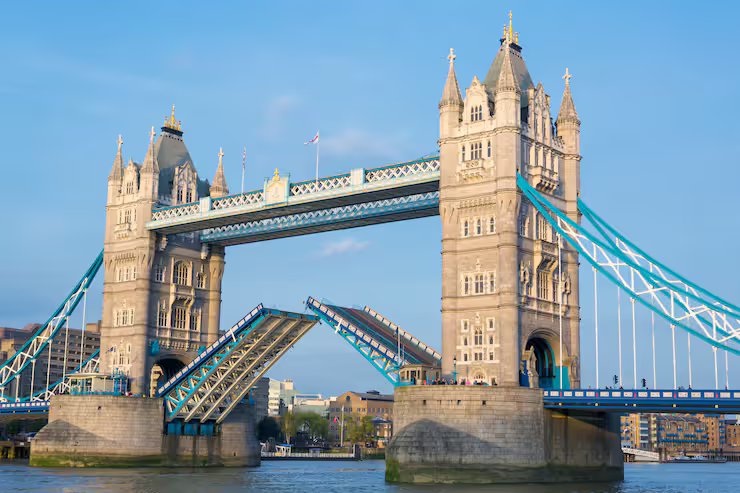
| Tower Bridge | Victorian engineering landmark | 19th century |
| Maritime Greenwich | Naval, scientific and royal heritage | 17th–19th centuries |
| Kew Gardens | Botanical and royal landscape heritage | 18th century onward |
| London Wall | Evidence of Roman and medieval London | Roman–Medieval |
Visit London describes the Tower of London as dating from 1078 and notes its historical roles as a royal palace, fortress, prison, and other uses over its long history.
Why London's Historical Landmarks Matter
Historical landmarks help explain how London developed from a Roman settlement into a major modern capital.
They also provide opportunities to understand architecture, politics, science, religion, transportation, military history, art, and social change through physical places.
The importance of heritage extends beyond tourism. Historic buildings can contribute to neighborhood identity and help communities understand the origins of the areas where they live.
Four World Heritage Sites
London has four UNESCO World Heritage Sites:
- Palace of Westminster and Westminster Abbey, including St Margaret's Church
- Tower of London
- Maritime Greenwich
- Royal Botanic Gardens, Kew
The Greater London Authority explains that these sites have Outstanding Universal Value and are protected through London planning policies that consider both the sites and their surrounding settings.
This creates an important planning challenge. London must accommodate new housing, transportation, infrastructure, offices, and public spaces while protecting historic environments.
Heritage and Education
Historical landmarks also support learning outside traditional classrooms.
Visitors can use buildings and archaeological locations to understand:
- Roman London
- Medieval monarchy
- Religious history
- Industrial development
- Victorian engineering
- British parliamentary history
- Maritime trade
- Scientific development
- Urban planning
- Architectural design
The result is a physical connection between historical information and the places where events, technologies, and communities developed.
Recent Heritage Developments in London
London's historic environment continues to change as conservation organizations, local authorities, and property owners work to protect important buildings while allowing appropriate adaptation.
New Historic Listings in 2025
Historic England announced 19 notable historic places that received protection in 2025. The London additions included several listed buildings and historic structures.
Among them were Southwark London Underground Station, buildings at Old Palace Croydon, and the submarine telephone cable hauler and gantry at Enderby's Wharf in Greenwich. The Enderby's Wharf structures were recognized for their connection to the development of international undersea communications.
This illustrates that heritage protection is not limited to medieval buildings. More recent industrial and technological structures can also acquire historical significance.
Crystal Palace Dinosaurs Removed from Heritage at Risk
In July 2026, Historic England announced that the Grade I listed Crystal Palace Dinosaurs in South London had been repaired and removed from the Heritage at Risk Register.
The dinosaurs were created in the 1850s and represent an important example of Victorian scientific interpretation and public education.
Their restoration demonstrates how conservation can involve unusual structures as well as conventional historic architecture.
Funding for At-Risk Buildings
In March 2026, Historic England announced more than £1 million in grants for three listed church buildings in London.
The projects included structural work at St Richard's Church in Richmond, repairs to the spire of St Andrew's Church in Islington, and restoration work at Union Chapel's Sunday School.
These projects demonstrate the continuing challenge of maintaining historic buildings that require substantial repair.
Greater London Historic Environment Record
The Greater London Historic Environment Record became available online, giving the public access to information covering archaeological sites, historic buildings, parks, landscapes, and other heritage records.
Historic England states that the database contains more than 98,000 records covering periods from early human occupation through modern times.
For researchers and travelers interested in lesser-known landmarks, this creates a useful way to explore London's historical landscape beyond its most famous attractions.
Laws and Policies Protecting London Heritage
Historic landmarks in London are affected by UK heritage legislation, national planning policy, local planning rules, conservation-area controls, and World Heritage policies.
Listed Buildings
Buildings considered to have special architectural or historic interest can be placed on the National Heritage List for England.
Listed status can affect alterations, demolition, and other forms of physical change. Some proposed alterations require Listed Building Consent in addition to normal planning permission.
The City of London currently has more than 600 listed buildings and other listed structures. Its planning guidance states that proposed changes to listed buildings may require Listed Building Consent so that their special character can be protected.
Conservation Areas
Conservation areas protect groups of buildings and the character of historic neighborhoods rather than focusing only on individual structures.
London contains numerous conservation areas managed by local planning authorities.
These controls can affect demolition, external alterations, building design, trees, streetscapes, and development proposals.
World Heritage Planning
The London Plan includes policies designed to conserve and enhance London's World Heritage Sites and their settings.
This means that development near a protected landmark may be assessed not only according to the building itself but also according to how proposed changes could affect its wider historic setting.
Heritage at Risk
Historic England maintains an annual Heritage at Risk Register covering vulnerable heritage assets.
The register can include listed buildings, scheduled monuments, registered parks and gardens, conservation areas, and other protected assets.
In August 2026, Historic England also updated guidance concerning Building Preservation Notices. These can temporarily protect an unlisted building while its potential historic significance is assessed for formal listing.
Tools and Resources for Exploring London History
Digital resources can make historical sightseeing more informative and easier to plan.
Visit London
The official London tourism guide provides information about historic houses, palaces, landmarks, museums, churches, attractions, and suggested sightseeing routes.
Its current historical-landmark guides include locations such as the Tower of London, Westminster Abbey, St Paul's Cathedral, Tower Bridge, Greenwich, and other heritage locations.
Historic England
Historic England provides authoritative information about listed buildings, conservation, archaeological sites, heritage protection, and historic places in England.
Its National Heritage List for England is particularly useful when researching whether a building or site has formal national protection.
Greater London Historic Environment Record
The GLHER database is useful for discovering lesser-known historical locations, archaeological sites, historic buildings, parks, and landscapes across Greater London.
Digital Maps
Map applications can help travelers plan routes between landmarks and identify nearby:
- Underground stations
- Rail stations
- Walking routes
- Museums
- Public parks
- River crossings
- Accessibility information
- Rest areas
London's historic center is compact in some areas, so combining walking routes with public transportation can make it easier to visit several landmarks in one day.
Historical Landmark Planning Table
| Planning Question | Useful Resource |
|---|---|
| Is a building nationally protected? | National Heritage List for England |
| Where are historic sites located? | GLHER and digital maps |
| What landmarks are open today? | Official attraction websites |
| What are current events? | Visit London |
| What planning rules apply? | Local council planning authority |
| Is an area a World Heritage Site? | Greater London Authority |
| Is a site at risk? | Historic England Heritage at Risk Register |
Frequently Asked Questions
What are the most famous historical landmarks in London?
Major examples include the Tower of London, Westminster Abbey, the Palace of Westminster, St Paul's Cathedral, Tower Bridge, and Maritime Greenwich. London also contains many less internationally known historic buildings and archaeological sites.
What is the oldest historical landmark in London?
London contains archaeological evidence that predates the Roman period. The Tower of London is among the city's oldest major surviving visitor landmarks, with the White Tower dating from the late 11th century.
How are historic buildings protected in London?
Protection can involve national listing, Listed Building Consent, conservation-area controls, scheduled-monument protection, local planning policies, and World Heritage planning policies. The applicable rules depend on the type and designation of the site.
Can visitors explore London's historical landmarks independently?
Yes. Many landmarks can be explored independently using official websites, maps, audio resources, museum information, and historical databases. Some locations have restricted areas or scheduled entry arrangements, so checking official information before visiting is useful.
What is the best resource for researching lesser-known London landmarks?
The Greater London Historic Environment Record is particularly useful because it contains extensive information about archaeological sites, historic buildings, parks, landscapes, and other elements of London's historic environment.
Conclusion
London's historical landmarks represent many different periods rather than a single chapter of British history. Roman remains, medieval fortifications, royal buildings, churches, Victorian engineering, industrial structures, and modern heritage sites all contribute to the capital's historic environment.
Recent developments demonstrate that heritage protection remains active. New buildings and structures were added to the national heritage list in 2025, Crystal Palace Dinosaurs were removed from the Heritage at Risk Register in 2026 following repairs, and significant funding was directed toward vulnerable historic buildings.
For travelers, London's historical landmarks provide opportunities to study architecture, culture, politics, science, religion, transportation, and community history. For researchers and residents, resources such as Historic England's heritage databases and the Greater London Historic Environment Record make it possible to explore thousands of locations beyond the city's most recognizable attractions.
Understanding the rules surrounding listed buildings, conservation areas, archaeological sites, and World Heritage locations also helps explain why London's historic character continues to evolve while many important places are preserved for future generations.