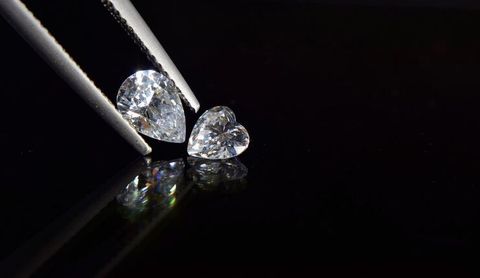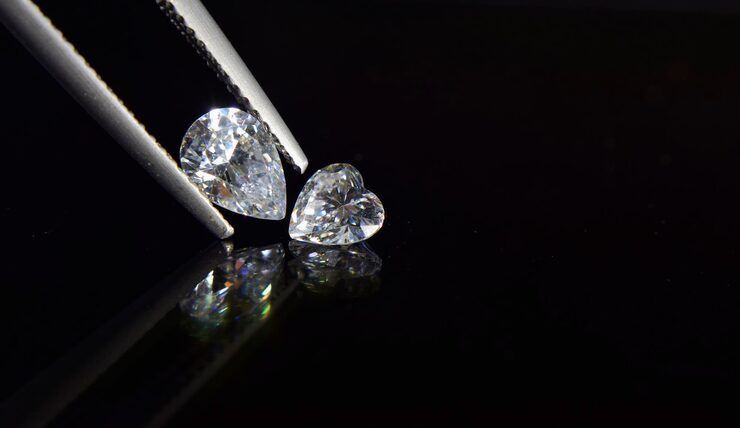
Lab-grown diamonds are diamonds produced through controlled technological processes rather than formed naturally underground over geological periods.
They are also called laboratory-grown diamonds or laboratory-created diamonds. Unlike diamond simulants such as cubic zirconia or moissanite, lab-grown diamonds have the same fundamental chemical composition and crystal structure as natural diamonds: crystallized carbon.
Two major production methods are used:
- Chemical Vapor Deposition (CVD): Carbon-containing gases are introduced into a controlled chamber, where carbon atoms gradually form diamond material on a substrate.
- High Pressure High Temperature (HPHT): A carbon source is exposed to extremely high pressure and temperature conditions designed to reproduce aspects of the environment in which diamonds form.
After growth, a laboratory-grown diamond can undergo cutting, polishing, and, in some cases, additional treatments.
The final appearance is evaluated using characteristics such as carat weight, color, clarity, and cut. These are commonly known as the 4Cs.
| Characteristic | What It Describes |
|---|---|
| Carat | Weight of the diamond |
| Color | Degree of color in a diamond |
| Clarity | Internal and external characteristics |
| Cut | How the diamond's proportions and finish affect its optical performance |
A laboratory-grown diamond should not be confused with a diamond imitation. A laboratory-grown diamond is diamond material, while an imitation is another material designed to resemble diamond.
Why Lab-Grown Diamonds Matter Today
Laboratory-grown diamonds have become an important part of the global diamond industry because technological advances have made controlled diamond growth possible at commercial scale.
They are relevant to consumers, jewelry designers, gemological laboratories, manufacturers, researchers, and India's diamond-processing industry.
One important distinction is origin. A natural diamond originates through geological processes, whereas a laboratory-grown diamond originates through a controlled manufacturing process.
The physical and optical characteristics can be very similar, making specialized gemological testing and documentation important when identifying a diamond's origin.
Laboratory-grown diamonds can also provide researchers with a controlled environment for studying diamond growth, crystal properties, defects, and related technologies.
India has a particularly important role in this field. The country has a major diamond-cutting and polishing ecosystem, while government policy has also encouraged domestic development of laboratory-grown diamond technology.
However, laboratory-grown and natural diamonds are not identical in every commercial or geological respect. Their origins, production methods, market dynamics, and long-term supply characteristics are different.
The distinction should therefore be clearly disclosed when a diamond is described.
Recent Developments in Lab-Grown Diamonds
The laboratory-grown diamond industry has continued to develop during 2025 and 2026, with changes in technology, terminology, production, and consumer awareness.
In April 2026, NITI Aayog reported that India had recognized laboratory-grown diamonds as a technology-driven segment. Its report highlighted the India Centre for Lab-Grown Diamonds (InCent-LGD) at IIT Madras, established with a ₹242 crore research grant announced in the Union Budget 2023–24. The initiative focuses on developing indigenous technology, including diamond-growth reactors and diamond seeds.
The same NITI Aayog report noted that the Union Budget 2026–27 extended duty-free imports of certain LGD seeds and sawn diamonds until March 2028.
India's diamond market has also continued to evolve. In April 2026, The Economic Times reported that India had become the world's second-largest diamond jewelry market by global demand share, while noting that natural diamonds remained dominant and laboratory-grown diamonds were gaining traction.
In August 2026, The Economic Times reported increasing interest in laboratory-grown diamond jewelry beyond India's major metropolitan areas, including growing activity in tier-2 and tier-3 cities.
Another important development concerns terminology. NITI Aayog reported that BIS introduced IS 19469:2025, aligning Indian terminology with international standards and distinguishing natural diamonds, laboratory-grown diamonds, treated stones, and imitations. The standard emphasizes precise, non-misleading nomenclature.
Gemological grading has also remained an important topic. In July 2025, the International Gemological Institute stated that it would continue applying its 4Cs grading system to both natural and laboratory-grown diamonds.
These developments show that laboratory-grown diamonds are increasingly being addressed through technology, standards, certification, and industry policy rather than being treated simply as a niche category.
Laws, Standards, and Government Policies in India
India's rules concerning diamonds involve standards, consumer information, precious-metal jewelry regulations, and government policies supporting domestic technology.
The Bureau of Indian Standards (BIS) has introduced terminology for diamonds through IS 19469:2025. The standard distinguishes laboratory-grown diamonds from natural diamonds, treated diamonds, and imitation materials. Clear terminology is important because consumers should be able to understand the nature and origin of the gemstone being described.
It is also important to distinguish diamond standards from gold hallmarking. BIS hallmarking primarily concerns the purity or fineness of precious metals such as gold and silver. BIS states that hallmarking is the official recording of the proportion of precious metal in an article.
Therefore, a gold ring containing a laboratory-grown diamond can involve two separate areas of information: the gemstone's identification and grading, and the precious-metal article's applicable hallmarking requirements.
India has continued expanding mandatory gold hallmarking. In March 2026, the sixth phase added seven districts, bringing the total number of districts covered under mandatory hallmarking to 380.
Government policy has also supported domestic laboratory-grown diamond research. The InCent-LGD initiative at IIT Madras is intended to develop domestic capabilities in areas such as diamond-growth technology and related equipment.
These policies do not mean that every laboratory-grown diamond has identical characteristics. Certification and grading documentation remain important for identifying individual stones.
Tools and Resources for Lab-Grown Diamonds
Several resources can help people understand diamond characteristics, certification, terminology, and Indian standards.
- Bureau of Indian Standards: Provides information on Indian standards, hallmarking, and applicable jewelry regulations.
- India Centre for Lab-Grown Diamonds: Supports research and technological development related to laboratory-grown diamond production.
- IGI: Provides diamond grading information and documentation for laboratory-grown and natural diamonds.
- GIA: Provides educational resources explaining diamond characteristics, identification, and gemological science.
- Diamond grading reports: Document characteristics such as carat weight, color, clarity, cut, measurements, and relevant identification information.
- BIS standards resources: Useful for understanding Indian terminology and requirements.
- 4Cs reference guides: Help explain the major characteristics used in diamond grading.
- Gemological testing laboratories: Specialized laboratories can examine diamonds using advanced instruments when origin or treatments require verification.
When reviewing a laboratory-grown diamond, useful information can include the grading laboratory, report number, growth method where disclosed, 4Cs characteristics, measurements, treatments, and identification markings.
Frequently Asked Questions
Are lab-grown diamonds real diamonds?
Yes. Laboratory-grown diamonds are crystallized carbon with the fundamental crystal structure and chemical composition of diamond. Their difference from natural diamonds is their origin and method of formation.
How are lab-grown diamonds made?
The two primary technologies are CVD and HPHT. CVD grows diamond material from carbon-containing gases under controlled conditions, while HPHT uses high pressure and high temperature to grow diamond from a carbon source.
How can a lab-grown diamond be identified?
Specialized gemological equipment can identify laboratory-grown diamonds and distinguish them from natural diamonds. Grading laboratories can issue reports containing information about the stone and its characteristics.
Are lab-grown diamonds graded using the 4Cs?
Many gemological laboratories use the 4Cs—carat, color, clarity, and cut—to describe laboratory-grown diamonds. IGI, for example, has stated that it applies its 4Cs grading system to both natural and laboratory-grown diamonds.
Does BIS hallmark a lab-grown diamond?
BIS hallmarking primarily concerns precious-metal articles such as gold and silver. A laboratory-grown diamond itself is a gemstone rather than a precious-metal article. If it is mounted in a gold jewelry article, the applicable hallmarking requirements concern the metal article.
Understanding Diamond Certification
A diamond grading report provides structured information about an individual stone. Depending on the laboratory and report type, it can include measurements, carat weight, color, clarity, cut characteristics, proportions, treatments, and identification information.
Certification terminology can sometimes be confusing because different laboratories have their own report formats and grading practices.
A useful approach is to distinguish between identification and grading.
Identification determines what the gemstone is and can address whether it is natural, laboratory-grown, treated, or another material.
Grading describes characteristics of the identified diamond using established criteria.
A report number can also provide a reference for checking whether a document corresponds to a particular stone, subject to the laboratory's verification system.
The presence of a grading report does not mean every diamond with the same grade will look identical. Cut proportions, fluorescence, shape, and other characteristics can affect visual appearance.
Natural Diamonds and Lab-Grown Diamonds
Natural and laboratory-grown diamonds share fundamental diamond properties, but they differ in origin.
| Factor | Natural Diamond | Laboratory-Grown Diamond |
|---|---|---|
| Origin | Geological formation | Controlled laboratory process |
| Main Material | Crystallized carbon | Crystallized carbon |
| Production Method | Natural geological processes | CVD or HPHT |
| Identification | Gemological testing | Gemological testing |
| 4Cs Evaluation | Commonly used | Commonly used |
| Geological Rarity | Naturally limited | Production can be expanded technologically |
| Industry Role | Established diamond category | Technology-driven diamond category |
Neither category should be described solely through assumptions about appearance. Individual diamonds can differ considerably based on their characteristics and grading.
The Future of Lab-Grown Diamonds
Laboratory-grown diamonds are becoming an established part of the broader diamond and jewelry ecosystem. Advances in CVD and HPHT technology continue to influence production capabilities, while research is addressing reactors, diamond seeds, growth conditions, and crystal quality.
India's government-backed research initiatives indicate an emphasis on developing domestic technological capabilities. The InCent-LGD program at IIT Madras is one example of this approach.
The sector is also being shaped by clearer terminology and standards. BIS's IS 19469:2025 provides a framework for distinguishing laboratory-grown diamonds from natural diamonds and other materials.
At the consumer level, certification and transparent descriptions remain important. Understanding the difference between natural diamonds, laboratory-grown diamonds, treated stones, and simulants can help people interpret jewelry information accurately.
Laboratory-grown diamonds therefore represent both a gemological category and a technology-driven manufacturing field. Their future will depend on continued advances in diamond-growth technology, laboratory identification, industry standards, consumer awareness, and India's role in the global diamond ecosystem.