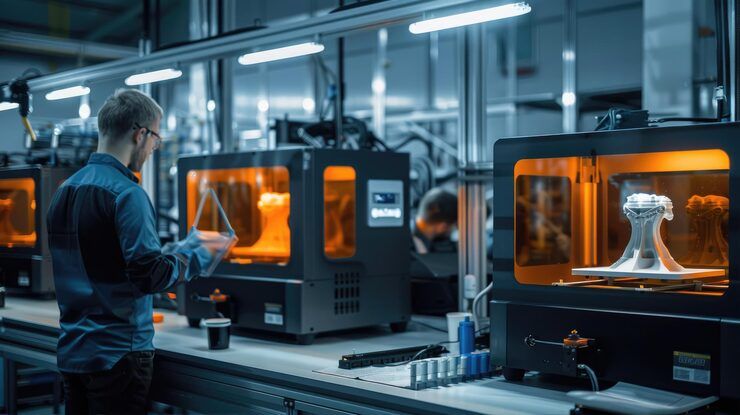
Industrial 3D printers are advanced manufacturing systems that create physical components directly from digital three-dimensional designs. Instead of removing material from a solid block, additive manufacturing builds an object layer by layer.
Industrial systems are designed for applications that require repeatability, controlled material properties, dimensional accuracy, complex geometries, or larger production volumes. They can process materials including polymers, metals, ceramics, composites, and specialized materials.
The technology has evolved from rapid prototyping into a broader manufacturing method used in aerospace, automotive, healthcare, electronics, energy, tooling, and industrial engineering.
How Industrial 3D Printing Works
The process generally begins with a three-dimensional CAD model. Specialized software converts the model into layers and generates the instructions required by the printer.
The machine then deposits, cures, melts, sinters, or binds material according to the selected additive manufacturing process.
Common industrial technologies include:
Fused filament fabrication/material extrusion
Selective laser sintering
Selective laser melting
Laser powder bed fusion
Electron beam melting
Stereolithography
Digital light processing
Binder jetting
Directed energy deposition
Each technology has different material, precision, speed, surface-finish, and post-processing characteristics.
Major Industrial Printer Categories
| Technology | Typical Materials | Common Applications |
|---|---|---|
| Material extrusion | Thermoplastics, composites | Prototypes, fixtures, tooling |
| Powder bed fusion | Polymer powders | Functional components |
| Metal powder bed fusion | Stainless steel, titanium, aluminum alloys | Aerospace, medical, engineering |
| Vat photopolymerization | Photopolymer resins | Detailed prototypes, models |
| Binder jetting | Metals, ceramics, sand | Complex components, molds |
| Directed energy deposition | Metal powders or wire | Repairs, large components |
The appropriate technology depends on the required geometry, material, production volume, dimensional requirements, and post-processing process.
Why Industrial 3D Printing Matters Today
Industrial additive manufacturing can change how complex components are designed and produced. Conventional manufacturing may require multiple operations, specialized tooling, or significant material removal, while additive processes can create some geometries directly from a digital model.
This is particularly relevant for industrial 3D printing, metal additive manufacturing, advanced manufacturing, rapid prototyping, and CNC and additive manufacturing integration.
Complex Geometry
Additive manufacturing can produce internal channels, lattice structures, topology-optimized shapes, and other geometries that can be difficult to manufacture through conventional processes.
This capability is particularly valuable in aerospace and thermal-management applications, where reducing component weight or improving heat transfer can be important.
Reduced Material Waste
Because material is generally deposited or consolidated only where needed, additive manufacturing can reduce certain forms of material waste compared with subtractive manufacturing.
However, the overall environmental impact depends on machine energy consumption, material production, support structures, post-processing, rejected parts, and the entire production workflow.
Rapid Design Iteration
Industrial 3D printers can help engineering teams evaluate physical prototypes without creating conventional tooling for every design iteration.
Digital files can also make design changes easier to incorporate into subsequent production runs.
Key Industrial Applications
Industrial 3D printing is used in areas such as:
Aerospace components
Automotive prototypes and production parts
Medical and dental components
Industrial tooling
Robotics
Electronics
Energy equipment
Research laboratories
Architecture and construction
Customized engineering components
Recent Industrial 3D Printing Developments
Additive manufacturing continued to receive significant attention in 2025 and 2026 as manufacturers explored automation, advanced materials, digital production, and more consistent quality control.
India’s Advanced Manufacturing Focus
On February 23, 2026, India's Office of the Principal Scientific Adviser and Ministry of Heavy Industries held a stakeholder consultation at CMTI, Bengaluru, focused on developing a cohesive strategy for advanced manufacturing systems. The consultation included manufacturing enterprises, MSMEs, startups, academia, research institutions, industry groups, and technology developers.
The development is relevant to industrial 3D printing because additive manufacturing is increasingly considered part of the wider advanced manufacturing ecosystem.
National Additive Manufacturing Symposium 2026
On March 13, 2026, the Ministry of Electronics and Information Technology organized the second National Additive Manufacturing Symposium in New Delhi. The event brought together policymakers, researchers, industry participants, startups, and other stakeholders to discuss additive manufacturing technology, policy directions, and ecosystem development.
This indicates continued institutional attention toward additive manufacturing within India's digital manufacturing strategy.
New Work on Powder Additive Manufacturing
In August 2025, BIS published terms of reference for an R&D project concerning powder additive manufacturing. The project focuses on collecting and validating chemical, mechanical, and physical data for powders used in additive manufacturing in India, with the aim of supporting development of a future standard.
The work is significant because material consistency is an important factor in industrial metal 3D printing. Powder characteristics can influence layer formation, density, mechanical properties, and finished-part performance.
Digital Manufacturing and Industry 4.0
India's 2025–26 MeitY material describes additive manufacturing as an enabler of Industry 4.0 and 5.0, combining digital design, simulation, and layer-by-layer fabrication for complex components.
Industrial systems are increasingly being integrated with CAD/CAM platforms, simulation tools, production monitoring, automated inspection, and digital manufacturing workflows.
Laws, Standards and Policies in India
India's additive manufacturing ecosystem is influenced by standards, product-specific regulations, workplace requirements, environmental rules, and sector-specific requirements.
There is not one universal certification requirement covering every industrial 3D printer. The applicable framework depends on the machine, material, printed component, industry, and intended application.
BIS Standards and Certification
The Bureau of Indian Standards provides a Know Your Standard platform where users can search Indian Standards using an IS number or keyword. The platform provides access to standard documents, amendments, notifications, testing information, and related resources. The BIS page was updated on May 8, 2026.
BIS also explains that certification becomes compulsory for specific products when the Central Government places them under mandatory requirements. Therefore, manufacturers should identify the relevant Indian Standard and applicable regulatory notification rather than assuming that every industrial 3D printer has the same certification requirement.
Powder Material Standardization
BIS's 2025 R&D project on powder additive manufacturing is particularly relevant to metal 3D printing. The project notes that powder additive manufacturing has wide applications but that further standardization work is needed for the chemical, physical, and mechanical characteristics of different powders.
Material qualification can be especially important for aerospace, medical, automotive, and other applications where component performance must be documented.
3D-Printed Construction
India is also developing technical guidance for 3D-printed concrete structures. A May 2025 BIS draft included guidance covering extrusion-based concrete printing, material printability, testing, durability, and performance requirements. It also states that printed components should meet applicable Indian Standards for equivalent components where relevant.
This demonstrates how standards are evolving alongside new additive manufacturing applications.
Tools and Resources for Industrial 3D Printing
Successful additive manufacturing requires more than the printer itself. Digital design, material selection, simulation, machine calibration, inspection, and post-processing all influence the final component.
Useful Digital Tools
CAD software: Used to create and modify three-dimensional component designs.
Slicing software: Converts a 3D model into printable layers and machine instructions.
Build-orientation tools: Help determine how a component should be positioned.
Topology optimization software: Can generate lightweight structures based on engineering requirements.
3D printing simulation: Helps identify potential deformation, thermal effects, support requirements, and manufacturing problems.
Material databases: Provide information about polymers, metals, ceramics, and composite materials.
3D scanning software: Helps compare manufactured components with their original digital geometry.
Dimensional inspection equipment: Measures finished components against specified tolerances.
BIS Know Your Standard: Helps researchers and manufacturers locate applicable Indian Standards.
Important Parameters to Compare
When evaluating an industrial 3D printer, useful technical parameters include:
Build volume
Layer thickness
Positioning accuracy
Material compatibility
Printing speed
Laser or extrusion configuration
Temperature control
Build-plate characteristics
Software compatibility
Automated monitoring
Post-processing requirements
Inspection capability
Safety controls
A machine with a large build volume is not automatically appropriate for every application. Material compatibility, dimensional requirements, production workflow, and qualification requirements can be equally important.
Frequently Asked Questions
What is an industrial 3D printer?
An industrial 3D printer is a professional additive manufacturing system designed to create components from digital models. It can use polymers, metals, ceramics, composites, or other specialized materials depending on the printing technology.
What is the difference between industrial and desktop 3D printers?
Industrial systems generally provide larger build volumes, broader material capabilities, tighter process controls, higher levels of automation, and more extensive monitoring and qualification options. Desktop systems are typically intended for smaller-scale prototyping, education, and general-purpose applications.
Can industrial 3D printers manufacture metal parts?
Yes. Metal additive manufacturing technologies such as laser powder bed fusion, electron beam melting, binder jetting, and directed energy deposition can produce metal components. Material selection and process parameters depend on the required mechanical and dimensional characteristics.
Is 3D printing environmentally friendly?
The environmental impact varies by technology and application. Additive manufacturing can reduce some material waste and enable lightweight designs, but energy consumption, powder or resin production, support structures, post-processing, and rejected components must also be considered.
Does India have standards for industrial 3D printing?
India has standards and standardization activities relevant to additive manufacturing, while additional areas are still being developed. In 2025, BIS initiated an R&D project focused on powder additive manufacturing materials, while its standards ecosystem continues to develop requirements for emerging applications.
Conclusion
Industrial 3D printers have developed from primarily prototyping-oriented equipment into important tools within advanced manufacturing. Their ability to create complex geometries, customize components, reduce certain forms of material waste, and connect digital design directly with physical production makes additive manufacturing relevant across numerous industries.
Current developments are increasingly focused on automation, advanced materials, digital simulation, process monitoring, inspection, and integration with broader Industry 4.0 manufacturing systems.
Developments in India during 2025 and 2026 also demonstrate growing institutional attention. The National Additive Manufacturing Symposium in March 2026, advanced-manufacturing consultations, and BIS work on additive-manufacturing powders all point toward continued development of the country's industrial AM ecosystem.
For organizations researching industrial 3D printing machines, the most important considerations are technology type, material compatibility, build volume, dimensional requirements, process repeatability, software integration, inspection, safety, and applicable standards.
As additive manufacturing continues to mature, its role is likely to extend beyond prototyping into increasingly specialized production environments where digital design, advanced materials, and automated manufacturing can work together.