AI-powered extended reality (XR) systems combine artificial intelligence (AI) with immersive digital technologies to create interactive environments. Extended reality is an umbrella term covering virtual reality (VR), augmented reality (AR), and mixed reality (MR). These technologies allow users to experience digital information through headsets, smart glasses, mobile devices, and other interactive equipment.
Artificial intelligence adds capabilities such as object recognition, speech understanding, gesture tracking, language processing, and personalized interaction. When these capabilities work with XR, digital environments can respond to a person's actions and surrounding conditions rather than relying entirely on fixed instructions.
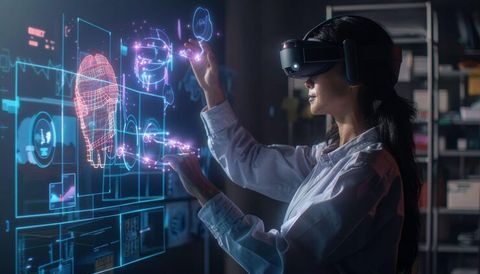
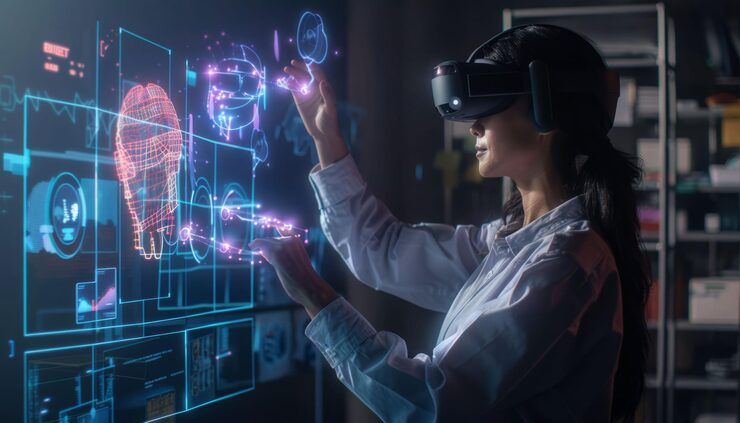
For example, an augmented reality application can identify a machine component and display relevant technical information over it. A virtual reality training environment can adjust a simulated scenario based on a learner's decisions. A mixed reality application can place digital models within a physical workspace so users can examine designs from different angles.
How AI and XR Work Together
An AI-powered XR system generally combines several technical components:
XR hardware: Headsets, cameras, motion sensors, microphones, displays, and controllers collect information and present digital content.
Computer vision: AI models analyze images and video to recognize objects, surfaces, movements, and surroundings.
Machine learning: Systems identify patterns in data and may improve particular tasks through training and model updates.
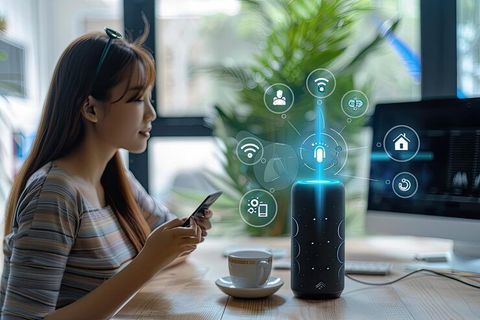
Natural language processing: Speech and text technologies allow users to communicate with digital assistants using everyday language.
Spatial computing: Sensors and software estimate positions, distances, surfaces, and movement within a physical environment.
Real-time rendering: Graphics engines generate digital objects and environments that respond to user movement and interaction.
These components can operate locally on a device, on a nearby computer, or through remote computing infrastructure. The architecture affects response time, data privacy, battery consumption, and the complexity of applications.
Not every XR application requires AI, and not every AI-powered application uses immersive technology. Their combination is most useful when intelligent interpretation and interactive visual information address a specific task.
Why AI-Powered XR Systems Matter Today
AI-powered XR systems are becoming relevant across education, manufacturing, healthcare training, architecture, logistics, and technical research. They provide ways to visualize information in three dimensions, interact with digital models, and practice tasks in simulated environments.
Traditional computer interfaces often display instructions on a separate screen. XR can place relevant information within the user's field of view, while AI can help interpret the environment and determine which information may be useful.
Applications Across Different Industries
Manufacturing and industrial maintenance
Technicians can use AR instructions to examine equipment, identify components, and follow maintenance procedures. AI-based image recognition may help distinguish between parts or identify visible abnormalities. These systems should support, rather than replace, established safety procedures and qualified technical judgment.
Education and workforce training
Virtual reality training environments allow learners to practice procedures without immediately interacting with physical machinery. AI-driven virtual characters can respond to questions, while adaptive learning systems can adjust scenarios according to performance.
Healthcare and medical education
XR can support anatomy visualization, clinical simulation, rehabilitation exercises, and medical training. AI may help analyze movement or make simulations more interactive. Clinical applications require appropriate validation, privacy safeguards, and professional oversight.
Architecture and construction
Design teams can examine three-dimensional building models at realistic scale. AI can assist with object recognition, design visualization, and identifying differences between a digital model and captured site information. The reliability of these tasks depends on data quality and model limitations.
Warehousing and logistics
XR displays can provide contextual information about inventory, equipment, and navigation. AI may help interpret visual labels or identify objects, although performance can vary with lighting, camera quality, and environmental conditions.
Key Benefits and Practical Limitations
Potential benefits include improved spatial understanding, interactive training, contextual instructions, and more natural ways to explore complex information.
However, organizations must consider several limitations:
Headsets may cause discomfort, fatigue, or motion sickness for some users.
AI recognition can produce incorrect results in unfamiliar environments.
High-quality graphics and continuous sensing may consume substantial computing power.
Device compatibility and application development can complicate deployment.
Cameras and microphones may capture sensitive information.
Immersive interfaces can create accessibility challenges for some users.
Successful implementation therefore depends on the intended task, user needs, technical reliability, and appropriate safeguards.
Recent Developments in AI-Powered XR Technology
AI-powered extended reality is evolving through improvements in generative AI, spatial computing, wearable hardware, and real-time interaction. Developments during 2025 and 2026 have placed greater emphasis on practical applications, AI transparency, and responsible data use.
Generative AI and Interactive Virtual Environments
Generative AI can create text, images, dialogue, and certain three-dimensional assets. Within XR environments, these capabilities can support virtual instructors, interactive characters, and scenario-based training.
For example, a learner practicing equipment maintenance could ask a virtual assistant to explain a component. The system could provide a contextual explanation while displaying the relevant part in a three-dimensional environment.
Generated content still requires evaluation. AI systems can provide inaccurate instructions, and applications involving physical safety need suitable verification procedures.
Spatial Computing and Wearable Devices
Spatial computing combines sensors, software, and three-dimensional interfaces to connect digital information with physical surroundings.
Recent development priorities include:
More natural hand and eye tracking.
Improved recognition of rooms, surfaces, and objects.
Better integration of voice assistants with wearable displays.
More efficient processing for mobile and headset-based applications.
Collaboration in shared virtual environments.
These developments can improve usability, although performance varies by device, software, environmental conditions, and network connection.
AI Governance Developments in 2025–2026
India published its AI Governance Guidelines on November 5, 2025, establishing a principle-based framework for responsible AI adoption. On February 15, 2026, the government highlighted recommendations concerning accountability, privacy, fairness, cybersecurity, and AI oversight.
The European Union's AI Act also reached an important implementation milestone on August 2, 2026, when most of its provisions became applicable, subject to specific exceptions and transitional periods. Certain transparency requirements affect AI-generated content and interactions.
These developments are relevant to XR applications that use AI-generated characters, personal data, biometric information, or automated decision-making. The precise obligations depend on the application's purpose and the jurisdiction in which it operates.
Laws and Policies Affecting AI-Powered XR Systems
AI-powered XR applications may fall under several legal frameworks because they combine software, personal data processing, digital content, and physical devices. Requirements depend on how the technology is used and what information it collects.
India's Digital and AI Governance Framework
The following laws and policy frameworks are particularly relevant in India.
Digital Personal Data Protection Act, 2023: Establishes a framework for processing digital personal data, including obligations concerning lawful processing and individual rights, subject to applicable provisions and implementation timelines.
Digital Personal Data Protection Rules, 2025: Notified on November 14, 2025, these rules provide further details for implementing India's personal data protection framework. XR developers should assess the applicable requirements when collecting identifiable images, voice recordings, account information, or other personal data.
Information Technology Act, 2000: Provides a broader legal framework for electronic records, digital activity, and specified cyber-related matters.
India AI Governance Guidelines, 2025: Outline principles for responsible AI development and deployment, including accountability, transparency, safety, and privacy. The guidelines should be distinguished from binding statutory requirements.
International Regulatory Considerations
Organizations operating internationally may also need to consider:
European Union AI Act: Applies according to the AI system's function, risk classification, and relevant implementation dates.
General Data Protection Regulation (GDPR): May apply when personal data is processed within its territorial scope.
Consumer protection and product safety laws: May govern misleading representations, device safety, and certain digital applications.
Intellectual property laws: May affect the use of copyrighted material in AI training, virtual environments, and generated content.
XR developers should provide clear information about data collection, establish appropriate security controls, and assess accessibility and user safety. A virtual reality application used for entertainment may have different obligations from one used for medical assessment or workplace safety.
Tools and Resources for AI-Powered XR Development
Developers, educators, researchers, and organizations can use various tools to build, test, and evaluate AI-enabled immersive applications.
Common Development Platforms
Unity: A real-time development platform used to create interactive 3D applications and XR experiences.
Unreal Engine: Supports advanced real-time graphics, simulation, and immersive environments.
OpenXR: An open standard that helps developers build XR applications compatible with supported devices.
ARCore: Google's platform for developing augmented reality experiences on supported Android devices.
ARKit: Apple's framework for creating augmented reality applications on supported Apple devices.
Blender: A three-dimensional modeling and animation application useful for preparing digital assets.
AI and Evaluation Resources
Developers may also use speech recognition, computer vision, language models, and spatial mapping tools to add intelligent features.
Useful evaluation methods include latency testing, object recognition accuracy checks, accessibility reviews, privacy assessments, and user experience questionnaires.
The following table summarizes important evaluation areas.
Evaluation area | What to measure | Why it matters |
|---|---|---|
AI accuracy | Correct identification and responses | Reduces misleading outputs |
Interaction latency | Time between action and response | Supports natural interaction |
Spatial tracking | Position and movement accuracy | Improves digital alignment |
Privacy | Data collection and retention | Protects sensitive information |
Accessibility | Usability across different needs | Supports broader participation |
Device performance | Frame rate and battery use | Improves practical usability |
Frequently Asked Questions
What are AI-powered XR systems?
They are applications that combine artificial intelligence with virtual reality, augmented reality, or mixed reality. They can recognize objects, interpret voice commands, adapt simulations, and display contextual digital information.
How are AI-powered XR systems used in industry?
They support equipment maintenance guidance, employee training, product visualization, warehouse navigation, design reviews, and simulated operating environments. Their suitability depends on accuracy, hardware, safety requirements, and the intended task.
What is the difference between AI, AR, VR, and XR?
Artificial intelligence enables computers to perform tasks such as recognizing patterns and understanding language. Augmented reality adds digital information to physical surroundings, virtual reality creates immersive digital environments, and extended reality includes AR, VR, and mixed reality.
Are AI-powered XR systems safe for personal data?
They can be designed with appropriate privacy safeguards, but safety depends on how data is collected, processed, stored, and shared. Cameras, microphones, eye tracking, and spatial mapping may capture sensitive information. Organizations should apply relevant data protection laws and minimize unnecessary collection.
What skills are useful for developing AI-powered XR applications?
Relevant skills include three-dimensional modeling, programming, computer vision, machine learning, spatial computing, interaction design, and software testing. Knowledge of privacy, accessibility, and human-computer interaction is also valuable.
Conclusion
AI-powered XR systems bring artificial intelligence and immersive technology together to create interactive, context-aware digital experiences. Their applications span education, manufacturing, healthcare training, architecture, logistics, and technical research.
Advances in generative AI, spatial computing, and wearable devices are expanding what these systems can do. However, reliable implementation requires careful attention to accuracy, user comfort, data privacy, cybersecurity, and applicable regulations.
By combining suitable development tools with practical testing and responsible AI governance, organizations can evaluate where extended reality provides meaningful benefits. The long-term value of AI-powered XR will depend not only on technical innovation but also on usability, trust, and the ability to solve clearly defined problems