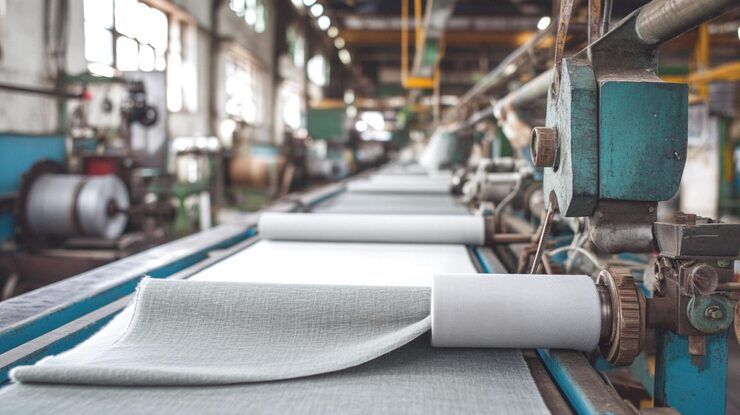
Nonwoven fabric machines are industrial systems used to manufacture fabrics by bonding or entangling fibers rather than weaving or knitting conventional yarns. These machines convert synthetic or natural fibers into sheets of material designed for specific strength, filtration, absorbency, softness, durability, or barrier properties.
Nonwoven fabrics are widely used in healthcare, hygiene products, automotive interiors, construction, agriculture, filtration, packaging, and household applications. Their properties can be adjusted through the choice of raw materials, fiber arrangement, bonding method, and finishing process.
Unlike traditional woven textiles, nonwoven materials can often be produced through integrated manufacturing lines that combine fiber preparation, web formation, bonding, and finishing. The appropriate machine configuration depends on the intended product, production volume, material specifications, and required quality standards.
Understanding Nonwoven Fabric Manufacturing Equipment
A nonwoven production line typically contains several interconnected machines. Some systems begin with prepared staple fibers, while others process polymer granules directly into continuous filaments.
The manufacturing process generally involves forming a fiber web and then bonding the fibers to create a stable fabric structure.
Common equipment includes:
Spunbond machines: Extrude thermoplastic polymers into continuous filaments that form a web.
Meltblown machines: Produce fine polymer fibers used in specialized filtration and absorbent materials.
Needle-punching machines: Mechanically entangle fibers using barbed needles.
Spunlace machines: Use high-pressure water jets to entangle fibers.
Thermal bonding machines: Apply heat to bond suitable fibers or polymer components.
Airlaid systems: Distribute fibers through an air stream to create a uniform web.
Carding machines: Separate, align, and distribute staple fibers into a web.
Slitting and winding machines: Convert finished material into specified widths and rolls.
Not every manufacturing facility requires all these machines. A production line is selected according to the fabric type, raw material, production capacity, and end-use requirements.
How Nonwoven Fabric Machines Work
The manufacturing process varies by technology, but most production systems follow several basic stages.
Raw material preparation: Polymer granules, staple fibers, or other suitable materials are prepared for processing.
Fiber formation or web preparation: Depending on the system, polymers are extruded into filaments, or existing fibers are opened, carded, and distributed into a web.
Web formation: Fibers are arranged into a sheet with a specified weight, thickness, and distribution.
Bonding: Mechanical entanglement, water jets, heat, or chemical binders hold the fibers together.
Finishing: The material may undergo stretching, surface treatment, lamination, cutting, or other finishing operations.
Inspection and winding: Sensors and quality-control systems help identify defects and maintain consistent product dimensions before the material is wound into rolls.
The exact sequence depends on the manufacturing technology and the physical properties required in the finished fabric.
Why Nonwoven Fabric Machines Matter
Nonwoven manufacturing equipment supports industries that require materials with specialized performance characteristics and consistent production quality.
Healthcare and Hygiene Applications
Nonwoven fabrics are used in medical gowns, masks, absorbent products, disposable sheets, and selected protective materials. The suitability of a fabric depends on its filtration performance, barrier properties, strength, cleanliness, and compliance with applicable product standards.
Different applications require different material structures. A fabric intended for filtration, for example, may need a finer fiber structure than one designed for absorbency or cushioning.
Automotive and Construction Applications
In the automotive industry, nonwoven materials can be used in interior panels, insulation, carpeting, acoustic components, and filtration systems.
Construction applications include roofing membranes, geotextiles, insulation layers, and materials used to separate or reinforce soil. These products require different combinations of tensile strength, dimensional stability, permeability, and durability.
Production Efficiency and Quality
Modern nonwoven machinery can integrate web formation, bonding, inspection, and winding into continuous processes. Automation can help maintain consistent operating conditions and reduce variation between production batches.
Important operating factors include:
Production speed
Fiber distribution
Fabric weight per square metre
Tensile strength
Thickness and uniformity
Energy consumption
Material waste
Machine downtime
A high production speed alone does not guarantee good performance. The fabric must also meet the specifications of its intended application.
Recent Developments in Nonwoven Manufacturing
During 2025 and 2026, the nonwoven industry continued to focus on production automation, material efficiency, filtration performance, and the environmental impact of textile manufacturing.
Automation and Digital Monitoring
Manufacturers increasingly use sensors, automated controls, and production-monitoring systems to track temperature, line speed, material thickness, and other operating variables.
These systems can help identify process deviations earlier and support more consistent production. The effectiveness of automation depends on correct sensor placement, equipment calibration, and the quality of production data.
Recycling and Material Efficiency
Interest in textile circularity has encouraged research into recyclable nonwoven structures and the use of recycled polymer feedstocks.
However, recycling can be difficult when products combine different polymers, adhesives, coatings, or multiple layers. Manufacturers must evaluate whether recycled materials can meet the required performance and safety standards for the intended application.
Filtration and Advanced Materials
Meltblown technology remains important for applications requiring fine fibers and controlled filtration characteristics. Spunbond and composite technologies are also used to manufacture materials that combine strength, softness, absorbency, or barrier properties.
Developments in these areas are application-specific, and performance must be verified through appropriate testing rather than inferred from the manufacturing method alone.
Laws, Regulations, and Industry Standards
Nonwoven fabric manufacturers must consider regulations covering machinery safety, worker protection, chemical use, environmental emissions, and the finished product.
The exact requirements depend on the manufacturing location and the intended application.
Textile and Machinery Safety
Industrial equipment may be subject to requirements concerning machine guarding, emergency stops, electrical safety, noise, and worker exposure to heat or airborne particles.
In the European Union, machinery placed on the market must comply with applicable machinery legislation. Regulation (EU) 2023/1230 establishes a new EU machinery framework, with its main provisions applying from January 20, 2027. During 2026, manufacturers should verify which existing and transitional requirements apply to their equipment.
Environmental and Chemical Compliance
Manufacturing facilities may need permits or controls for air emissions, wastewater, industrial waste, and chemical handling.
Where applicable, chemical substances used in fiber production, bonding agents, coatings, or finishing treatments must comply with the relevant national rules. Manufacturers supplying regulated markets should maintain material documentation and appropriate testing records.
Standards for Finished Products
The required standards depend on the final application.
Examples include:
Filtration performance testing
Tensile strength and elongation tests
Fabric weight and thickness measurements
Flammability testing for relevant applications
Medical-device requirements for applicable healthcare products
Product-specific hygiene and safety standards
A nonwoven fabric is not automatically suitable for medical, protective, or filtration use simply because it was produced on a particular machine.
Tools and Resources for Nonwoven Fabric Production
Technical resources can help manufacturers evaluate machinery, monitor quality, and understand regulatory obligations.
Production Monitoring Tools
Manufacturing monitoring software can record machine speed, temperature, production output, downtime, and material consumption. These measurements help identify process variation and support maintenance planning.
Fabric Testing Equipment
Quality-control laboratories may use:
GSM testers for fabric weight
Thickness gauges
Tensile testing machines
Air permeability testers
Filtration testing equipment
Moisture measurement instruments
Microscopes for fiber examination
The correct testing method depends on the product specification and applicable standard.
Equipment Evaluation Checklist
| Factor | Information to Evaluate |
|---|---|
| Technology | Spunbond, meltblown, spunlace, needle-punching, or another process |
| Raw material | Polymer type or staple fiber composition |
| Production capacity | Target output per hour |
| Fabric specifications | GSM, width, thickness, and strength |
| Quality control | Required testing and inspection systems |
| Utilities | Electricity, water, compressed air, and ventilation |
| Automation | Sensors, control systems, and data recording |
| Compliance | Machinery safety and product standards |
| Maintenance | Spare components and inspection requirements |
Government manufacturing agencies, textile research institutes, standards organizations, and equipment documentation can provide additional technical information.
Frequently Asked Questions
What are nonwoven fabric machines used for?
They manufacture fabrics by forming and bonding fibers without conventional weaving or knitting. The resulting materials are used in healthcare, hygiene, filtration, automotive products, construction, agriculture, and other industries.
What is the difference between spunbond and meltblown machines?
Spunbond machines produce continuous polymer filaments that form relatively strong webs. Meltblown machines create much finer fibers, which can be useful for filtration and absorbent applications. Some products combine both technologies.
Which factors determine nonwoven machine production capacity?
Capacity depends on machine width, operating speed, raw material, fabric weight, bonding method, process stability, and the required quality specifications.
Can nonwoven fabrics be manufactured using recycled materials?
Yes, some nonwoven products can incorporate recycled fibers or polymers. Suitability depends on material purity, fiber characteristics, manufacturing requirements, and the safety and performance standards applicable to the finished product.
What quality tests are important for nonwoven fabrics?
Common tests include fabric weight, thickness, tensile strength, elongation, air permeability, and filtration performance where relevant. Additional testing may be necessary for medical, protective, automotive, or construction applications.
Conclusion
Nonwoven fabric machines are important components of modern textile manufacturing. Spunbond, meltblown, needle-punching, spunlace, thermal bonding, and airlaid technologies enable manufacturers to produce materials with different combinations of strength, softness, filtration, absorbency, and durability.
Developments in automation, process monitoring, recycling, and advanced fiber structures continue to influence the industry. However, the right manufacturing system depends on the intended application, raw material, required output, production capacity, and quality specifications.
Manufacturers evaluating nonwoven machinery should consider the complete production process, including fiber formation, web bonding, finishing, inspection, maintenance, and regulatory compliance. Careful equipment selection and consistent quality testing help ensure that finished materials meet their intended industrial requirements.