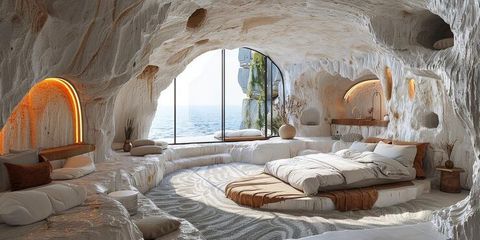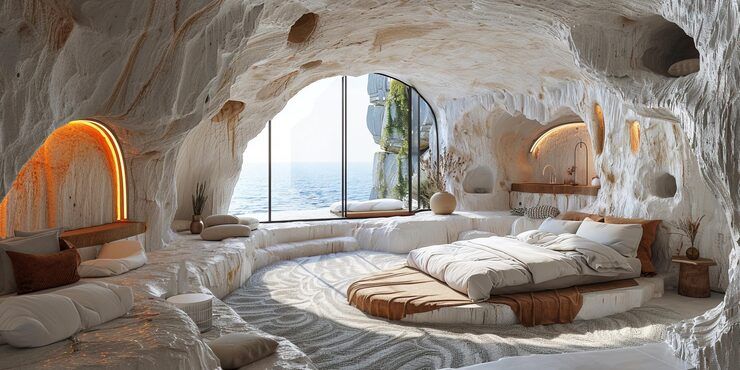
Cave accommodation refers to lodging created inside, beneath, or alongside naturally formed caves and rock formations. Some properties use historic cave dwellings that have been adapted for modern accommodation, while others incorporate cave-like architecture into purpose-built structures.
The concept has existed for centuries in regions where people used caves for shelter because underground spaces can provide natural insulation from temperature extremes. Modern cave accommodation has transformed this traditional architectural idea into a specialized form of cultural, rural, and experiential tourism.
Countries such as Spain, Türkiye, Greece, Italy, Jordan, and parts of the United States have developed tourism experiences connected with caves and underground architecture. In Spain, the cave houses of Andalusia, particularly around Granada and Guadix, demonstrate how traditional underground dwellings can become part of contemporary accommodation.
Cave accommodation can range from simple historic dwellings to sophisticated boutique properties with modern bathrooms, climate-control systems, carefully designed lighting, and contemporary interiors.
How Cave Accommodation Works
The basic principle is to use the natural thermal and structural characteristics of rock while adapting the interior for modern habitation.
Important design considerations include:
Rock stability
Ventilation
Humidity control
Drainage
Natural and artificial lighting
Electrical installation
Fire protection
Emergency access
Waterproofing
Indoor air quality
Accessibility
The quality of a cave accommodation concept depends heavily on the geological characteristics of the site. A property located in stable rock may have very different engineering requirements from one in a region affected by groundwater, erosion, seismic activity, or unstable geological formations.
Why Cave Accommodation Matters Today
Cave accommodation has become increasingly relevant to travelers interested in cultural tourism, architecture, heritage travel, and distinctive hotel experiences.
Instead of constructing an entirely new building, some projects adapt existing underground spaces or historic cave dwellings. This can preserve architectural traditions while creating accommodation connected with local history.
Heritage and Cultural Tourism
Traditional cave dwellings often reflect the geography, climate, materials, and social history of a region.
In Granada province, for example, cave houses have long been associated with the local landscape and rural architecture. Their thick rock surroundings can provide relatively stable indoor temperatures, reducing reliance on conventional heating or cooling in suitable conditions.
This makes cave accommodation relevant to several areas of travel research:
Cultural tourism
Heritage accommodation
Luxury travel
Boutique hotel research
Rural tourism
Sustainable architecture
European vacation planning
Adventure and nature travel
The concept can also encourage visitors to explore less conventional destinations rather than concentrating exclusively on major metropolitan areas.
Thermal Characteristics
One reason underground spaces have historically been attractive is their comparatively stable temperature.
The surrounding rock can moderate temperature fluctuations, although actual performance depends on geology, depth, climate, ventilation, humidity, orientation, and building modifications.
| Feature | Potential advantage | Important consideration |
|---|---|---|
| Underground location | Reduced temperature fluctuations | Humidity needs monitoring |
| Thick rock walls | Thermal mass | Structural condition must be assessed |
| Historic structure | Cultural character | Modern safety upgrades may be required |
| Natural setting | Strong destination identity | Environmental sensitivity |
| Limited exterior surface | Distinctive architecture | Natural lighting can be limited |
| Existing cave | Potential heritage value | Geological stability is essential |
Cave accommodation should therefore not automatically be described as sustainable. Environmental performance needs to be evaluated according to the individual property and its operating systems.
Recent Developments and Trends
Cave accommodation is part of a broader movement toward distinctive lodging, heritage preservation, rural tourism, and experience-oriented travel.
During 2025 and 2026, tourism authorities in several European destinations continued strengthening regulation of short-term accommodation and emphasizing the relationship between tourism development, housing, cultural heritage, and environmental sustainability.
Andalusia Strengthens Tourism Accommodation Oversight
Andalusia is particularly relevant because traditional cave dwellings are an established part of the region's architectural landscape.
In June 2026, the Andalusian government reported that measures introduced to strengthen oversight of tourist-use dwellings had helped reduce the growth rate of this accommodation category during 2025. The government reported growth of 3.12% in 2025 compared with 16.89% in the preceding period.
The measures included greater cooperation with municipalities to identify planning and tourism compliance issues. This development illustrates a broader European trend toward closer management of accommodation within local planning systems.
Sustainable Tourism Investment
Spain also continued implementing tourism sustainability initiatives during 2026. A February 2026 state resolution documented funding allocations connected with energy-efficiency projects for tourism businesses under Spain's recovery and resilience framework.
For cave accommodation, energy efficiency can be particularly relevant because natural thermal properties may be combined with modern ventilation, heating, cooling, lighting, and hot-water systems.
Digital Research and Accommodation Planning
Travel research has also become increasingly digital. Official tourism databases, mapping applications, online accommodation directories, environmental information systems, and digital booking platforms allow travelers to compare locations before planning a trip.
For unusual accommodation such as cave dwellings, travelers should verify information using official or property-specific sources rather than relying only on photographs.
Laws, Regulations and Policies
Spain provides a useful regulatory example because cave accommodation can intersect with tourism, urban planning, heritage protection, environmental rules, and building requirements.
Andalusian Tourism Regulation
Andalusia maintains a formal tourism framework covering different accommodation categories and registration procedures. Its tourism registry includes categories such as hotels, rural accommodation, tourist-use dwellings, apartments, campsites, and other tourism activities.
Cave accommodation may fall under different categories depending on the property's legal characteristics and location.
Specific Rules for Cave-Type Buildings
A particularly relevant development is Decree 31/2024, which amended various Andalusian tourism accommodation regulations. The decree explicitly states that cave-type constructions must comply with applicable territorial and urban-planning regulations.
The same regulatory framework addresses requirements involving ventilation, heating, cooling, and other accommodation characteristics.
This is important because a cave cannot necessarily be treated like an ordinary house simply because it has been converted into accommodation.
Planning and Urban Regulations
Local planning rules can determine whether a particular cave dwelling can legally be used for tourism. In some circumstances, planning permission, registration, environmental assessment, or other approvals may be relevant.
Andalusia's 2025 housing measures also strengthened the relationship between tourist accommodation and municipal urban planning. In certain municipalities, residential classification alone does not automatically permit tourist accommodation, and compatibility with local planning rules may be required.
Heritage and Environmental Considerations
Historic cave dwellings may also have cultural heritage significance. A property located within or near a protected cultural or natural area can face additional requirements.
Before developing or substantially modifying a cave property, relevant authorities may therefore include:
Municipal planning authorities
Regional tourism authorities
Heritage authorities
Environmental authorities
Building regulators
Fire-safety authorities
Rules differ between countries and even between municipalities, so local regulations should always be checked before development or renovation.
Tools and Resources for Cave Accommodation Research
Several digital resources can make research easier for travelers, architects, property researchers, and tourism professionals.
Mapping and Geological Research
Useful tools include:
Digital mapping applications
Satellite imagery
Geological maps
Topographic maps
Weather applications
Local hazard information
Environmental databases
These resources can help identify terrain, accessibility, nearby roads, elevation, climate, and potential environmental constraints.
Accommodation Research
Travelers can compare:
Official tourism portals
Hotel accommodation directories
Municipal tourism websites
Property websites
Cultural heritage databases
Digital maps
Travel-planning applications
For registered tourist accommodation in Andalusia, the regional tourism authority provides a searchable directory of registered establishments.
Cave Stay Planning Checklist
Before selecting cave accommodation, consider:
Accessibility and stairs
Ventilation
Humidity
Temperature
Emergency exits
Mobile connectivity
Nearby medical facilities
Transportation
Seasonal weather
Travel insurance coverage
Local cultural expectations
Travelers with mobility requirements should confirm accessibility directly because traditional cave properties can contain narrow passages, uneven floors, stairs, and limited natural light.
Frequently Asked Questions
What is cave accommodation?
Cave accommodation is lodging located within natural caves, traditional underground dwellings, or structures integrated into rock formations. Some properties preserve historic architecture, while others use modern construction techniques inspired by caves.
Are cave hotels naturally cooler?
They can have relatively stable indoor temperatures because surrounding rock provides thermal mass. However, actual conditions vary according to geology, climate, ventilation, depth, and building systems.
Where are cave accommodations popular?
Spain, Türkiye, Greece, Italy, and Jordan are among the destinations associated with cave-based accommodation and tourism. Spain's Andalusia region is particularly notable for traditional cave dwellings.
Are cave accommodations regulated?
Yes. Regulations can cover tourism registration, building safety, planning, fire protection, environmental protection, heritage, and accessibility. Requirements vary according to the country and local authority.
Are cave stays suitable for all travelers?
Not necessarily. Traditional cave properties may have stairs, uneven surfaces, enclosed spaces, humidity, limited natural lighting, or restricted accessibility. Travelers should review property-specific information before making travel arrangements.
Conclusion
Cave accommodation concepts demonstrate how traditional architecture can be adapted to contemporary tourism while retaining connections with geography, history, and local culture. Their appeal comes from the unusual relationship between natural rock, architecture, climate, and the visitor experience.
The concept also presents important challenges. Structural stability, humidity, ventilation, fire safety, accessibility, environmental protection, and local planning rules must be considered carefully.
Spain, particularly Andalusia, provides an interesting example of how cave accommodation fits within modern tourism regulation. Recent measures have placed greater emphasis on urban planning and oversight of tourism accommodation, while energy-efficiency initiatives are encouraging broader sustainability improvements across the tourism sector.
For travelers, cave accommodation can provide a distinctive way to explore heritage destinations and rural landscapes. For the hospitality and architecture sectors, it demonstrates how existing geological and cultural resources can influence modern accommodation design when development is approached with appropriate safety, planning, and environmental considerations.