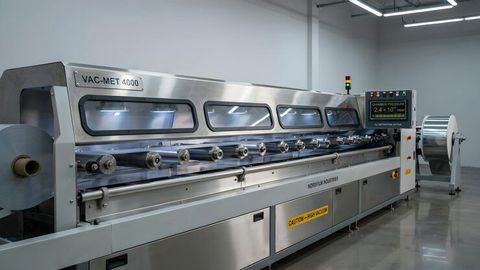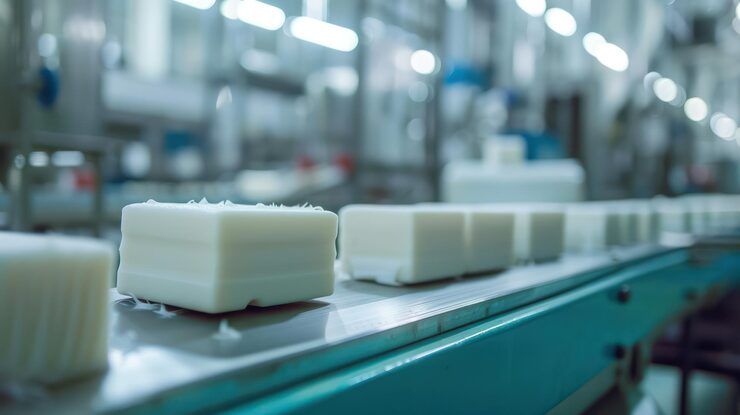
Soap extrusion lines are integrated manufacturing systems used to transform processed soap noodles, flakes, or blended soap materials into consistent bars or other shaped products. Extrusion is an important stage in continuous soap manufacturing because it combines compression, homogenization, deaeration, shaping, and controlled cutting.
A typical line can connect several operations, beginning with soap preparation and ending with accurately sized bars ready for wrapping or other packaging processes. Depending on the formulation and production scale, equipment may include mixers, refiners, plodders, cutters, stamping machines, conveyors, and inspection systems.
Modern soap manufacturing equipment increasingly combines mechanical controls with sensors, programmable logic controllers, machine vision, and production monitoring software. This allows manufacturers to maintain consistent dimensions and process parameters while collecting production data.
How a Soap Extrusion Line Works
The exact configuration varies according to the soap formulation, bar shape, production volume, and required surface finish. A typical sequence can include:
Soap noodle or raw-material preparation
Mixing and blending
Refining
Fragrance and additive incorporation
Vacuum deaeration
Soap extrusion
Bar cutting
Stamping or shaping
Surface inspection
Weight and dimension checks
Packaging preparation
The soap plodder machine is generally one of the central pieces of equipment. It compresses and homogenizes the soap mass before forcing it through a die to create a continuous billet with a controlled cross-section.
Main Equipment Used
| Equipment | Main Function | Typical Process Stage |
|---|---|---|
| Mixer | Combines soap materials and additives | Blending |
| Refining mill | Improves texture and uniformity | Refining |
| Vacuum plodder | Compresses, deaerates, and extrudes soap | Extrusion |
| Die head | Determines billet shape | Shaping |
| Bar cutter | Divides continuous billets | Cutting |
| Soap stamper | Creates final bar shape and markings | Forming |
| Conveyor | Transfers bars between stages | Material handling |
| Vision system | Checks appearance and dimensions | Inspection |
Why Soap Extrusion Technology Matters Today
Soap remains an important personal-care and hygiene product across many regions. Manufacturers need production systems capable of handling different formulations, bar dimensions, fragrances, colors, and packaging formats while maintaining repeatable physical characteristics.
This makes automated soap production, soap extrusion machinery, industrial soap manufacturing, and soap processing equipment relevant areas for modern manufacturing planning.
Improving Production Consistency
Soap bars need relatively consistent dimensions and weight for controlled packaging and predictable consumer use. Variations can arise from moisture content, temperature, formulation, pressure, and material flow.
Extrusion systems help regulate the shape and density of the soap billet before cutting and stamping. Automated sensors can also monitor process variables and identify deviations.
Supporting Different Soap Formulations
Soap manufacturers may process traditional fatty-acid soaps, vegetable-oil formulations, syndet-type cleansing bars, specialty formulations, or products containing fragrances, pigments, and botanical ingredients.
Each formulation can behave differently during mixing and extrusion. Equipment therefore needs appropriate temperature control, screw configuration, pressure management, and die geometry.
Reducing Material Waste
Accurate cutting and controlled extrusion can help reduce variation in bar dimensions. Better process monitoring can also help identify problems earlier, limiting the amount of material requiring reprocessing.
Supporting Hygiene and Quality Control
Soap production involves ingredients that must be handled under controlled manufacturing conditions. Equipment design can influence cleaning, inspection, material transfer, and contamination-control procedures.
Recent Developments in Soap Extrusion
During 2025 and 2026, industrial manufacturing continued moving toward greater automation, digital monitoring, energy awareness, and more flexible production systems.
Increased Automation
Modern automatic soap making machines can integrate extrusion, cutting, stamping, conveying, and inspection into coordinated production cells.
Machine controllers can monitor variables such as:
Extrusion pressure
Motor load
Material temperature
Screw speed
Conveyor speed
Bar dimensions
Production counts
Equipment alarms
This creates a more controlled production environment and can simplify troubleshooting.
Digital Monitoring and Traceability
Manufacturing plants increasingly use production software to collect information from individual machines. Data can include batch identification, operating parameters, inspection results, downtime, and maintenance records.
For large facilities, connecting extrusion equipment to manufacturing execution systems can create a more complete production history.
Machine Vision
Machine vision is becoming increasingly relevant for high-throughput soap production. Cameras can inspect bar shape, surface appearance, stamping quality, alignment, and other visible characteristics.
Automated inspection can complement manual quality checks and provide consistent monitoring across long production runs.
Greater Formulation Flexibility
Consumer preferences continue to create demand for different soap shapes, fragrances, colors, ingredient combinations, and packaging formats. Flexible extrusion and forming systems can help manufacturers accommodate more product variations.
A modular production layout can also simplify changes between different bar dimensions and formulations.
Energy and Resource Efficiency
Manufacturers are paying greater attention to electricity consumption, compressed air, heating requirements, equipment efficiency, and material utilization.
Efficient motors, variable-speed drives, improved insulation, optimized heating systems, and production monitoring can contribute to more controlled resource use.
Global Laws, Standards and Regulatory Considerations
Soap regulation differs significantly by market because authorities may classify products according to their ingredients, intended use, claims, and formulation.
Manufacturers therefore need to determine the regulatory category applicable to each product before establishing production and labeling procedures.
United States
In the United States, the regulatory treatment of soap depends partly on how the product is formulated and represented. The FDA explains that products meeting its specific definition of soap can fall outside the cosmetic category, while other cleansing products may be regulated as cosmetics or, in certain circumstances, drugs.
This distinction matters for extrusion-line planning because formulation and product claims can influence the regulatory framework surrounding the finished product.
The FDA also notes that products intended to treat or prevent disease can fall under drug requirements rather than being treated simply as conventional cleansing products.
European Union
In the European Union, many personal-cleansing products are governed by the EU Cosmetics Regulation when they fall within the cosmetic category. Manufacturers need to consider ingredient restrictions, safety assessment, product information, labeling, and responsible-person requirements where applicable.
Chemical restrictions can change over time, so formulation teams should regularly review the current regulatory status of ingredients used in soap products.
United Kingdom
Great Britain regulates cosmetic products through its national framework based on Regulation (EC) No. 1223/2009 as retained and amended in UK law. Official guidance identifies soaps among cosmetic products and requires appropriate safety assessment, product notification, labeling, and a named Responsible Person where the product falls within the cosmetic category.
The UK also introduced additional cosmetic chemical restrictions during 2025 and 2026. Regulations made in January 2026 introduced further restrictions on specified substances, with provisions taking effect during July and August 2026.
The U.S. Modernization of Cosmetics Regulation Act, or MoCRA, also continued implementation activity during 2026, with FDA updates published in February and May 2026.
Other Markets
Countries such as Canada, Australia, Japan, South Korea, China, and countries across Latin America and the Middle East maintain their own requirements for cosmetic products, chemical ingredients, labeling, workplace safety, and manufacturing.
For international production, manufacturers should therefore maintain a regulatory matrix covering:
Ingredient restrictions
Product classification
Labeling requirements
Safety documentation
Manufacturing controls
Packaging requirements
Chemical handling
Environmental obligations
Import documentation
Product notification where required
Tools and Resources for Soap Extrusion
Several technical tools can support planning, production monitoring, quality assurance, and regulatory review.
Useful Manufacturing Tools
CAD software: Used for designing dies, conveyors, machine frames, and production layouts.
Process-control software: Monitors temperature, pressure, motor load, and production parameters.
PLC systems: Coordinate extrusion, cutting, conveying, and safety functions.
Machine-vision software: Supports automated inspection of bar dimensions and surface characteristics.
Production calculators: Help estimate throughput from bar weight, line speed, and operating time.
Energy-monitoring systems: Track electricity consumption across production equipment.
Maintenance platforms: Record inspections, component replacement, alarms, and preventive maintenance.
MES platforms: Connect production data with batch records and quality information.
Regulatory databases: Help verify current ingredient restrictions and product requirements.
Digital quality-control templates: Can record bar weight, dimensions, appearance, batch information, and inspection results.
Key Specifications to Evaluate
When comparing a soap extrusion machine or complete production line, important technical factors include:
Production throughput
Extrusion pressure range
Screw configuration
Vacuum capability
Die dimensions
Cutting accuracy
Bar-weight control
Formulation compatibility
Temperature control
Automation level
Machine-vision integration
Cleaning requirements
Changeover procedures
Data connectivity
Electrical safety features
Throughput should be assessed together with formulation characteristics, operating time, inspection requirements, equipment downtime, and downstream packaging capacity.
Frequently Asked Questions
What is a soap extrusion line?
A soap extrusion line is a group of connected machines that processes prepared soap material into continuous extruded shapes and then divides and forms those shapes into individual bars.
What does a soap plodder do?
A soap plodder compresses and homogenizes prepared soap material, often under vacuum, before pushing it through a die to create a continuous soap billet.
What factors affect soap extrusion quality?
Important factors include formulation, moisture, temperature, material consistency, screw speed, extrusion pressure, vacuum conditions, die geometry, and cutting accuracy.
Can extrusion lines handle different soap shapes?
Yes. Production systems can use different dies, cutters, and stamping configurations to create various bar dimensions and shapes. The practical flexibility depends on the machine architecture and formulation characteristics.
Why is automation important in soap manufacturing?
Automation can coordinate production stages, monitor process variables, record data, support consistent dimensions, and identify abnormal operating conditions. The appropriate automation level depends on production volume, formulation complexity, and quality requirements.
Conclusion
Soap extrusion lines form an important part of modern continuous soap manufacturing. They connect material preparation, refining, deaeration, extrusion, cutting, forming, inspection, and downstream production into an organized process.
The technology has evolved beyond basic mechanical extrusion. Modern systems increasingly incorporate PLC controls, digital monitoring, machine vision, automated inspection, energy tracking, and production data collection.
Developments during 2025 and 2026 also highlight the importance of regulatory awareness. Changes in cosmetic chemical restrictions in the United Kingdom and continued implementation of U.S. cosmetic regulations demonstrate why manufacturers need to monitor regulatory requirements alongside equipment development.
For organizations researching industrial soap extrusion machines, automated soap production equipment, or soap manufacturing machinery, the most important considerations include formulation compatibility, extrusion design, throughput, bar accuracy, quality control, automation, energy use, maintenance, and regulatory requirements.
A well-planned extrusion system is therefore not simply a shaping machine. It is part of a broader manufacturing process that connects formulation, mechanical processing, quality assurance, data management, and final product consistency.