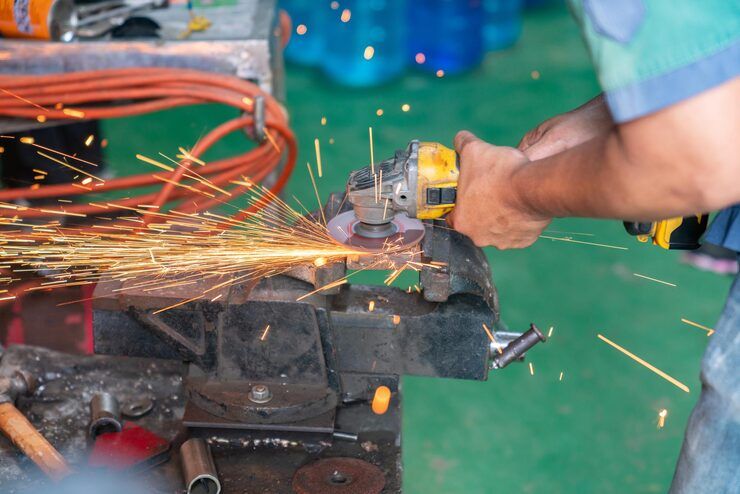
Arc welding machines are essential tools in metal fabrication, construction, manufacturing, shipbuilding, automotive production, and equipment maintenance. They create a strong joint between metal components by generating an electric arc that produces sufficient heat to melt and fuse the materials.
The process can be performed manually, mechanically, or through automated systems. Depending on the application, arc welding equipment may be designed for structural steel, stainless steel, aluminum, pipelines, industrial machinery, or precision metal components.
Modern welding systems combine electrical power control, thermal management, operator controls, and safety features. Understanding these components helps engineers, fabricators, maintenance professionals, and technical students evaluate welding processes and equipment requirements.
Understanding How Arc Welding Machines Work
An arc welding machine supplies controlled electrical current between an electrode and a workpiece. The resulting electric arc produces intense heat, melting the base metal and, when required, a filler material. As the molten material cools, it forms a welded joint.
The machine's power source controls characteristics such as current, voltage, and arc stability. Some systems use conventional transformer-based designs, while others use inverter technology to regulate electrical power electronically.
A typical welding setup includes:
Welding power source
Electrode holder or welding torch
Electrode or filler material
Workpiece and work-return connection
Welding cables and connectors
Protective equipment
Gas supply, where required by the process
The appropriate configuration depends on the metal type, material thickness, joint design, working environment, and required weld quality.
Main Types of Arc Welding Machines
Different welding processes are designed for different operating conditions and material requirements.
Shielded Metal Arc Welding (SMAW)
Also called stick welding, SMAW uses a flux-coated consumable electrode. The flux helps protect the molten weld pool from atmospheric contamination and forms a protective slag layer.
Stick welding is commonly used in structural fabrication, construction, repair work, and outdoor applications. Its equipment is relatively straightforward, although electrode selection, slag removal, and operator technique influence weld quality.
Gas Metal Arc Welding (GMAW)
GMAW, commonly known as MIG or MAG welding depending on the shielding gas and application, uses a continuously fed consumable wire electrode. Shielding gas protects the welding area from atmospheric contamination.
The process is widely used in manufacturing, automotive production, sheet-metal fabrication, and industrial assembly because it can support relatively high welding productivity.
Gas Tungsten Arc Welding (GTAW)
GTAW, commonly called TIG welding, uses a non-consumable tungsten electrode. Filler metal can be added separately when necessary.
TIG welding provides precise control of the weld pool and is commonly used for stainless steel, aluminum, thin materials, and applications requiring careful control of weld appearance and quality.
Flux-Cored Arc Welding (FCAW)
FCAW uses a tubular wire containing flux. Depending on the wire type, the process may use external shielding gas or operate without it.
It is frequently used in structural steel fabrication, heavy manufacturing, and applications where deposition rate and welding conditions influence process selection.
Comparing Arc Welding Technologies
| Welding Process | Electrode Type | Common Applications | Key Consideration |
|---|---|---|---|
| SMAW | Consumable coated rod | Construction and maintenance | Electrode changes and slag removal |
| GMAW | Continuous wire | Manufacturing and fabrication | Shielding gas and wire-feed control |
| GTAW | Non-consumable tungsten | Precision metalwork | High operator skill requirements |
| FCAW | Flux-filled wire | Heavy fabrication | Wire selection and slag management |
Why Arc Welding Machines Matter Today
Arc welding supports the production and maintenance of many structures and industrial products. Its importance extends from large infrastructure projects to small precision components.
Industrial Manufacturing
Manufacturers use welding to join metal parts into frames, housings, brackets, tanks, machinery, and assemblies. Consistent welding parameters help maintain dimensional accuracy and joint strength across repeated production cycles.
In automated manufacturing environments, welding equipment may be integrated with robotic arms, programmable controllers, sensors, and production monitoring systems.
Construction and Infrastructure
Arc welding is widely used in structural steelwork, bridges, industrial buildings, pipelines, and equipment supporting infrastructure projects.
The welding process must be selected according to the base metal, joint geometry, loading conditions, environmental exposure, and applicable engineering requirements.
Maintenance and Repair
Industrial facilities depend on welding to repair or modify metal equipment and structures. Correct process selection can help restore functionality while limiting distortion and avoiding unnecessary damage to surrounding components.
However, repairs to pressure equipment, lifting structures, pipelines, and other safety-critical assets require appropriate engineering procedures and inspection.
Energy Efficiency and Productivity
Modern inverter welding machines can provide compact power conversion, adjustable output, and improved electrical control compared with some conventional designs.
Energy consumption depends on the welding process, operating current, duty cycle, equipment efficiency, and time spent welding. Actual performance should be assessed using manufacturer specifications and measured operating conditions.
Recent Developments and Industry Trends
Arc welding technology continues to evolve through digital controls, automation, improved power electronics, and welding-process monitoring.
Inverter-Based Welding Systems
Inverter technology is now widely used across many welding equipment categories. Electronic switching and power conversion allow manufacturers to develop compact machines with adjustable output characteristics.
Depending on the model, additional features may include controlled arc starting, selectable operating modes, digital parameter displays, and protection against certain electrical or thermal faults.
These functions can help operators manage welding conditions, although performance varies by equipment design and application.
Robotic and Automated Welding
Robotic welding continues to be important in automotive manufacturing, heavy equipment production, and repeatable industrial fabrication.
Automated systems can coordinate torch movement, wire feeding, travel speed, and welding parameters. Some systems also use cameras, seam-tracking sensors, and monitoring software to detect variations in joint position or process conditions.
Automation does not eliminate the need for process qualification, maintenance, inspection, and skilled technical oversight.
Digital Monitoring and Artificial Intelligence
Digital welding systems increasingly record parameters such as current, voltage, wire-feed speed, and operating time. These records can support quality analysis, production planning, and troubleshooting.
Artificial intelligence and machine-learning techniques are also being studied and applied to weld inspection, defect recognition, parameter optimization, and predictive maintenance.
During 2025–2026, these capabilities remained an important direction in industrial automation, although adoption and demonstrated performance differ between manufacturers and applications.
Sustainability and Material Efficiency
Industrial welding improvements increasingly focus on reducing rework, improving energy efficiency, and managing consumables. Better process control can reduce material waste when it produces fewer defective joints.
The overall environmental impact still depends on electricity use, filler materials, shielding gases, ventilation, equipment lifetime, and the production process in which welding is used.
Laws, Policies, and Welding Safety Standards
Arc welding machines operate within workplace safety, electrical safety, environmental, and product-compliance frameworks. Requirements depend on the country, industry, and type of equipment.
Occupational Safety
In the United States, the Occupational Safety and Health Administration establishes workplace requirements relevant to welding, cutting, and brazing under its general-industry and construction regulations.
Important safety considerations include:
Protection against electric shock
Welding fumes and ventilation
Fire prevention
Eye and skin protection from arc radiation
Safe handling of compressed gases
Protection against hot metal and sparks
Safe operation in confined spaces
Employers must evaluate the workplace and implement applicable protective measures.
Welding Fume Exposure
Welding can generate fumes containing particles and gases that vary according to the base metal, filler material, coating, and process.
Suitable ventilation, exposure assessment, and respiratory protection where required are important parts of a welding safety program. Particular attention is needed when welding stainless steel, coated metals, or materials containing hazardous substances.
Electrical and Equipment Standards
International standards provide frameworks for welding equipment design and safety. The IEC 60974 series addresses arc welding equipment, with different parts covering power sources, cooling systems, and other equipment categories.
In the United States, applicable electrical requirements may include National Electrical Code provisions and relevant product safety standards. Product certification and compliance requirements depend on the equipment and jurisdiction.
Welding Procedure and Quality Requirements
Industrial welding projects may use standards from organizations such as the American Welding Society and the International Organization for Standardization.
Requirements can address welding procedure qualification, welder qualification, inspection, acceptance criteria, and documentation. Structural, pressure-containing, and other critical applications may require specific approved procedures and qualified personnel.
Tools and Resources for Arc Welding
Technical resources can help users understand equipment specifications, select welding processes, and assess safety requirements.
Welding Parameter Calculators
Welding calculators can help estimate starting ranges for current, voltage, wire-feed speed, and material thickness. These values are only starting points; final settings depend on the process, joint, electrode, shielding gas, machine, and qualified procedure.
Equipment Specification Sheets
Manufacturer documentation typically provides:
Input voltage and phase requirements
Output current range
Duty cycle
Supported welding processes
Electrode compatibility
Wire-feed specifications
Thermal protection information
Recommended operating conditions
The duty cycle indicates how long a machine can operate at a specified output within a defined test period without exceeding its thermal limits.
Inspection and Quality Tools
Depending on the project, welding quality assessment may involve visual inspection, dimensional measurement, dye penetrant testing, magnetic particle testing, ultrasonic testing, or radiographic testing.
The appropriate method depends on the material, weld geometry, defect type, and governing inspection requirements.
Practical Equipment Selection Checklist
Before selecting a welding machine, consider:
Base metal and thickness
Required welding process
Available electrical supply
Duty cycle and output range
Indoor or outdoor working conditions
Portability requirements
Shielding gas availability
Applicable safety standards
Required weld quality and inspection
A technically appropriate machine must match both the welding task and the operating environment.
Frequently Asked Questions
What is an arc welding machine?
An arc welding machine supplies controlled electrical power to create an arc between an electrode and a workpiece. The heat melts the metal and forms a joint as the molten material solidifies.
What is the difference between MIG and TIG welding?
MIG welding uses a continuously fed consumable wire electrode, while TIG welding uses a non-consumable tungsten electrode and may use separate filler material. MIG is often suitable for productive fabrication, whereas TIG provides precise control for many detailed welding applications.
What does duty cycle mean in a welding machine?
Duty cycle describes the proportion of a specified operating period during which a welding machine can operate at a stated output under defined test conditions. Exceeding the rated duty cycle can cause overheating or trigger thermal protection.
Are inverter welding machines energy-efficient?
Inverter machines can provide efficient electronic power conversion and compact designs. Actual energy performance depends on the machine, operating conditions, welding process, and output settings.
What safety equipment is needed for arc welding?
Common protective equipment includes a suitable welding helmet, safety glasses, protective gloves, flame-resistant clothing, and appropriate footwear. Ventilation, fire prevention, electrical protection, and respiratory controls may also be required depending on the work environment.
Conclusion
Arc welding machines remain fundamental to modern metal fabrication, infrastructure construction, industrial maintenance, and manufacturing. Different processes—including SMAW, GMAW, GTAW, and FCAW—address different material requirements, production conditions, and weld-quality objectives.
Recent developments in inverter power supplies, robotic welding, digital monitoring, and automated inspection continue to influence industrial welding practices. At the same time, electrical safety, fume control, equipment standards, qualified procedures, and inspection requirements remain essential.
Understanding the available welding technologies, machine specifications, process limitations, and applicable safety requirements helps engineers, operators, and manufacturers make informed technical decisions. The most suitable approach is one that meets the material and production requirements while maintaining consistent weld quality and safe operating conditions.