Concrete mixers are machines designed to combine cementitious materials, aggregates, water, and, when required, admixtures into a uniform concrete mixture. They are essential equipment across building construction, infrastructure projects, precast manufacturing, road development, and civil engineering.
The basic purpose of a mixer is to distribute the different ingredients consistently throughout the mixture. Uniform mixing can influence workability, strength development, durability, and the performance of the finished concrete.
Concrete mixers range from small portable units to large industrial systems integrated into batching plants. Their configuration depends on production volume, concrete formulation, site conditions, and the required mixing process.
How Concrete Mixers Work
A typical mixing cycle involves loading the required ingredients into a mixing chamber or drum. Internal blades, paddles, or other mixing elements then move the materials through the chamber.
Different mixer designs create different movement patterns. Drum mixers rotate the container itself, while pan and planetary mixers use internal mixing mechanisms.
A basic workflow can include:
Measuring aggregates and cementitious materials
Adding materials to the mixer
Introducing water and approved admixtures
Mixing for the required period
Checking consistency
Discharging the concrete
Cleaning the mixing chamber
Main Types of Concrete Mixers
Several mixer designs are used in construction and concrete production.
Drum mixers: Use a rotating drum to mix ingredients.
Tilting drum mixers: Allow the drum angle to change during discharge.
Non-tilting drum mixers: Maintain a fixed drum position.
Pan mixers: Use a stationary pan with rotating mixing elements.
Planetary mixers: Combine rotating and planetary movement for intensive mixing.
Twin-shaft mixers: Use two counter-rotating shafts and are common in high-throughput applications.
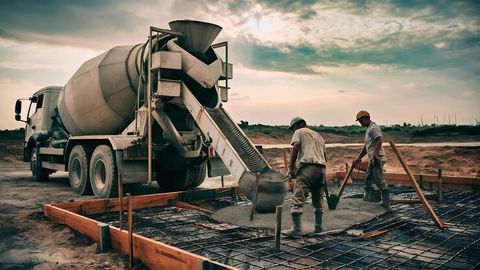
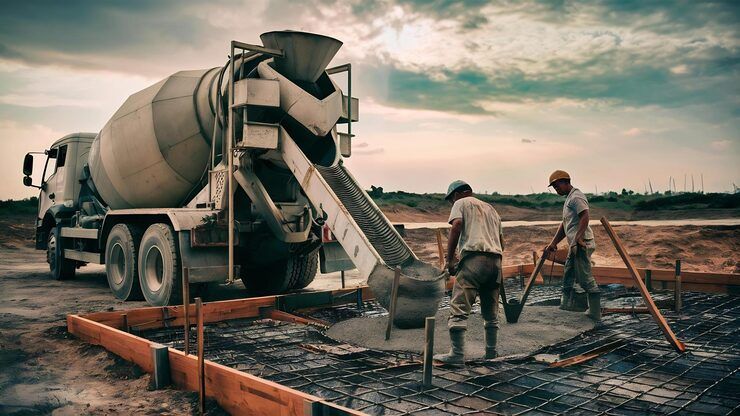
Truck mixers: Transport and continuously agitate concrete while moving between a batching facility and a construction location.
| Mixer Type | Typical Application | Main Characteristic |
|---|---|---|
| Drum mixer | General construction | Rotating drum |
| Pan mixer | Precast and smaller batches | Stationary pan |
| Planetary mixer | Intensive mixing | Multiple mixing movements |
| Twin-shaft mixer | Large-scale production | High-intensity mixing |
| Truck mixer | Concrete transportation | Mixing during transit |
Why Concrete Mixers Matter Today
Concrete is one of the world's most widely used construction materials, making consistent concrete production important for buildings, bridges, roads, foundations, tunnels, industrial facilities, and infrastructure.
Concrete mixers help convert individually measured ingredients into a workable mixture that can be transported, placed, compacted, and cured.
Construction Productivity
Mechanized mixing can provide greater consistency than manual mixing, particularly when large quantities of concrete are required.
The appropriate mixer can also help coordinate concrete production with batching equipment, pumps, conveyors, molds, and automated control systems.
Concrete Quality
Concrete quality depends on much more than the mixer itself. Ingredient proportions, aggregate grading, water-cement ratio, admixtures, mixing time, temperature, transportation, placement, compaction, and curing all contribute to final performance.
A well-maintained mixer can support consistent processing, but machine selection cannot compensate for an unsuitable concrete mixture design.
Major Applications
Concrete mixers are used in:
Residential construction
Commercial buildings
Roads and highways
Bridges
Dams and water infrastructure
Precast concrete plants
Industrial construction
Tunnels
Foundations
Urban infrastructure
Large civil-engineering projects
The equipment is particularly relevant to industrial concrete mixers, automatic concrete mixing systems, commercial concrete equipment, concrete batching plants, and construction machinery.
Recent Concrete Mixer and Construction Developments
Construction equipment continued moving toward automation, digital monitoring, emissions reduction, and more efficient concrete production during 2025 and 2026.
Digital Concrete Production
Modern concrete batching operations increasingly integrate computerized weighing, automated ingredient dosing, moisture sensors, PLC controls, and production monitoring.
Digital systems can record batch information and help operators identify variations in aggregate moisture, material quantities, mixing cycles, and other process parameters.
This is especially relevant to large concrete plants where many batches may be produced during a single operating period.
Automation and Process Monitoring
Automated batching systems can coordinate ingredient measurement and mixer operation through centralized controls.
Sensors can monitor variables such as:
Aggregate moisture
Material weight
Mixer load
Motor conditions
Mixing duration
Temperature
Production volume
Data collection can also support quality documentation and equipment maintenance.
Lower-Carbon Concrete
The construction sector is increasingly examining ways to reduce greenhouse-gas emissions associated with cement and concrete. Strategies include supplementary cementitious materials, optimized mixture designs, recycled aggregates where technically appropriate, and improved production efficiency.
The International Energy Agency's cement-sector analysis continues to identify material efficiency, clinker substitution, low-carbon fuels, and emerging technologies as important areas for reducing cement-related emissions.
For mixer manufacturers and concrete producers, this development means equipment may increasingly need to handle alternative binder systems and mixtures with different rheological characteristics.
India Infrastructure Development
India's infrastructure construction continues to support demand for concrete-production equipment. Government infrastructure programs covering highways, urban development, railways, housing, and other construction activities create a broad application environment for batching and mixing technology.
The National Infrastructure Pipeline and related infrastructure initiatives have continued to emphasize large-scale infrastructure development across India.
Laws, Standards and Policies in India
India provides an important regulatory example because concrete production and construction equipment are influenced by technical standards, workplace safety requirements, environmental rules, and construction specifications.
BIS Concrete Standards
The Bureau of Indian Standards publishes standards covering concrete materials, mix design, production, testing, and construction.
IS 10262 provides guidelines for concrete mix proportioning. The standard is important when determining the quantities and proportions of materials required for a particular concrete mixture.
IS 456 provides a major code of practice for plain and reinforced concrete and addresses requirements covering materials, workmanship, durability, design, and construction.
The current Indian Standards should be checked directly through BIS because standards can be revised or amended.
Construction Equipment Safety
Concrete mixers contain rotating drums, shafts, blades, motors, electrical systems, and other moving components. Appropriate guarding, emergency controls, electrical protection, operator instructions, and maintenance procedures are therefore important.
Workplace safety requirements can vary according to the facility, state, equipment configuration, and applicable occupational-safety framework.
Environmental Considerations
Concrete production can generate dust, wash water, slurry, and solid residues. Large plants may therefore require environmental controls covering water use, wastewater management, dust emissions, aggregate handling, and waste materials.
The applicable requirements depend on plant capacity, location, environmental permissions, and local regulations.
Quality Control
Construction projects may specify concrete strength classes, slump, aggregate grading, cement type, admixture requirements, testing frequency, and acceptance criteria.
Concrete mixer operation should therefore be considered part of a larger quality-control system rather than as an isolated equipment decision.
Tools and Resources for Concrete Mixing
Concrete production requires accurate measurement, mixture calculations, equipment monitoring, and testing.
Useful Tools
Concrete mix-design calculators: Help estimate quantities based on specified mixture parameters.
Batching spreadsheets: Track material quantities for individual batches.
Moisture correction calculators: Adjust aggregate quantities and water based on moisture conditions.
Slump testing equipment: Measures concrete consistency.
Concrete compression-testing machines: Evaluate hardened concrete strength.
Digital weighing systems: Improve ingredient measurement.
Moisture sensors: Monitor aggregate moisture content.
PLC monitoring systems: Coordinate automated batching and mixer operation.
Concrete temperature meters: Help monitor fresh-concrete temperature.
BIS Standards resources: Provide access to applicable Indian Standards.
Equipment maintenance checklists: Track lubrication, inspection, cleaning, and component condition.
Important Mixer Specifications
When researching industrial concrete mixers, useful parameters include:
Nominal mixing capacity
Batch size
Mixing cycle duration
Motor power
Mixer type
Mixing intensity
Aggregate-size compatibility
Discharge mechanism
Automatic control capability
Moisture-monitoring capability
Wear-resistant components
Cleaning access
Safety features
Capacity should be interpreted carefully because rated volume, usable batch volume, and actual production throughput are not always identical.
Frequently Asked Questions
What is a concrete mixer?
A concrete mixer is a machine that combines cementitious materials, aggregates, water, and, when required, chemical or mineral admixtures to produce a uniform concrete mixture.
What are the main types of concrete mixers?
Common types include drum mixers, pan mixers, planetary mixers, twin-shaft mixers, and truck mixers. Each type has different mixing mechanisms and is suited to different production environments.
What determines concrete mixer capacity?
Capacity depends on the mixer design, drum or chamber dimensions, maximum permissible load, material characteristics, batch configuration, and manufacturer specifications. Actual production output also depends on loading, mixing, discharge, and cleaning cycles.
How long should concrete be mixed?
There is no single mixing time that applies to every concrete mixture. Required mixing time depends on the mixer type, mixture composition, batch size, and applicable project specification. The concrete should achieve the required uniformity rather than relying only on a fixed time.
Why is aggregate moisture important?
Aggregate moisture affects the total water entering a concrete mixture. If moisture conditions change and are not accounted for, the effective water-cement ratio and workability can also change. Moisture measurement and batch corrections are therefore important in controlled concrete production.
Conclusion
Concrete mixers are central to modern concrete production, connecting material batching with the production of a uniform fresh-concrete mixture. Their applications range from small construction projects to large infrastructure and automated precast facilities.
Mixer technology is increasingly connected with digital batching controls, moisture sensors, automated weighing, production monitoring, and data collection. These technologies can help improve process consistency when combined with appropriate mixture design and quality-control procedures.
The industry is also responding to the broader need for lower-carbon concrete. Alternative binders, supplementary cementitious materials, optimized mixtures, and more efficient production methods are changing the characteristics of some concrete mixtures and creating new technical considerations for mixing equipment.
In India, standards such as IS 456 and IS 10262 provide important technical references for concrete design and construction, while equipment operators must also consider applicable safety and environmental requirements.
For organizations researching concrete mixing machines, industrial concrete mixers, or automatic batching systems, important factors include mixer type, capacity, mixing intensity, material characteristics, automation, moisture control, maintenance access, safety, and applicable standards.
Concrete mixer technology will continue to evolve alongside construction automation, digital quality control, infrastructure development, and efforts to improve the material efficiency and environmental performance of concrete production.