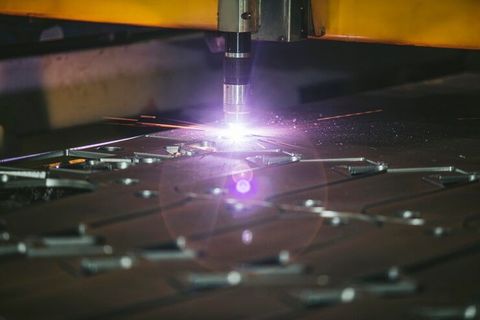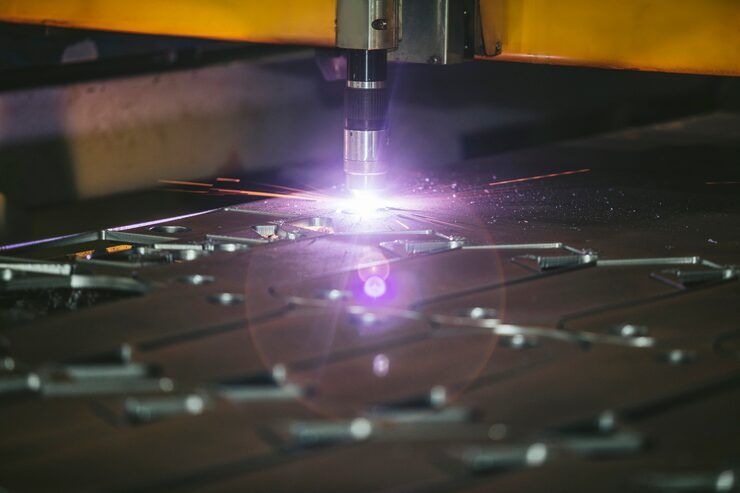
Laser cutting machines use a concentrated beam of light to cut, engrave, mark, or profile materials with high precision. The beam is directed through an optical system toward a defined point on the workpiece, where its energy interacts with the material.
mely short pulses and are useful for specialized micromachining applications where controlled material removal is important.
| Laser Type | Common Applications | Typical Strength |
|---|---|---|
| Fiber | Metal sheet and plate | High efficiency and precision |
| CO₂ | Non-metal and some metal applications | Broad material capability |
| Solid-state | Precision processing | Specialized applications |
| Ultrafast | Micro-machining | Controlled material removal |
Why Laser Cutting Matters Today
Laser cutting has become an important part of modern manufacturing because digital control can connect design files directly with automated material processing.
The technology can produce intricate profiles without requiring a conventional mechanical cutting tool to physically contact the material.
Precision Manufacturing
Laser cutting is widely associated with CNC laser cutting, industrial laser cutting machines, fiber laser cutting machines, sheet metal laser cutting, and precision metal fabrication.
The narrow cutting zone can allow detailed profiles and small features to be produced when appropriate machine settings are used.
Material Applications
Industrial laser systems can process many materials, depending on the machine configuration:
Carbon steel
Stainless steel
Aluminum
Copper and brass
Titanium
Plastics
Wood
Acrylic
Textiles
Ceramics
Composite materials
Material compatibility should always be confirmed for the specific laser system. Reflective metals, plastics that release hazardous fumes, and composite materials can require specialized equipment and controls.
Production Benefits
Laser cutting can support:
Complex geometric profiles
Digital production workflows
Repeatable positioning
Automated nesting
Rapid design changes
Reduced mechanical tool contact
Integration with robotic handling
Automated inspection
However, actual production performance depends on material thickness, laser power, cutting parameters, machine configuration, operator procedures, and maintenance.
Recent Laser Cutting Developments in 2025–2026
Laser cutting technology continued to move toward higher automation, software integration, energy efficiency, and smart manufacturing during 2025 and 2026.
Fiber Laser Development
Fiber laser systems have continued to gain importance in metal fabrication because of their beam characteristics and suitability for high-speed processing. Industry analysis published in November 2025 highlighted fiber lasers, robotics, and connected manufacturing systems as important developments in modern fabrication.
Modern systems can combine laser sources with automated material handling, nesting software, sensors, and production monitoring.
Smart Machine Controls
Another important direction is the integration of sensors, connected controls, and real-time monitoring. A 2025 industry technology review identified AI-assisted monitoring, IoT connectivity, and automated quality checks as emerging elements of smart laser-cutting workflows.
These capabilities can help operators monitor machine conditions, detect process variations, and collect production information.
Automation and Robotics
Robotic loading, unloading, sorting, bending, and welding can increasingly be connected with laser-cutting operations. This allows manufacturers to build integrated production cells rather than treating cutting as an isolated process.
Automated sheet handling can be particularly useful when large-format materials or repetitive production sequences are involved.
Energy and Resource Efficiency
Recent laser-cutting developments also focus on controlling laser power according to material thickness and cutting conditions. Industry reporting in 2025 highlighted adaptive power management and integrated automation as areas of development.
Efficiency should be evaluated across the complete production process, including electricity consumption, assist gases, material nesting, extraction, cooling, and machine utilization.
India's Advanced Manufacturing Environment
India continued expanding its advanced manufacturing ecosystem during 2026. On June 17, 2026, an advanced manufacturing facility was inaugurated in Pune, highlighting the country's continuing investment in digitally enabled industrial production.
Laser cutting is one of several technologies that can form part of these advanced manufacturing environments.
Laws, Standards and Policies in India
India provides an important regulatory example for industrial laser cutting because machinery can be affected by safety, electrical, environmental, workplace, and conformity requirements.
Machinery Safety Framework
BIS maintains a Scheme-X certification framework covering specified machinery and electrical equipment. Its product-specific information includes machine-category guidelines for metal-cutting machines, with the page updated April 1, 2026.
BIS also identifies metal-cutting machine tools under the machinery categories covered by its broader certification framework.
Whether a particular laser cutting machine falls within a mandatory certification requirement depends on its classification, specifications, applicable order, and relevant Indian Standards.
Technical Documentation
BIS's 2025 guidelines for metal-cutting machines describe requirements involving technical files, machine categories, conformity information, labeling, marking, and certification procedures.
The guidelines also state that applicable machines need to meet relevant labeling and marking requirements, including safety information and information for use.
Manufacturers and industrial operators should therefore identify the precise standard and regulatory classification applicable to their equipment rather than assuming that every laser machine follows the same certification route.
Laser and Workplace Safety
Laser cutting involves hazards associated with laser radiation, high temperatures, moving machine axes, electrical systems, fumes, fire, and processed materials.
Industrial installations should incorporate appropriate:
Machine guarding
Interlocks
Emergency-stop controls
Laser shielding
Ventilation and extraction
Fire-risk controls
Electrical protection
Operator training
Preventive inspection
The appropriate controls depend on the machine design, laser classification, material, and operating environment.
Tools and Resources for Laser Cutting Machines
A laser-cutting workflow normally combines hardware, CAD/CAM software, nesting systems, parameter databases, inspection tools, and safety resources.
Useful Tools
CAD software: Creates two-dimensional and three-dimensional component designs.
CAM software: Converts designs into machine instructions.
Nesting software: Arranges parts efficiently on sheets to improve material utilization.
Laser parameter databases: Help establish starting parameters for particular materials and thicknesses.
Kerf calculators: Estimate the width of material removed during cutting.
Power and speed calculators: Help evaluate starting process parameters.
CNC simulation software: Allows toolpaths to be reviewed before production.
Digital calipers: Measure finished components.
Coordinate measuring machines: Support dimensional inspection for precision parts.
Fume extraction systems: Help control airborne contaminants.
BIS Know Your Standard: Allows users to search Indian Standards by keyword or IS number and access related amendments, notifications, testing information, and certification information.
Important Specifications to Compare
When researching industrial laser cutting machines, useful specifications include:
Laser source type
Rated laser power
Maximum sheet dimensions
Maximum material thickness
Cutting-head configuration
Positioning accuracy
Repeatability
Cutting speed
Assist-gas requirements
CNC control system
Automatic focus
Material-handling capability
Fume extraction
Safety enclosure
Software compatibility
Energy consumption
Higher laser power does not automatically mean better performance for every application. Material type, thickness, beam quality, cutting head, gas pressure, and process parameters must be considered together.
Frequently Asked Questions
What is a laser cutting machine?
A laser cutting machine uses a focused laser beam to cut, engrave, or mark materials. CNC controls guide the laser head along a programmed path based on digital design information.
What is a fiber laser cutting machine?
A fiber laser cutting machine uses an optical-fiber-based laser source to generate and deliver the laser beam. Fiber systems are widely used for metal processing because of their beam characteristics and suitability for industrial cutting applications.
What materials can laser cutting machines process?
Depending on the laser type and configuration, machines can process steel, stainless steel, aluminum, copper, brass, titanium, plastics, wood, acrylic, textiles, and other materials. The appropriate machine must be selected according to the material's physical and optical properties.
What affects laser cutting quality?
Important variables include laser power, cutting speed, focal position, assist gas, nozzle condition, material thickness, beam quality, and machine alignment. Software settings and material preparation can also influence the final result.
Are laser cutting machines covered by Indian safety regulations?
Some categories of machinery are covered by India's machinery and electrical equipment safety framework. BIS identifies metal-cutting machine tools within its Scheme-X framework, but the exact requirements depend on the machine classification and applicable standards.
Conclusion
Laser cutting machines have become an important component of modern manufacturing because they connect precision material processing with digital design and CNC automation.
Fiber laser technology has become particularly important for metal fabrication, while robotics, automated material handling, sensors, software integration, and production monitoring are expanding the capabilities of modern cutting systems.
Developments during 2025 and 2026 demonstrate a wider movement toward smart and connected manufacturing. Industry reports have highlighted fiber lasers, robotics, adaptive controls, real-time monitoring, and automated workflows as important areas of development.
India's regulatory environment is also evolving. BIS maintains specific guidance for metal-cutting machinery under its Scheme-X framework, while its standards ecosystem provides resources for identifying applicable safety and technical requirements.
For organizations researching CNC laser cutting machines, fiber laser cutting machines, or industrial laser cutting equipment, the most important factors are laser type, material compatibility, thickness range, cutting-head configuration, automation, software, safety systems, extraction, and applicable standards.
As manufacturing becomes increasingly connected and automated, laser cutting is likely to remain an important technology for precision fabrication, particularly where digital production, complex geometries, repeatability, and flexible material processing are required.